Object Status:
Extant
Accession Date:
By 1799
Primary Source Reference:
Charles Willson Peale, Lecture on Natural History 28. (ca. 1799). Academy of Natural Sciences of Drexel University Archives, coll. 40. / https://ansp.org/research/library/archives/0000-0099/coll0040/
Additional Source Text:
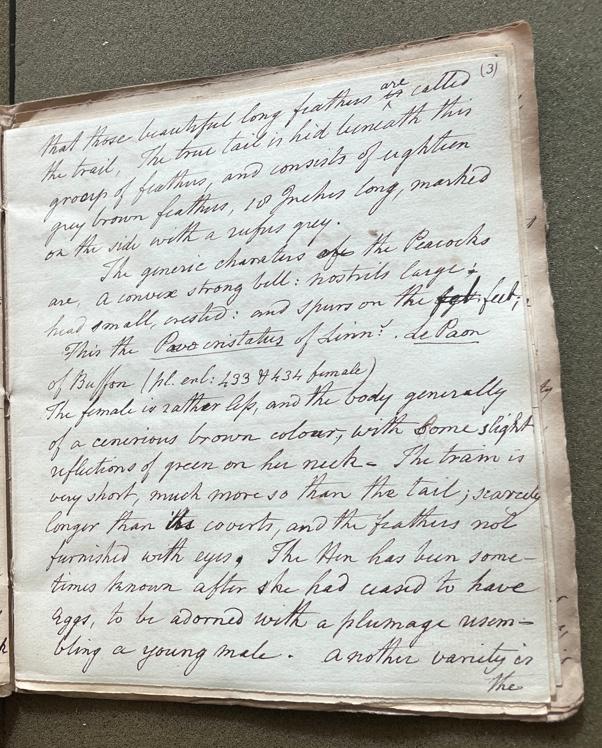
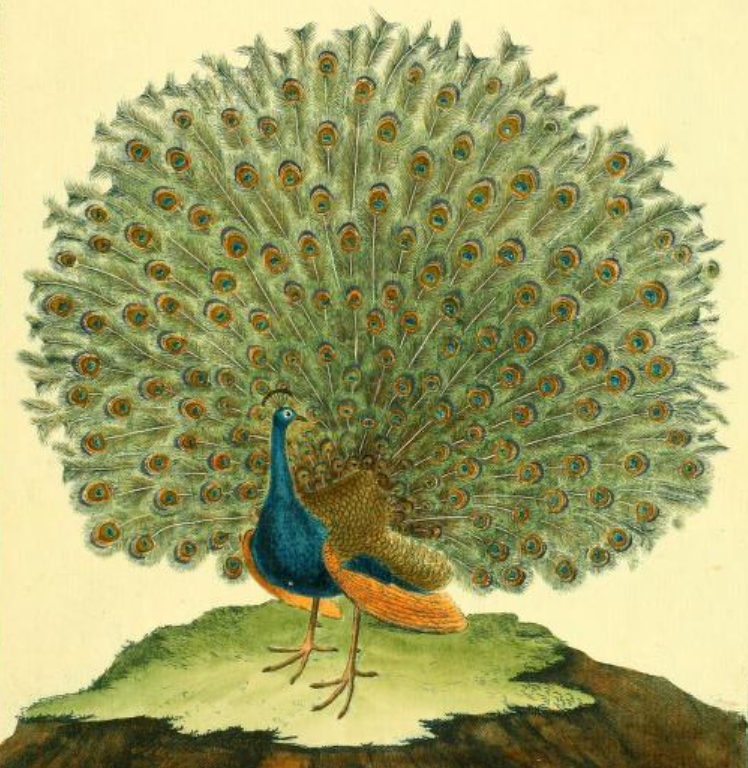
Charles Willson Peale (1741-1827) wrote, in his 28th Lecture (ca. 1799): "No. 1033 … This bird is so well known that I think it unnecessary to describe it, except to remark that those beautiful long feathers are called the trail. The true tail is hid beneath this group of feathers, and consists of eighteen grey brown feathers, 18 Inches long, marked on the side with a rufus grey. The generic characters of the Peacocks are, a convec strong bill; nostrils large; head small, crested; and spurs on the feet. This is the Pavo cristatus of Linn., de Paon of Buff (pl. enl. 433 & 434 female). The female is rather less, and the body generally of a cenerious brown colour, with some slight reflections of green on her neck. The train is very short, much more so than the tail; scarcely longer than the coverts, and the feathers not furnished with eyes. The Hen has been sometimes known after she had ceased to have Eggs, to be adorned with a plumage resembling a young male." (Academy of Natural Sciences of Drexel University Archives, coll. 40)
Peale wrote, in "A Walk Through the Philad[elphi]a Museum" (1805–1806): "The Genus Pavo Peacock contains a small variety, perhaps none of them more elegant than the Crested Peacock (P. Cristatus) Buffon gives a finished picture of its beauties in his description of it. It is adorned with a great variety of Colours that are brilliant but not gaudy. The diversity of beauties which we find diffused through such an infinite number of Objects, are highly useful to man, for while he enjoys the pleasure of contemplating them, he may forget some of the pains which human nature are liable too, and with his admiration of the Creature it is raised to the Creator! / Peacocks origionally belonged to the east India's. Domesticated now in every Country, except in the extreme cold regions." (Historical Society of Pennsylvania, coll. 0481)
Specimen Type:
Dead/preserved
Current Common Name:
Indian Peafowl
Current Scientific Name
Phasianidae | Pavo cristatus