Object Status:
Extant
Accession Date:
By 1799
Primary Source Reference:
Charles Willson Peale, Lecture on Natural History 33. (ca. 1799). Academy of Natural Sciences of Drexel University Archives, coll. 40. / https://ansp.org/research/library/archives/0000-0099/coll0040/
Additional Source Text:
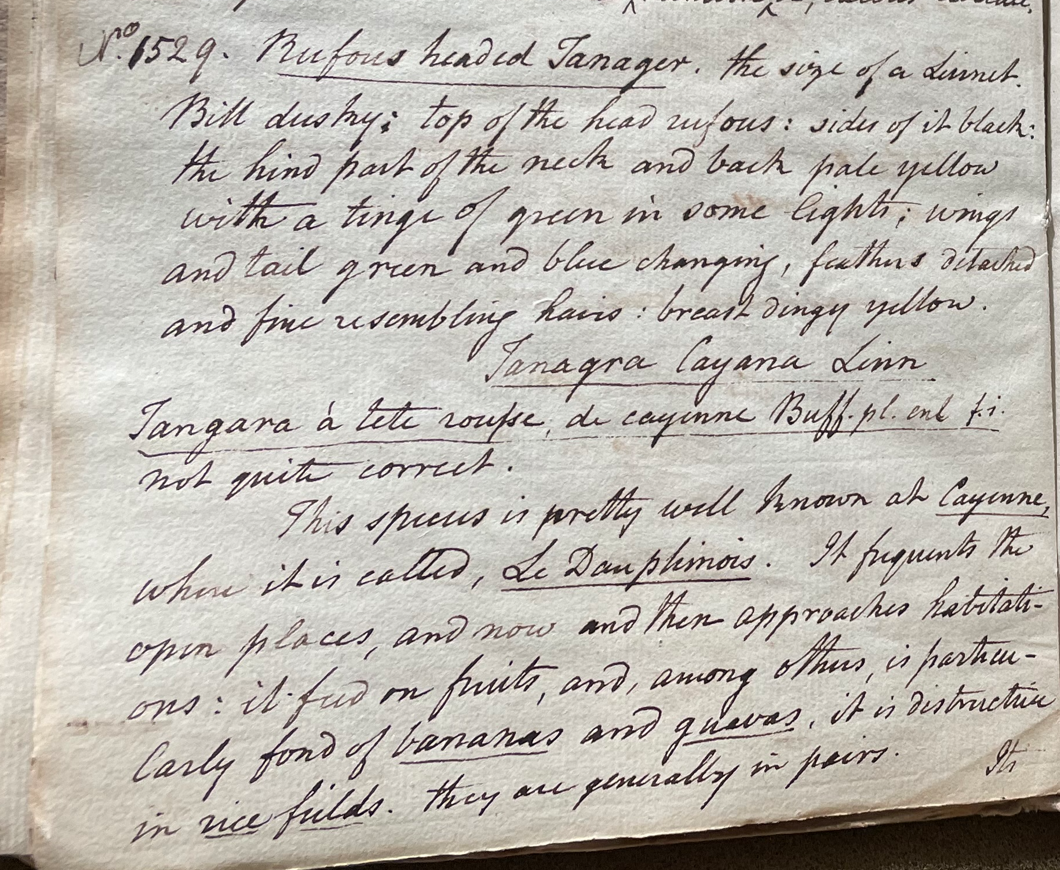
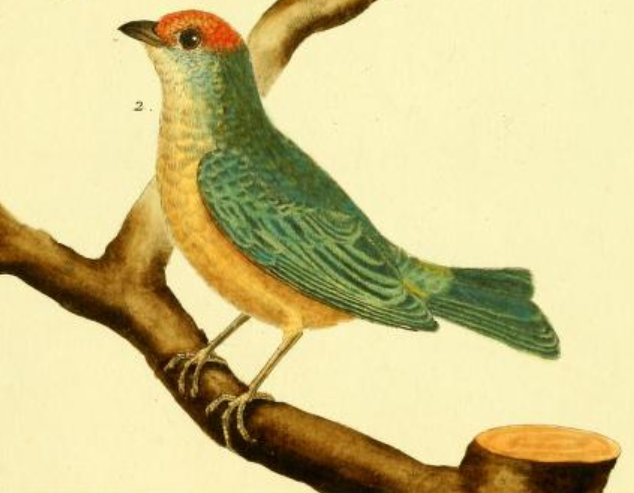
Charles Willson Peale (1741-1827) wrote, in his 33rd Lecture (ca. 1799): "No. 1529. Rufous headed Tanager. the size of a Linnet. Bill dusky; top of the head rufous; sides of it black; the hind part of the neck and back pale yellow with a tinge of green in some lights; wings and tail green and blue changing, feathers detached and fine resembling hairs; breast dingy yellow. Tanagra Cayana Linn. Tangara à tete rousse, de Cayenne. Buff. pl. enl. […] f. 1. not quite correct. This species is pretty well known at Cayenne, where it is called, Le Dauphinois. It frequents the open places, and now and then approaches habitations; it feed of fruits, and, among others, is particularly fond of bananas and guavas. it is destructive in rice fields. they are generally in pairs. Its note is a short shrill cry." (Academy of Natural Sciences of Drexel University Archives, coll. 40)
Peale wrote, in "A Walk Through the Philad[elphi]a Museum" (1805–1806): "Rufous headed Tanager (T. Cayana) at Cayenne they call it Le Dauphinois." (Historical Society of Pennsylvania, coll. 0481)
Notes:
In 1793, Raphaelle Peale (1774-1825) travelled to Cayenne, French Guiana, to collect specimens for Peale's Museum. However, to the editor's (MRH) knowledge, there is no detailed inventory of the specimens he brought back, and there are many examples of specimens from northern South America that were donated by other people. For more discussion about Raphaelle's travels, see Lillian B. Miller, 1993, "Father and Son: The Relationship of Charles Willson Peale and Raphaelle Peale", The American Art Journal 25: 4-161. / https://doi.org/10.2307/1594599
Specimen Type:
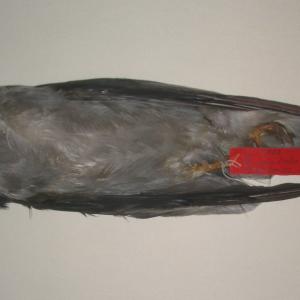
Dead/preserved
Current Common Name:
Burnished-buff Tanager
Current Scientific Name
Thraupidae | Stilpnia cayana