Object Status:
Extant
Accession Date:
By 1799
Primary Source Reference:
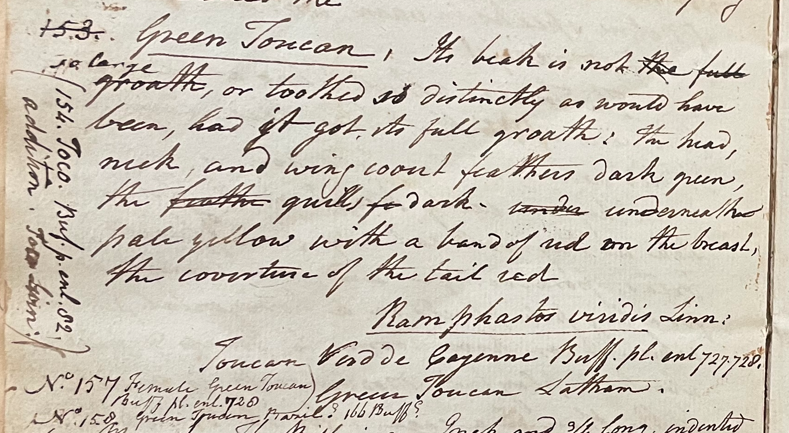
Charles Willson Peale, Lecture on Natural History 16. (ca. 1799). Academy of Natural Sciences of Drexel University Archives, coll. 40. / https://ansp.org/research/library/archives/0000-0099/coll0040/
Additional Source Text:
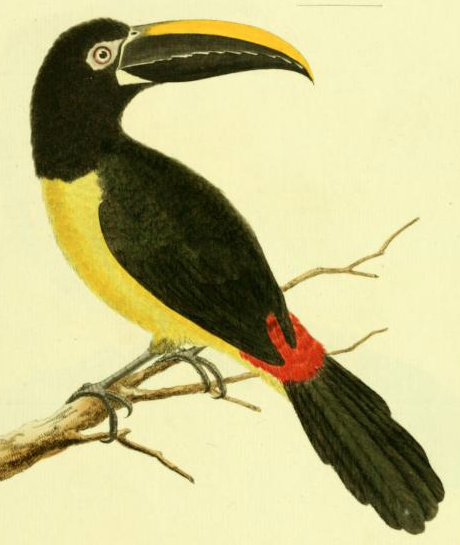
Charles Willson Peale (1741-1827) wrote, in his 16th Lecture (ca. 1799): "This before us, No. 153, is in very indifferent condition, it is a young Bird called the 153. Green Toucan. its beak is not the full groath, or toothed so distinctly as would have been, had it got its full groath; the head, neck, and wing covert feathers dark green, the feather quills dark. underneath pale yellow with a band of red on the breast, the coverts of the tail red. Ramphastos viridis Linn. Toucan Verd de Cayenne Buff. pl. enl. 727. 728. Green Toucan Latham. No. 157. Female Green Toucan. No. 158. Green Toucan Brazil? 166 Buffon?" (Academy of Natural Sciences of Drexel University Archives, coll. 40)
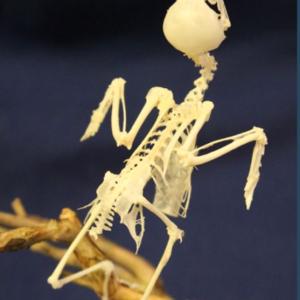
The donation of a skeleton of the Toucan (possibly this species), "Dissected for the Museum", was announced in the Aurora General Advertiser on 28 November 1806.
Notes:
Peale did not specify the origin of the specimen described in his lecture, but it seems likely to be Cayenne, French Guiana, a major South American trade center in the 18th century. In 1793, Raphaelle Peale (1774-1825) travelled to Cayenne to collect specimens for Peale's Museum. However, to the editor's (MRH) knowledge, there is no detailed inventory of the specimens he brought back, and there are many examples of specimens from northern South America that were donated by other people. For more discussion about Raphaelle's travels, see Lillian B. Miller, 1993, "Father and Son: The Relationship of Charles Willson Peale and Raphaelle Peale", The American Art Journal 25: 4-161. / https://doi.org/10.2307/1594599
Specimen Type:
Dead/preserved
Current Common Name:
Black-necked Aracari
Current Scientific Name
Ramphastidae | Pteroglossus aracari