Object Status:
Extant
Accession Date:
By 1799
Primary Source Reference:
Charles Willson Peale, Lecture on Natural History 23. (ca. 1799). Academy of Natural Sciences of Drexel University Archives, coll. 40. / https://ansp.org/research/library/archives/0000-0099/coll0040/
Additional Source Text:
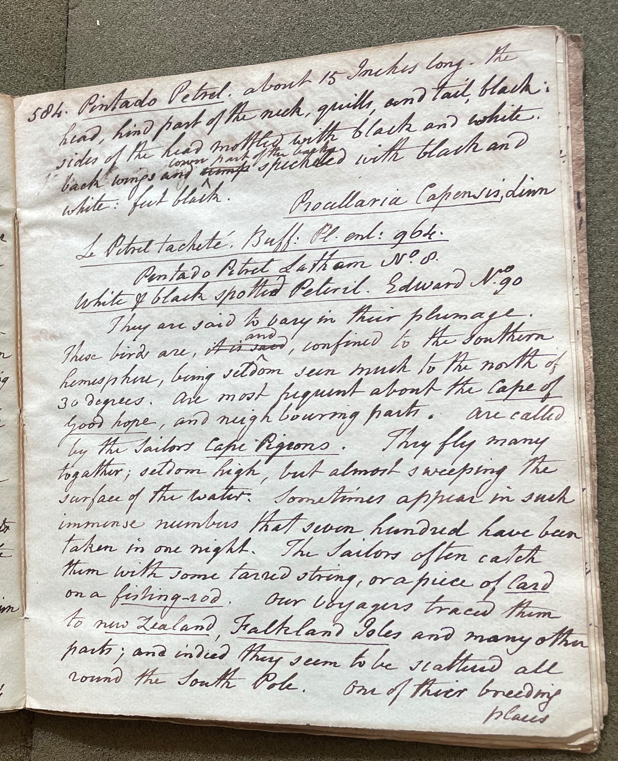
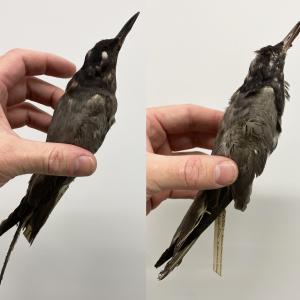
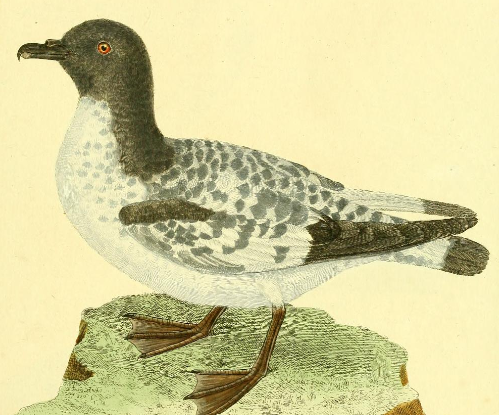
Charles Willson Peale (1741-1827) wrote, in his 23rd Lecture (ca. 1799): "No. 584. Pintado Petrel. about 15 Inches long. the head, hind part of the neck, quills, and tail, black; sides of the head mottled with black and white. back, wings and lower part of the body with black and white; feet black. Procellaria Capensis, Linn. Le Petrel tacheté. Buff. pl. enl. 964. Pintado Petril Latham No. 8. White & black spotted Petril. Edward No. 90. They are said to vary in their plumage. The birds are, and confined to the Southern hemisphere, being seldom seen much to the north of 30 degrees. Are most frequent about the Cape of Good hope and neighbouring parts. Are called by the Sailors Cape Pigeons." (Academy of Natural Sciences of Drexel University Archives, coll. 40)
Peale continued: "They fly many together; seldom high, but almost sweeping the surface of the water. Sometimes appearing in such immense numbers that seven hundred have been taken in one night. The Sailors often catch them with some tarred string, or a piece of Card on a fishing-rod. Our voyagers traced them to new Zealand, Falkland Isles and many other parts; and indeed they seem to be scattered all round the South Pole. One of their breeding places is Kerquelan's Land. The Egg of the size of a pullet, and laid in December. When caught it makes a noise not unlike a Parrot; and spirits out oil from the nostrils into the face of the Person who holds it. It feeds on fish, but more frequently on the dead carcases of Whales, &c. about which time it is seen in vast numbers." (ANSP Archives, coll. 40)
Peale wrote, in "A Walk Through the Philad[elphi]a Museum" (1805–1806): "The Pintado Petrel (P. Capensis) by Sailors called the Cape Pigeons." (Historical Society of Pennsylvania, coll. 0481)
On 11 June 1818, the donation of a "Skin of a Cape Pigeon" by William Benner was recorded in the Peale Museum Accessions Book (HSP, coll. 0481).
On 16 February 1822, the donation of a "Skull of a Cape Pigeon" by Dr. Richard Harlan (1796-1843) was recorded in the same ledger (HSP, coll. 0481).
An unmounted specimen of "Procellaria capensis (Cape Pidgeon)" was listed in "A Catalogue of Duplicate Specimens...", May 1822. [unpublished] American Philosophical Society Library (Mss.B.P31).
Specimen Type:
Dead/preserved
Current Common Name:
Cape Petrel
Current Scientific Name
Procellariidae | Daption capensis