Object Status:
Extant
Accession Date:
By 1799
Primary Source Reference:
Charles Willson Peale, Lecture on Natural History 15. (ca. 1799). Academy of Natural Sciences of Drexel University Archives, coll. 40. / https://ansp.org/research/library/archives/0000-0099/coll0040/
Additional Source Text:
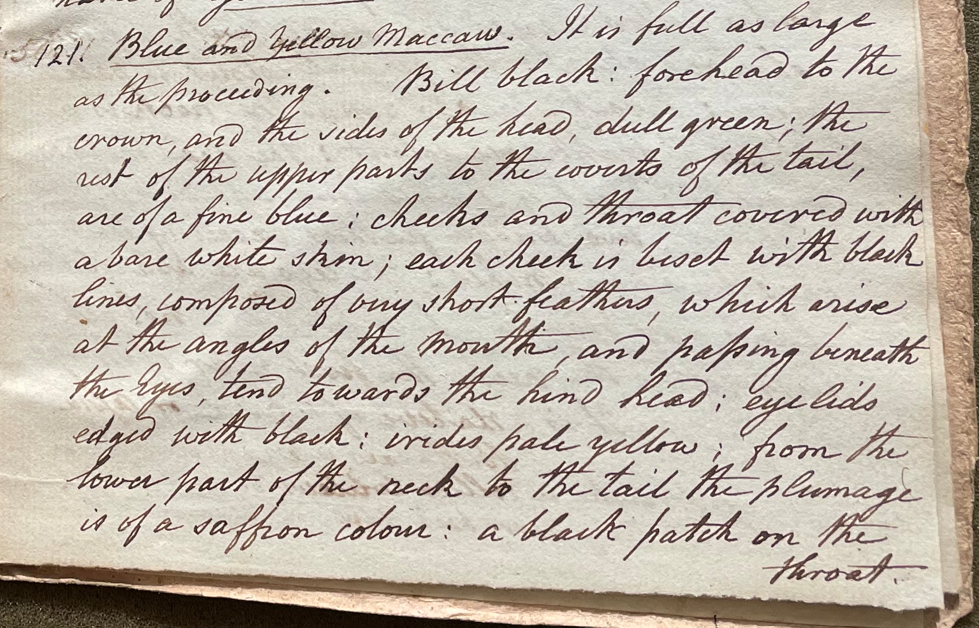
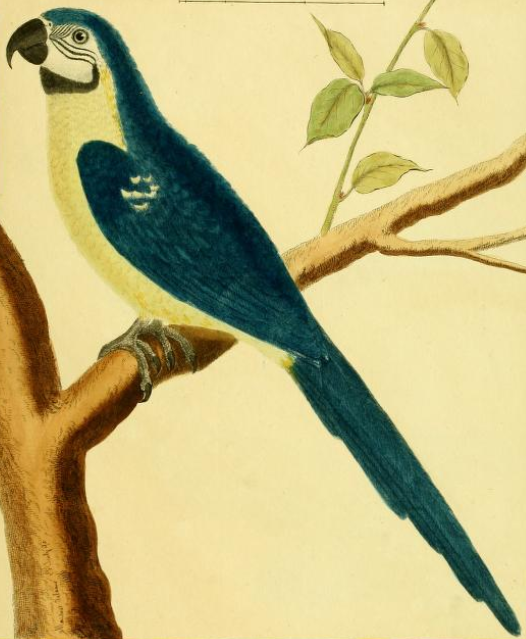
Charles Willson Peale (1741-1827) wrote, in his 15th Lecture (ca. 1799): "No. 121. Blue and Yellow Maccaw. It is full as large as the preceeding [Scarlet Macaw, Ara macao]. Bill black; forehead to the crown, and the sides of the head, dull green; the rest of the upper parts to the coverts of the tail, are of a fine blue; cheeks and throat covered with a bare white skin; each cheek is beset with black lines, composed of very short feathers, which arise at the angles of the mouth, and passing beneath the eyes, tend towards the hind head; eyelids edged with black; irides pale yellow; from the lower part of the neck to the tail the plumage is of a saffron colour; a black patch on the throat; the tail is blue above, and the two middle feathers of one plain colour; the rest have the inner margins inclining to violet, and near the base marginated with blackish; the tail is much cuneated, as in that before noted [A. macao]; the eye cinereous; claws black. Psittacus ararauna Linn. L'ara bleu. Buffon coloured plate 36." (Academy of Natural Sciences of Drexel University Archives, coll. 40)
Peale wrote, in "A Walk Through the Philad[elphi]a Museum" (1805–1806): "The Red & blue Maccaw (Psittacus Macao) and the Blue and Yellow Maccaw (Psittacus ararauna) are beautiful, and although they have power with those strong Bills to inflict sever wounds, yet they are good humoured and very innofensive domesticated." (Historical Society of Pennsylvania, coll. 0481)
The addition of a skeleton of the Maccaw (possibly this species), "Dissected for the Museum", was announced in the Aurora General Advertiser on 28 November 1806.
Notes:
Peale did not specify the origin of the specimen described in his lecture, but it seems likely to be Cayenne, French Guiana, a major South American trade center in the 18th century. In 1793, Raphaelle Peale (1774-1825) travelled to Cayenne to collect specimens for Peale's Museum. However, to the editor's (MRH) knowledge, there is no detailed inventory of the specimens he brought back, and there are many examples of specimens from northern South America that were donated by other people. For more discussion about Raphaelle's travels, see Lillian B. Miller, 1993, "Father and Son: The Relationship of Charles Willson Peale and Raphaelle Peale", The American Art Journal 25: 4-161. / https://doi.org/10.2307/1594599
Specimen Type:
Dead/preserved
Current Common Name:
Blue-and-yellow Macaw
Current Scientific Name
Psittacidae | Ara ararauna