Object Status:
Unlocated
Accession Date:
By 1807
Primary Source Reference:
Charles Willson Peale, undated pencil sketch (ca. 1807), American Philosophical Society (APS) Library, Peale-Sellers Family Collection, Mss.B.P31, vol. 148.
Additional Source Text:
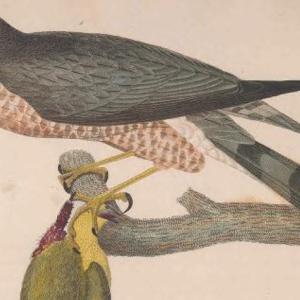
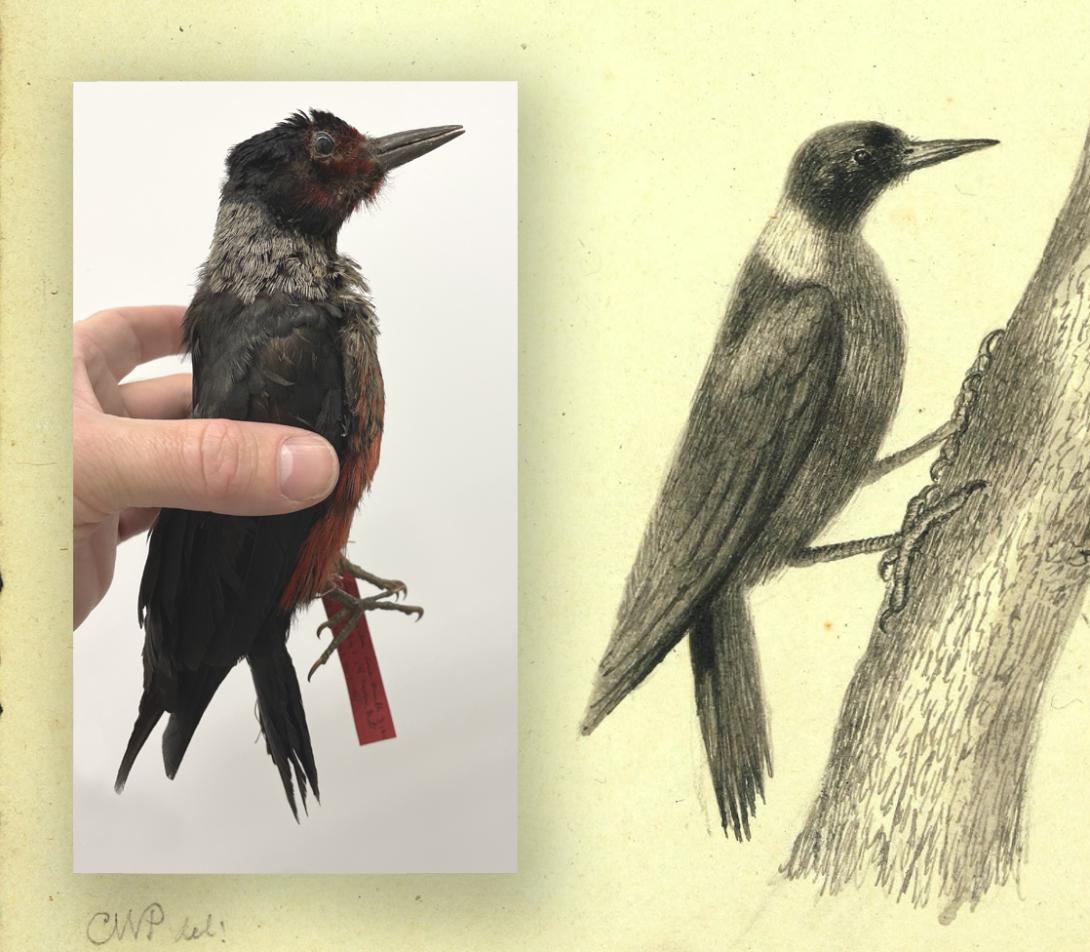
Charles Willson Peale's (1741-1827) drawing of Lewis's specimen has pencil inscriptions on the bottom left ("CWP del.") and bottom right ("Drawn for Capt M Lewis / (1806?) / by CWPeale"). (American Philosophical Society Library, Mss.B.P31) / https://diglib.amphilsoc.org/islandora/object/two-birds-drawn-capt-m-le…
Alexander Wilson (1766-1813) described and illustrated this species under the name "Lewis's Woodpecker / Picus torquatus" in American Ornithology vol. 3 (Pl. 20), where "Peale's Museum, No. 2020" was cited (Wilson 1811: 31). Wilson (1811: 31) wrote: "Several skins of this species were preserved [by the Lewis and Clark expedition]; all of which I examined with care." / https://www.biodiversitylibrary.org/item/175516#page/39/mode/1up (text) / https://www.biodiversitylibrary.org/item/175516#page/34/mode/1up (plate)
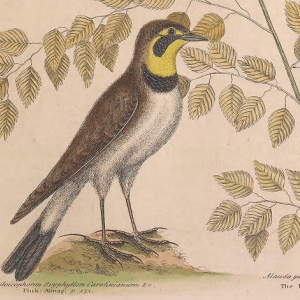
Titian Ramsay Peale (1799-1885) deposited "2 woodpeckers" and "1 woodpecker [drawing]" on 23 March 1821, after returning from the Long Expedition (Accessions Book, Historical Society of Pennsylvania, coll. 0481). His unfinished sketch of a male, collected on [11] July 1820 near the headwaters of the Arkansas River, is shown here (APS Library, Mss.B.P.31.15d).
Three unmounted specimens of "Picus torquatus (Lewis's Wr)" from the Rocky Mountains were listed in "A Catalogue of Duplicate Specimens...", May 1822. [unpublished] American Philosophical Society Library (Mss.B.P31).
Notes:
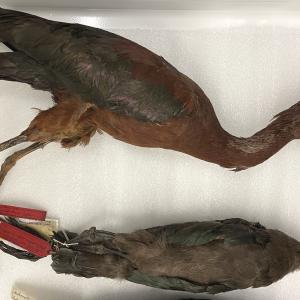
The first specimens were collected during the Lewis and Clark expedition in 1806, deposited by Lewis at Peale's Museum in 1807, and drawn by Peale shortly thereafter. For a discussion about Peale's acquisitions and drawings of Lewis's birds, see Matthew R. Halley, 2023, "The forgotten history of Oreortyx pictus (mountain quail), discovered by the Lewis and Clark expedition, 1806", Archives of Natural History, 50.2: 337-346. / https://www.euppublishing.com/doi/abs/10.3366/anh.2023.0865 After Peale's Museum closed, a portion of Peale's bird collection was purchased in 1850 by Moses Kimball (1809–95), who displayed it at his "Boston Museum". An advertisement in the Boston Transcript, printed 1 October 1850, stated that Kimball had acquired "One Half of the celebrated Peale's Philadelphia Museum". The other half of Peale's birds had been sold to the circus promoter P. T. Barnum (1810–91) and would be subsequently destroyed in a fire at his "American Museum" in New York City in July 1865. When the Boston Museum closed, Kimball's Peale remnants passed temporarily to the Boston Society of Natural History, who disposed of them to Charles J. Maynard (1845-1929), a local taxidermist. The specimens were stored in a barn in Massachusetts for several years, then eventually were deposited at the Museum of Comparative Zoology (MCZ), Harvard University. By the time the collection was catalogued by Walter Faxon (1848-1920) at MCZ, in 1914, in virtually every case the original mounts and labels had been disassociated from the specimens, and an untold number were lost. Walter Faxon, "Relics of Peale's Museum," Bulletin of the Museum of Comparative Zoology, 59, no. 3 (July 1915): 136, speculated that MCZ 67854 (shown here), a "single venerable looking specimen" from the Boston Museum collection, was "probably either [Wilson's] type, which was No. 2020 in the Peale Museum (Lewis and Clark Expedition), or else one of the two individuals shot by [Titian] R. Peale near the Rocky Mountains, on the Long Expedition, I presume." / https://www.biodiversitylibrary.org/page/6339801#page/186/mode/1up In fact, Titian collected three specimens (not two) on the Long Expedition, according to the unpublished "Catalogue of Duplicate Specimens..." (APS Library, Mss.B.P31). These were collected several years after Wilson's death, and so cannot have type status. Despite this uncertainty, the MCZ online database lists MCZ 67854 as the "Holotype" of Picus torquatus and the specimen was included in a recently funded grant proposal aimed at "Preserving the genomes of the type specimens in the MCZ (CSBR)" (National Science Foundation, NSF Collections in Support of Biological Research: Award #1946857). / https://mczbase.mcz.harvard.edu/guid/MCZ:Orn:67826 Here, for simplicity, we state that Titian R. Peale (1799-1885) deposited the Long Expedition specimens at Peale's Museum. However, it should be noted that the specimens did not belong to Titian, and were not his to give away. Officially, they were the property of the United States government, and as such were formally deposited by Major Stephen Harriman Long (1784-1864), who led the government-sponsored expedition. The Peale Museum Accessions Book, pp. 112-113 (Historical Society of Pennsylvania, coll. 0481) contains an "Invoice of Zoological Specimens and Drawings prepared by Titian Peale, Assistant Naturalist for the Exploring Expedition, and deposited in the Philadelphia Museum by Majr. S. H. Long, Maj. U.S. Engr. pursuant to instructions of the Secretary of War." At the conclusion of the invoice, "Rubens Peale [1784-1865], manager" signed the following statement: "Received, Philadelphia Museum, March 23d. 1821. of Majr. S. H. Long, the several articles, specified in the above Invoice, as a deposit for safe keeping, preservation and Exhibition; and I hereby promise, as agent for the Institution to hold the said articles subject to the orders of the War Department, thru the said Maj. Long." (HSP, coll. 0481)
Specimen Type:
Dead/preserved
Current Common Name:
Lewis's Woodpecker
Current Scientific Name
Picidae | Melanerpes lewis
Repository:
Museum of Comparative Zoology, Harvard University (MCZ 67854)
![Titian Ramsay Peale, [14] July 1820](/sites/default/files/2026-04/LEWO_Titian.png)