Object Status:
Extant
Accession Date:
By 1799
Primary Source Reference:
Charles Willson Peale, Lecture on Natural History 15. (ca. 1799). Academy of Natural Sciences of Drexel University Archives, coll. 40. / https://ansp.org/research/library/archives/0000-0099/coll0040/
Additional Source Text:
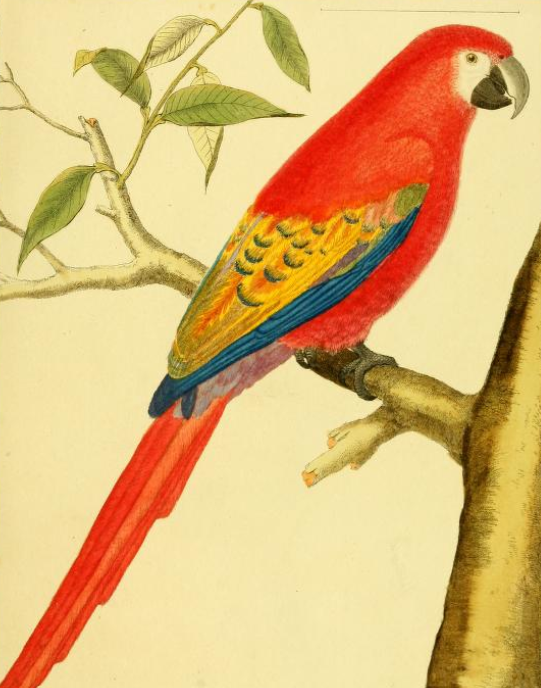
Charles Willson Peale (1741-1827) wrote, in his 15th Lecture (ca. 1799): "No. 120. Red and Blue Maccaw. The length of this bird is about 2 ½ feet, when the feathers are perfect they are near 3 feet long; the size of a common fowl. The upper mandible is white; the top, and sides at the base, black; the under mandible wholly black; the cheeks are bare of feathers, being covered with only a wrinkled skin of a whitish colour; the irides yellow; the head, neck, breast, belly, thighs, and upper part of the back are of a fine bright red; the lower part of the body a pale blue; scapulars blue and green tinged; the two middle tail feathers red, with pale blue tips; the next on each side half blue, half red; the four outer ones violet blue above, dull red beneath; the legs are dusky; claws black. Psittacus macao Linn. L'ara rouge, Buff." (Academy of Natural Sciences of Drexel University Archives, coll. 40)
Peale continued: "It inhabits Brasil, Guiana, and other parts of South America. The bill of this bird is so strong, that it is able, with it, to break a peach-stone with great ease. / This Maccaw was formerly pretty common at St. Domingo; but in proportion as that Island has become more inhabited, these birds are rarely met with. They mostly live in the moist woods, especially those planted with a particular kind of palm, on which it feeds, and of which there are large forests in the marshy wet savannahs. They are often seen in pairs then in greater numbers, and are sought after by the natives for food; but sometimes said to prove hurtful, having a poisonous quality, arising from their being driven by hunger to feed on the Manchineel apple [Hippomane mancinella], which on such occasions does not prove in the least injurious to the bird." (ANSP Archives, coll. 40)
Peale continued: "They make their nests in decayed trees, enlarging the hole with their bill, when it is not of a size sufficient for the purpose, lining the inside with feathers. / The female lays two eggs, the size of a Pidgeon, and spotted like the Partridge egg. They breed twice in a year, and the male and female sit on the nest alternately, as well as reciprocally nurse and feed the young birds. These are tamed with great ease, but the old birds are quite indocile. It is said that the maccaws in general do not learn to speak, and that their voice is particularly rough and disagreeable. The flesh is hard, black, and unsavory, but makes a good soup, and provides a great part of the food of the inhabitants of Cayenne, as well as other parts of South America. It is called in South America by the name of gonzalo." (ANSP Archives, coll. 40)
Peale wrote, in "A Walk Through the Philad[elphi]a Museum" (1805–1806): "The Red & blue Maccaw (Psittacus Macao) and the Blue and Yellow Maccaw (Psittacus ararauna) are beautiful, and although they have power with those strong Bills to inflict sever wounds, yet they are good humoured and very innofensive domesticated." (Historical Society of Pennsylvania, coll. 0481)
A skeleton of the "Maccaw" (possibly this species), "Dissected for the Museum", was announced in the Aurora General Advertiser on 28 November 1806.
A "Red Macakaw" (presumably this species) was donated by Master Shoomaker on 9 October 1809, as recorded in the Peale Museum Accessions Book, p. 42 (HSP, coll. 0481).
A male specimen of "Psittacus macao (Red & Blue Maccaw)" from South America was listed in "A Catalogue of Duplicate Specimens...", May 1822. [unpublished] American Philosophical Society Library (Mss.B.P31).
Specimen Type:
Dead/preserved
Current Common Name:
Scarlet Macaw
Current Scientific Name
Psittacidae | Ara macao