Object Status:
Extant
Accession Date:
By 1799
Primary Source Reference:
Charles Willson Peale, Lecture on Natural History 35. (ca. 1799). Academy of Natural Sciences of Drexel University Archives, coll. 40. / https://ansp.org/research/library/archives/0000-0099/coll0040/
Additional Source Text:
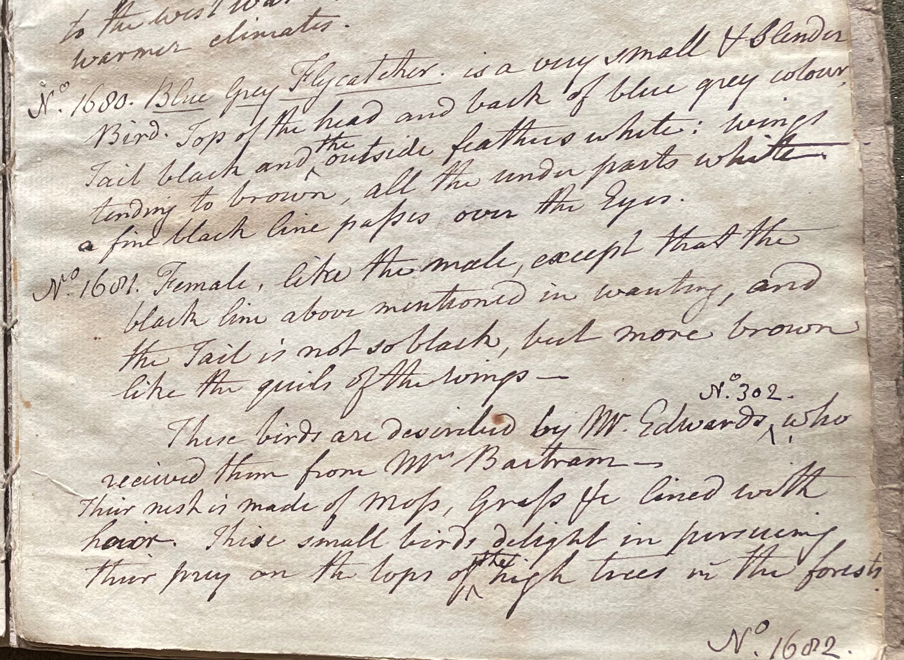
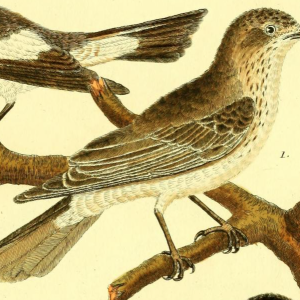
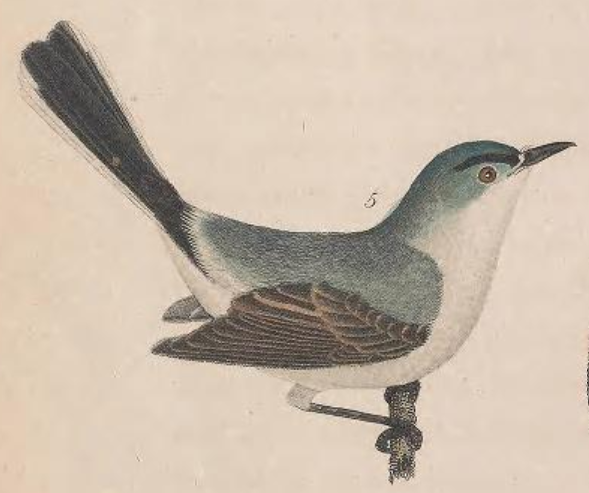
Charles Willson Peale (1741-1827) wrote, in his 35th Lecture (ca. 1799): "No. 1680. Blue Grey Flycatcher. is a very small & slender Bird. Top of the head and back of blue grey colour. Tail black and the outside feathers white; wings tending to brown, all the under parts white. a fine black line passes over the Eyes. No. 1681. Female. like the male, except that the black line above mentioned is wanting, and the Tail is not so black, but more brown like the quils of the wings. These birds are described by Mr. Edwards No. 302, who received them from Mr. [William] Bartram. Their nest is made of moss, grass & lined wth hair. These small birds delight in pursuing their prey on the tops of the high trees in the forest." (Academy of Natural Sciences of Drexel University Archives, coll. 40)
In a draft copy of "A Walk Through the Philad[elphi]a Museum" (1805-1806), Peale wrote: "Blue grey flycatcher, the smallest we possess. It is found catching flies on the tops of the highest Trees in the forest." (Historical Society of Pennsylvania, coll. 0481)
Alexander Wilson (1766-1813) described this species under the name "Small Blue Grey Flycatcher / Muscicapa caerulea" in American Ornithology vol. 2 (Pl. 18), where "Peale's Museum, No. 6829" was cited (Wilson 1810: 164). / https://www.biodiversitylibrary.org/item/175511#page/186/mode/1up (text) / https://www.biodiversitylibrary.org/item/175511#page/166/mode/1up (plate)
Specimen Type:
Dead/preserved
Current Common Name:
Blue-gray Gnatcatcher
Current Scientific Name
Polioptilidae | Polioptila caerulea