Object Status:
Extant
Accession Date:
By 1799
Primary Source Reference:
Charles Willson Peale, Lecture on Natural History 31. (ca. 1799). Academy of Natural Sciences of Drexel University Archives, coll. 40. / https://ansp.org/research/library/archives/0000-0099/coll0040/
Additional Source Text:
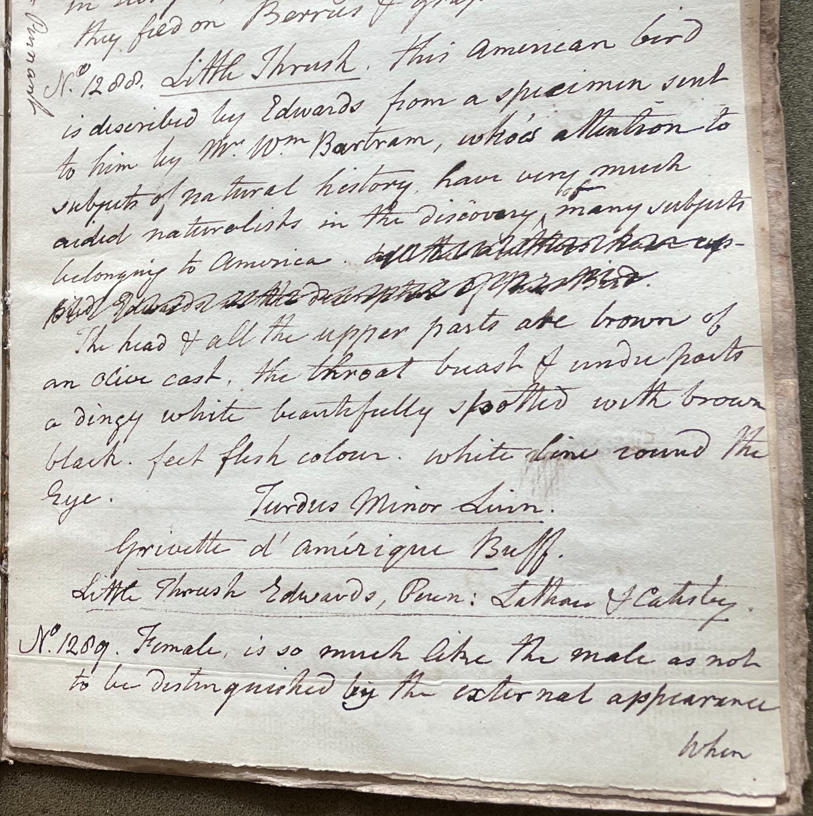
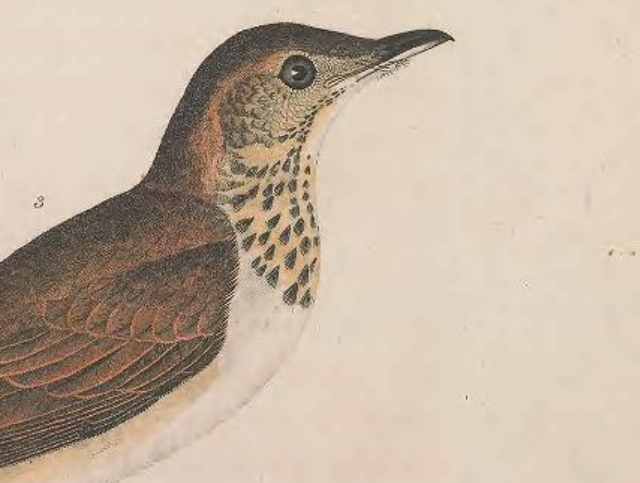
Charles Willson Peale (1741-1827) wrote, in his 31st Lecture (ca. 1799): "No. 1288. Little Thrush. this American bird is described by Edwards from a specimen sent to him by Mr. Wm. Bartram, who'es [sic] attention to subjects of natural history have very much aided naturalists in the discoverey of many subjects belonging to America. The Head & all the upper parts are brown of an olive cast, the throat breast & underparts a dingy white beautifully spotted with brown black. Feet flesh colour. White line round the eye. Turdus minor Linn. Grivette d'Amerique Buff. Little Thrush Edwards, Penn; Latham & Catesby. No. 1289. Female, is so much like the male as not to be distinguished by the external appearance, when preserving I have recourse to desection, which enables me to rectify the errors of several authors, who have wrote on the American birds. They are generally found in the retired places of our woods, and very often on the ground. common throughout the United States. No. 1290. A Variety of the same, the only difference, these are smaller. No. 1291. Female." (Academy of Natural Sciences of Drexel University Archives, coll. 40)
Alexander Wilson (1766-1813) split the composite T. minor into two species, which were also composites: (1) "Hermit Thrush / Turdus solitarius" in American Ornithology vol. 5 (Pl. 43), where "Peale's Museum, No. 3542" (possibly a typo, i.e., = 5542, in series with the other thrushes) was cited (Wilson 1812: 95) / https://www.biodiversitylibrary.org/item/175520#page/113/mode/1up (text) / and (2) "Tawny Thrush / Turdus mustelinus" in American Ornithology vol. 5 (Pl. 43), where "Peale's Museum, No. 5570" was cited (Wilson 1812: 98) / https://www.biodiversitylibrary.org/item/175520#page/116/mode/1up (text) / https://www.biodiversitylibrary.org/item/175520#page/108/mode/1up (plate)
Two unmounted specimens of "Turdus mustelinus (Tawny Thrush)" were listed in "A Catalogue of Duplicate Specimens...", May 1822. [unpublished] American Philosophical Society Library (Mss.B.P31).
Notes:
Peale evidently had specimens of multiple Catharus species in his collection but failed to distinguish more than one species, identifying them all as the composite Turdus minor. Notably, the specimen he described under this name, in his lecture account, best matches the Gray-cheeked Thrush (Catharus minimus), being entirely olive-brown on the upperparts (i.e., including the tail), with a white (not buffy) eyering, and lacking buff on the throat. These characters rule out the similar Hermit Thrush (C. guttatus, which has a rusty (reddish) tail, and C. [ustulatus] swainsoni, which has a bold buffy eye-ring and a buffy suffusion to the upper breast and face. The conspicuous absence in Peale’s writings of Wood Thrush Hylocichla mustelina, a common breeding species near Philadelphia, which was undoubtedly mounted in the Philadelphia Museum (see Wilson 1808: 29, American Ornithology vol. 1), suggests that he confused H. mustelina with the T. minor amalgamation. For more discussion of this convoluted topic, see Matthew R. Halley, 2018, "The ambiguous identity of Turdus mustelinus Wilson, and a neotype designation for the Veery Catharus fuscescens (Stephens)," Bulletin of the British Ornithologists’ Club 138: 78-91. / https://doi.org/10.25226/bboc.v138i2.2018.a3
Specimen Type:
Dead/preserved
Current Common Name:
Gray-cheeked Thrush
Current Scientific Name
Turdidae | Catharus minimus