Object Status:
Unlocated
Accession Date:
By 1799
Primary Source Reference:
Charles Willson Peale, Lecture on Natural History 14. (ca. 1799). Academy of Natural Sciences of Drexel University Archives, coll. 40. / https://ansp.org/research/library/archives/0000-0099/coll0040/
Additional Source Text:
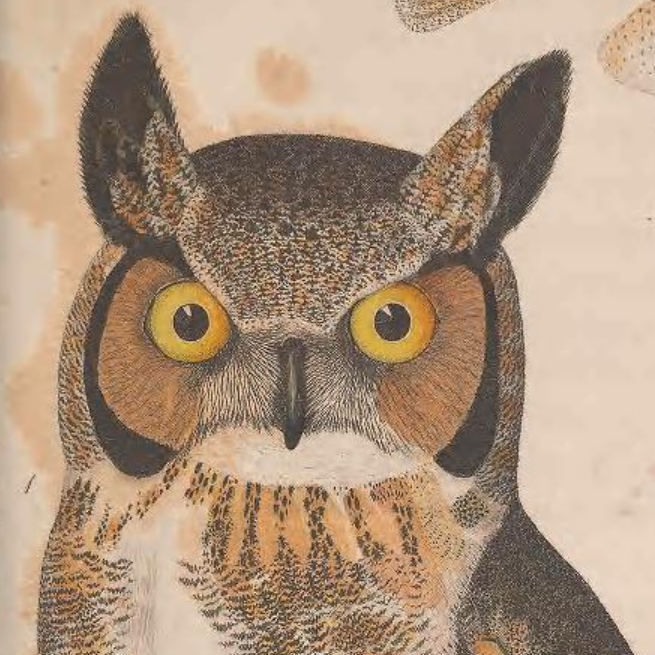
Charles Willson Peale (1741-1827) wrote, in his 14th Lecture (ca. 1799): "No. 55. Great horned Owl. Body variegated with brown, russet and black; large feathers in form of ears or horns; white spot under the neck and one below the breast; the toes of all the owls are so constructed that the two outer ones can be turned back like the toes of Parrots. Strix bubo. Linnaeus. There are varieties of the great […] this American owl differs from Buffon's le grand Duc p. 435. This has the black on the belly in bars, and in Buffon's they point downwards; the other differences may be too minute to be well ascertained without having both of them before us. Owls are not always silent. Their note to some is hideous. When persuing their prey it is seldom head, but may be considered rather as a call to courtship. It is seldom heard but in the silence of midnight, and breaks the general pause, with awful variation. These have a note very like the hoarse barking of a large Dog though not so loud, and afterwards a kind of screech; and to terrify their enemies they strike their bill together, best imitated by striking two stones together." (Academy of Natural Sciences of Drexel University Archives, coll. 40)
Peale wrote: "They are useful to man in some important points of view; although they feed on birds and sometimes rob the hen roost, yet a principal part of their food is field mice, which they devour entire, but the hair, bones, and skin which resist the action of the stomack, it vomits up in round balls. I have found these balls in meadows and often wondered how they came into such a compacted form. / Mice and moles are thus keept from too great an increase, consequently it is a prevention of the fatal destruction of grass and grain. They may be keept in barns to great advantage for destroying of rats. In my cellars, I have found them much more useful than cats, as they destroyed those large rats which soon mastered or rendered cowardly the best cats I could procure." (ANSP Archives, coll. 40)
Peale continued: "Goldsmith says, 'Whatever mischief one species of owl may do in the woods, the barn-owl makes a sufficient recompence for, by being equally active in destroying mice nearer home; so that a single owl is said to be more serviceable than half a dozen cats, in ridding the barn of its domestic vermin' … 'In the year 1580, says an old writer, at Hallontide, an army of mice so overran the marshes near Southminster that they eat up the grass to the very roots. But at length a great number of strange painted owls came and devoured all the mice. The like happened again in Essex about 60 years after.' Latham p. 119. No. 36. This we suppose to be the female of the preceeding kind; being somewhat larger and rather different in plumage." (ANSP Archives, coll. 40)
Peale wrote, in "A Walk Through the Philad[elphi]a Museum" (1805–1806): "The first Division are horned, here is the great horned Owl (Bubo) when domesticated very useful to catch Rats, but they will also destroy Poultry." (Historical Society of Pennsylvania, coll. 0481)
Alexander Wilson (1766-1813) described this species under the name "Great Horned-Owl / Strix virginiana" in American Ornithology vol. 6 (Pl. 50), where "Peale's Museum, No. 410" was cited (Wilson 1812: 52). / https://www.biodiversitylibrary.org/item/175484#page/72/mode/1up (text) / https://www.biodiversitylibrary.org/item/175484#page/73/mode/1up (plate)
Notes:
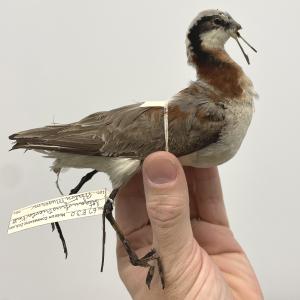
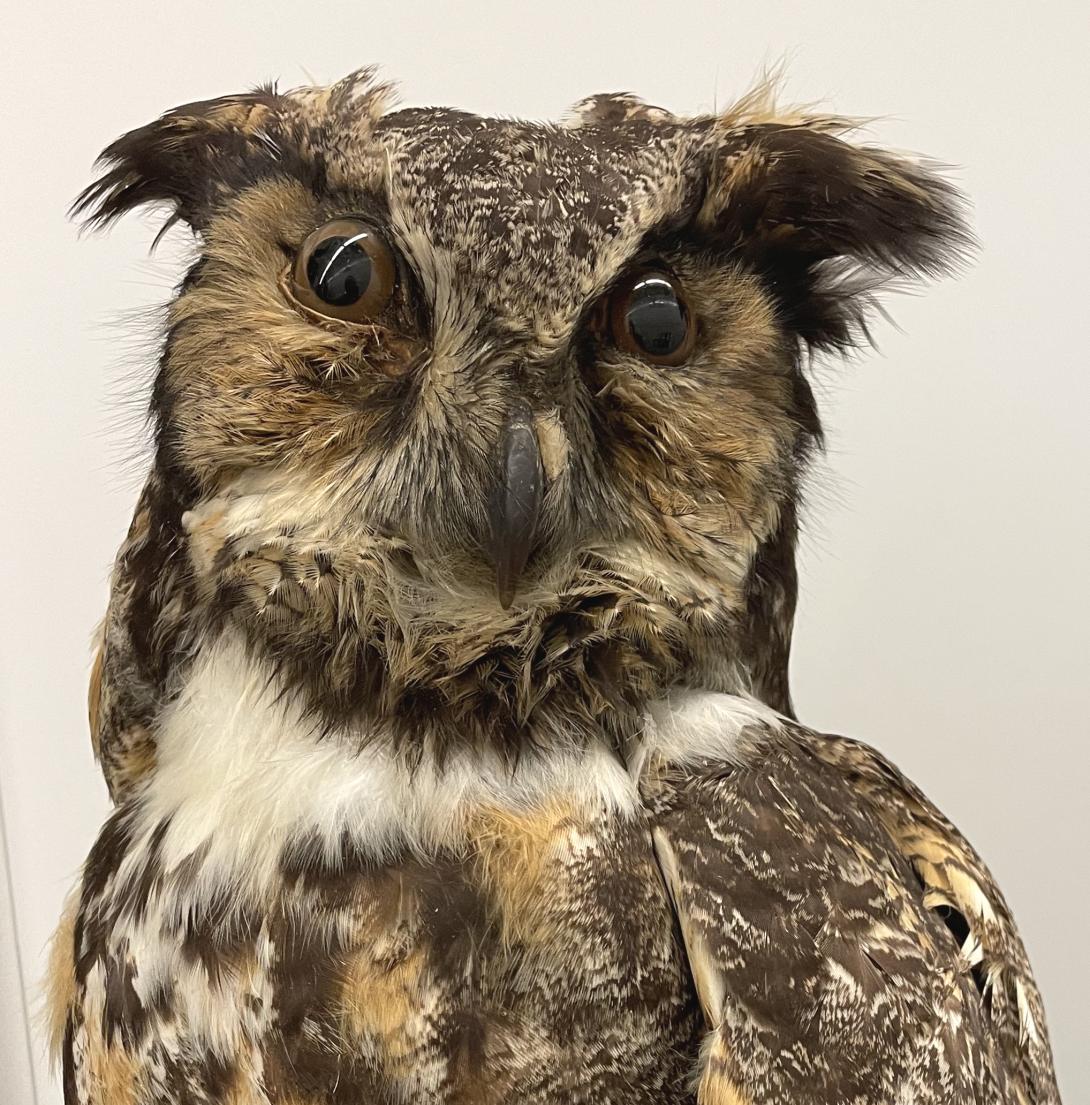
After Peale's Museum closed, a portion of Peale's bird collection was purchased in 1850 by Moses Kimball (1809–95), who displayed it at his "Boston Museum". An advertisement in the Boston Transcript, printed 1 October 1850, stated that Kimball had acquired "One Half of the celebrated Peale's Philadelphia Museum". The other half of Peale's birds had been sold to the circus promoter P. T. Barnum (1810–91) and would be subsequently destroyed in a fire at his "American Museum" in New York City in July 1865. When the Boston Museum closed, Kimball's Peale remnants passed temporarily to the Boston Society of Natural History, who disposed of them to Charles J. Maynard (1845-1929), a local taxidermist. The specimens were stored in a barn in Massachusetts for several years, then eventually were deposited at the Museum of Comparative Zoology (MCZ), Harvard University. By the time the collection was catalogued by Walter Faxon (1848-1920) at MCZ, in 1914, in virtually every case the original mounts and labels had been disassociated from the specimens, and an untold number were lost. Walter Faxon, "Relics of Peale's Museum," Bulletin of the Museum of Comparative Zoology, 59, no. 3 (July 1915): 136, speculated that MCZ 67852, a data-deficient specimen from the Boston Museum collection (shown here), is "Very probably the bird drawn by Wilson." Faxon's claim may be true, but Peale had this species in his collection by 1799 and had little room (or interest) to display duplicates. / https://www.biodiversitylibrary.org/page/6339801#page/186/mode/1up Wilson (1810: viii, American Ornithology, vol. 2) also stated that "no drawings have been, or will be made for this work, from any stuffed subjects, where living specimens of the same can be procured; yet the former serve a very important purpose; they enable the author to ascertain the real existence and residence of such subjects". / https://www.biodiversitylibrary.org/item/175511#page/14/mode/1up Wilson deposited many specimens at Peale's Museum, after completing his drawings, but the combined evidence from American Ornithology and the Peale Museum Accessions Book (Historical Society of Pennsylvania, coll. 0481) suggests that it was probably fewer than 50 skins, whereas many authors have assumed that all the "Peale numbers" cited in Wilson's work were those of his own specimens (e.g., "he contributed 279 specimens to the collection", Edward H. Burtt, Jr., and William E. Davis, Jr., 2013, Alexander Wilson: The Scot Who Founded American Ornithology, Belknap Press, p. 310). This assumption appears to be based on a misunderstanding — Wilson was citing the numbers to give credit to Peale, to acknowledge his contributions, not to stake a claim to his own specimen deposits. If Burtt & Davis (2013) were correct, the "Catalogue of Duplicate Specimens" (APS Library, Mss.B.P31) would be full of Wilson's specimen deposits—but this is not the case. No duplicates of Great Horned Owl are listed. To the editor's (MRH) knowledge, there is no evidence that Wilson deposited a Great Horned Owl at Peale's Museum.
Specimen Type:
Dead/preserved
Current Common Name:
Great Horned Owl
Current Scientific Name
Strigidae | Bubo virginianus
Repository:
Museum of Comparative Zoology, Harvard University (MCZ 67852)