Object Status:
Extant
Accession Date:
By 1799
Primary Source Reference:
Charles Willson Peale, Lecture on Natural History 17. (ca. 1799). Academy of Natural Sciences of Drexel University Archives, coll. 40. / https://ansp.org/research/library/archives/0000-0099/coll0040/
Additional Source Text:
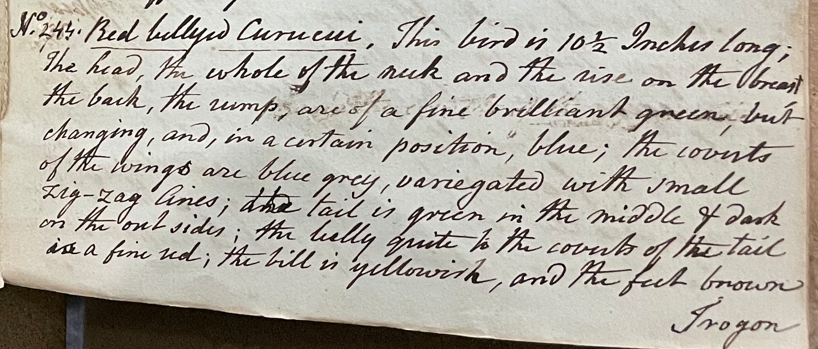
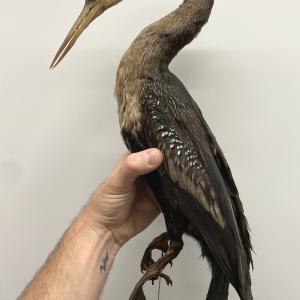
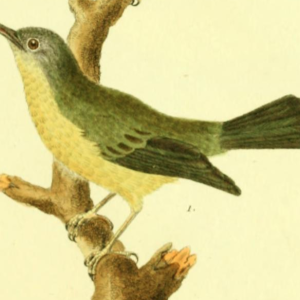
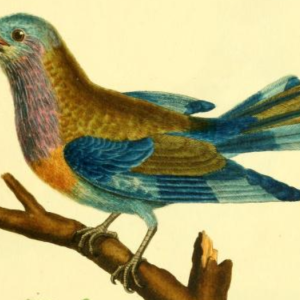
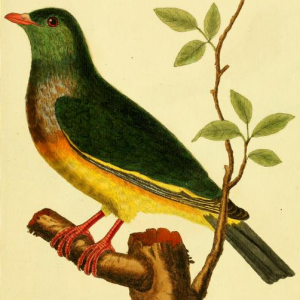
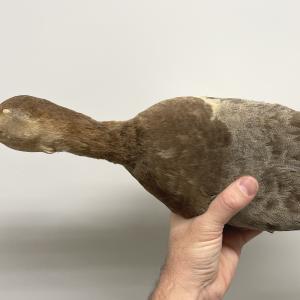
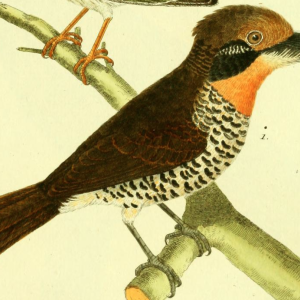
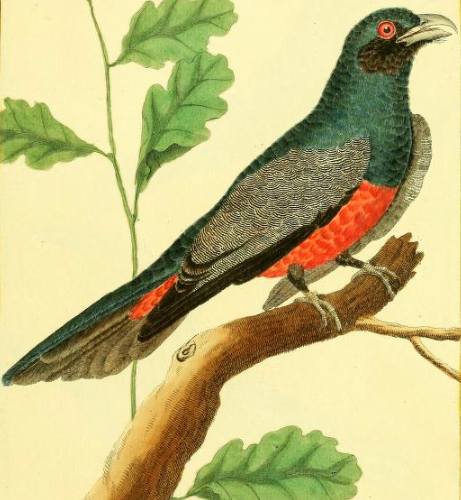
Charles Willson Peale (1741-1827) wrote, in his 17th Lecture (ca. 1799): "No. 244. Red bellyed Curucui. This bird is 10 ½ Inches long; the head, the whole of the neck and the rise on the breast, the back, [and] the rump, are of a fine brilliant green, but changing, and, in a certain position, blue; the coverts of the wings are blue grey, variegated with small zig-zag lines; the tail is green in the middle & dark on the outsides; the belly quite to the coverts of the tail is a fine red; the bill is yellowish, and the feet brown. Trogon curucui, Linn. Le Couroucou à ventre rouge. Buff. The female of this is said to differ, in having those parts which are of a fine brilliant green in the male, black grey, and totally without gloss; the zig-zag lines on the wings also are conspicuous." (Academy of Natural Sciences of Drexel University Archives, coll. 40)
Peale continued: "The Curucuis are solitary birds, live in the damp forests. They are never observed to consort in flocks; they generally sit on the middle branches, the cock and the hen on separate but adjacent trees, and call each other aternately, by repeating their hollow monotonous cry, ooroo-cais. They never fly far, but only from tree to tree, and seldom even do that; for they remain during the greatest part of the day in the same spot, concealed beneath the thickest boughs; where, though their voice is continually heard, yet, as they are motionless they can scarcely be discovered. They are cloathed so thickly with plumage, that they appear larger than in reality; they would often seem to equal the bulk of a pidgeon, though they have not more flesh than a thrush. But if their feathers be numerous and close, they are weakly rooted, for they drop with the least handling; so that it is difficult to prepare specimens for the Cabinet. These birds are among the most beautiful of South America. Fernandez says that the fine feathers of the Red-bellyed Curucui were used by the Mexicans in making Portraits, a gaudy kind of Paintings, and other ornaments which they wore at festivals, or in Battle." (ANSP Archives, coll. 40)
Peale wrote, in "A Walk Through the Philad[elphi]a Museum" (1805–1806): "These birds, with thick, short, Curved & serated on the edges belong to the genus Trogon or Curucui--from their note resembling that the sound of that word. They are chiefly natives of south America. Here is the Red bellyed (Trogon Curucui) [=T. curucui Linnaeus], and the Cenerious Curucui's (Trogon Strigilatus) [=T. viridis Linnaeus]. They are solitary Birds, that live in the heart of damp forests. They are cloathed so thickly with plumage, that they appear larger than in reality; they would oftain seem to equal the bulk of a Pidgeon, though they have not more flesh than a Thrush. Their feathers are so weakly rooted that is difficult to prepare specimens for the Cabinet." (Historical Society of Pennsylvania, coll. 0481)
Specimen Type:
Dead/preserved
Current Common Name:
Blue-crowned Trogon
Current Scientific Name
Trogonidae | Trogon curucui