Object Status:
Extant
Accession Date:
By 1799
Primary Source Reference:
Charles Willson Peale, Lecture on Natural History 22. (ca. 1799). Academy of Natural Sciences of Drexel University Archives, coll. 40. / https://ansp.org/research/library/archives/0000-0099/coll0040/
Additional Source Text:
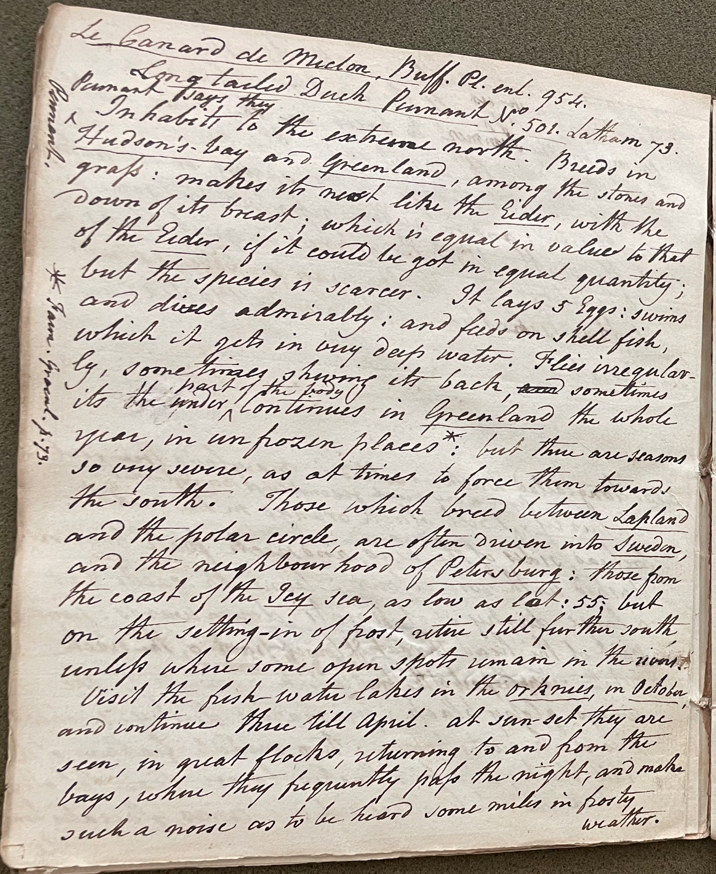
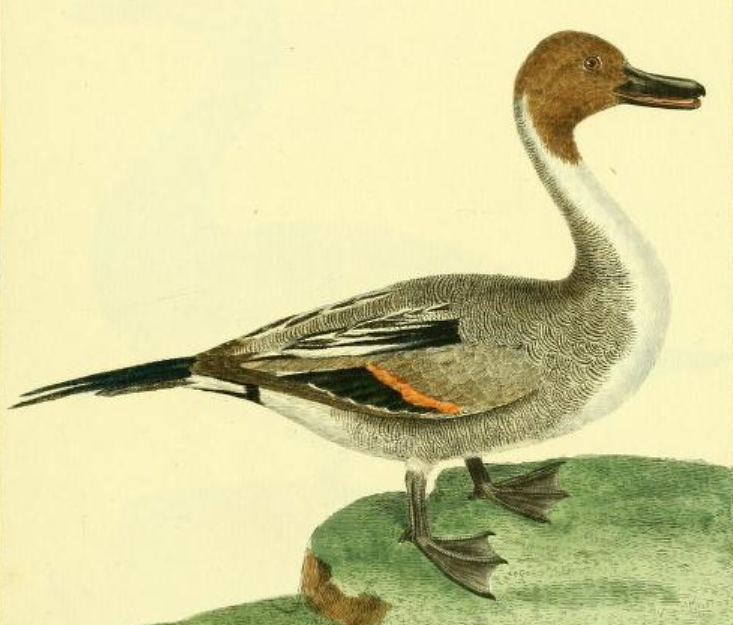
Charles Willson Peale (1741-1827) wrote, in his 22nd Lecture (ca. 1799): "513. Long tailed Duck. Called in Maryland the South-Southerly, from a cry much resembling these syllables. Bill black orange in the middle; forehead, sides of the head, and neck pale brown, dashed with rose colour; beneath each ear a large dusky spot points downwards; hind part of the head, throat & lower part of the neck, white; upper part of the breast dark […] lower white; coverts of the wings glossy black; primaries dusky; secondaries dark rusty brown; two middle feathers of the tail black, and four Inches longer than the others, which are white; legs red. Anas glacialis Linn. Le Canard de Miclon Buff. pl. enl. 954. Long tailed Duck Pennant No. 501. Latham 73." (Academy of Natural Sciences of Drexel University Archives, coll. 40)
Peale continued: "Pennant says they inhabit to the extreme north. Breeds in Hudson's Bay and Greenland, among the stones and grass; makes its nest like the Eider, with the down of its breast; which is equal in value to that of the Eider, if it could be got in equal quantity; but the species is scarcer. It lays 5 Eggs; swims and dives admirably; and feeds on shell fish, which it gets in very deep water. Flies irregularly, sometimes showing its back, sometimes its the under part of the body. Continues in Greenland the whole year, in unfrozen places [a footnote inserted by Peale gives his source as "Faun. Greenl. p. 73"]; but there are seasons so very severe, as at times to force them towards the south. Those which breed between Lapland and the polar circle, are often driven into Sweden, and the neighbourhood of Petersburg; those from the coast of the Icy sea, as low as lat. 55; but on the setting-in of frost, retire still further south, unless where some open spots remain in the […]. Visit the fresh water lakes in the Orknies in October, and continue there till April." (ANSP Archives, coll. 40)
Peale continued: "At sun-set they are seen, in great flocks, returning to and from the bays, where they frequently pass the night, and make such a noise as to be heard some miles in frosty weather. Their notes are not disagreeable, which they are continually repeating, while they remain on the waters of the Chessepeak, I have seen them in that Bay when the weather has been tolerably warm, which puts me into some doubts about this same duck going so far to the north as Mr. Pennant says they do. 514. Female, it has faintly the same kind of mark on the side of the neck. White neck & body & rather whiter about the Eyes than the male. Back, wings, breast & tail russet brown, without the 2 long feathers in the tail. 515. I take to be a young male, the wing coverts being the same as No. 513. it [is] mottled about the breast & heard, a circumstance very general in young birds. Without the long feathers in the tail." An undated scrap of paper tucked into Peale's 21st lecture manuscript contains a scribbled list of duck specimens, including: "Blue wing discors" and "Long tail South Southerly (glacialis)" (ANSP Archives, coll. 40)
Peale wrote, in "A Walk Through the Philad[elphi]a Museum" (1805–1806): "The … Long-tailed Duck (a. Glacialis? or Hyemalis) in Maryland is named the South southerly from its cry very much resembles those syllables - which it insessently repeats in the Chessapeak Bay especially in mild calm weather. Can this be the same species, which authors say breeds in the most northern parts of the world, and only visit the orknies and England in the severest winters. It is like the plates given of that in Europe which they say affords a down equal to the Eider's, but in small quantity." (Historical Society of Pennsylvania, coll. 0481)
Alexander Wilson (1766-1813) described this species under the name "Long-tailed Duck / Anas glacialis" in American Ornithology vol. 8, published posthumously (Pl. 70), in separate accounts for the male and female, where "Peale's Museum, No. 2810" and "Peale's Museum, No. 2811" cited, respectively (Wilson 1814: 93, 96). / https://www.biodiversitylibrary.org/item/175758#page/113/mode/1up (male text) / https://www.biodiversitylibrary.org/item/175758#page/116/mode/1up (female text) / https://www.biodiversitylibrary.org/item/175758#page/112/mode/1up (plate)
Specimen Type:
Dead/preserved
Current Common Name:
Long-tailed Duck
Current Scientific Name
Anatidae | Clangula hyemalis