Object Status:
Extant
Accession Date:
By 1799
Primary Source Reference:
Charles Willson Peale, Lecture on Natural History 21. (ca. 1799). Academy of Natural Sciences of Drexel University Archives, coll. 40. / https://ansp.org/research/library/archives/0000-0099/coll0040/
Additional Source Text:
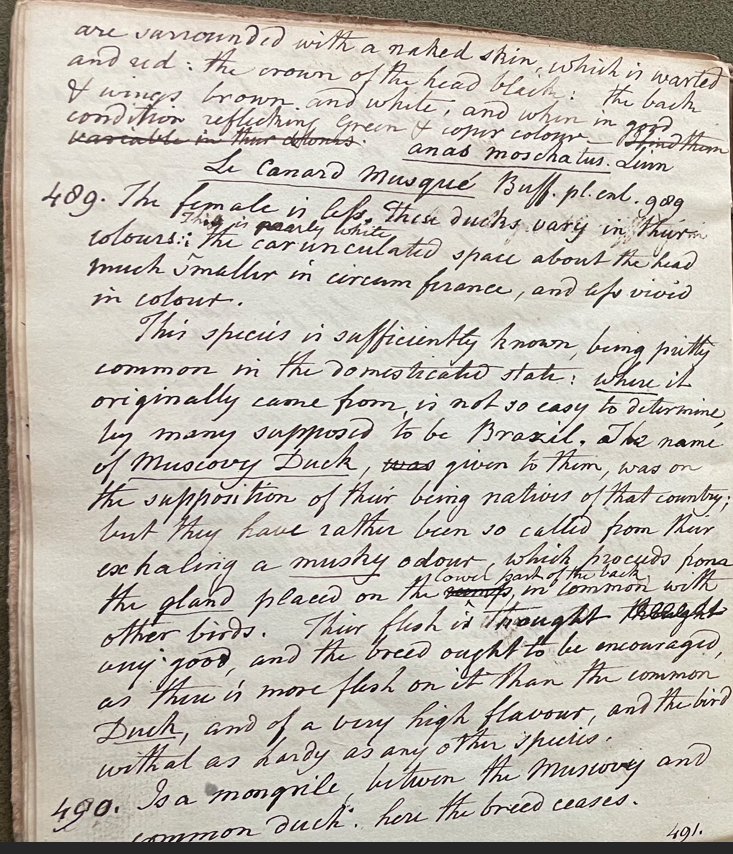
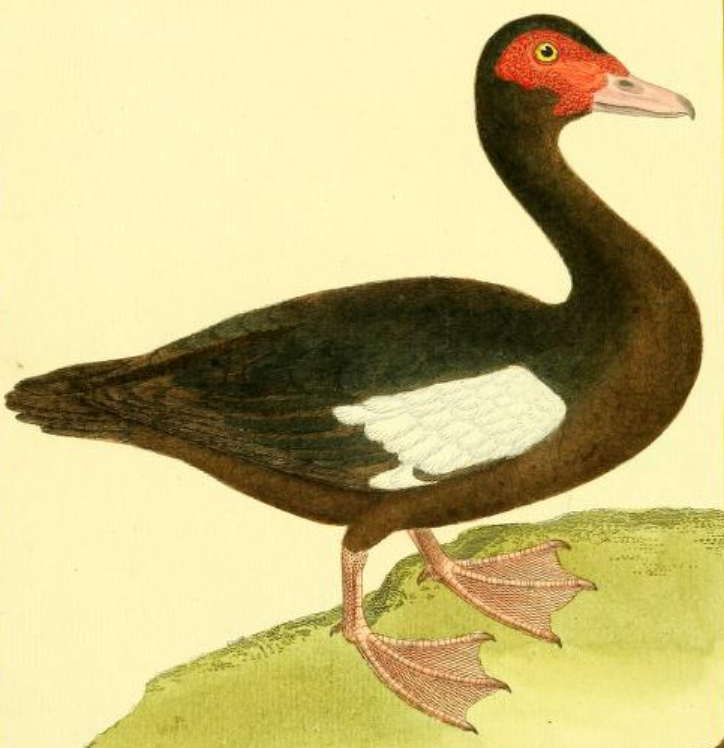
Charles Willson Peale (1741-1827) wrote, in his 21st Lecture (ca. 1799): "488. Muscovy Duck. bigger than the wild duck; length 2 feet. Bill 2 Inches long, and red, except about the nostrils and tip, where it is brown; the eyes are surrounded with a naked skin, which is warted and red; the crown of the head black; the back & wings brown and white, and when in good condition eflecting green & copper colour. I find them variable in their colours. Anas moschatus Linn. Le Canard Musqué Buff. pl. enl. 989." (Academy of Natural Sciences of Drexel University Archives, coll. 40)
Peale continued: "489. The female is less. These ducks vary in their colours. This [specimen] is pearly white, the carunculated space about the head much smaller in circumference, and less vivid in colour. This species is sufficiently known, being pretty common in the domesticated state; where it originally came from, is not so easy to determine, by many supposed to be Brazil. The name of Muscovy Duck, given to them, was on the supposition of their being natives of that country; but they have rather been so called from their exhaling a musky odour, which procees from the gland placed on the lower part of the back, in common with other birds. Their flesh is thought very good, and the breed ought to be encouraged, as there is more flesh on it than the common Duck, and of a very high flavor, and the bird withal as hardy as any other species. 490. Is a mongrel between the Muscovy and Common duck. Here the breed ceases." (ANSP Archives, coll. 40)
Peale wrote, in "A Walk Through the Philad[elphi]a Museum" (1805–1806): "The Muscovy, the Golden Eye, and the Channel Duck fills this Case." (Historical Society of Pennsylvania, coll. 0481)
On 2 February 1805, the following entry was written in the Peale Museum Accessions Book (Historical Society of Pennsylvania, coll. 0481): "A gizrd of a muscovy Duck, which [Isaac Jones] purchased in Market, in good order and health. when he killed it, he found the gizard filled with pins, to the number of 25 or 30" (HSP, coll. 0481).
On 30 November 1812, Methias Gebler donated "Two large ducks, which were shot in New Jersey, supposed to be a mongeral of the moscovy." (Accessions Book, HSP, coll. 0481)
Specimen Type:
Dead/preserved
Current Common Name:
Muscovy Duck
Current Scientific Name
Anatidae | Cairina moschata