Object Status:
Extant
Accession Date:
By 1799
Primary Source Reference:
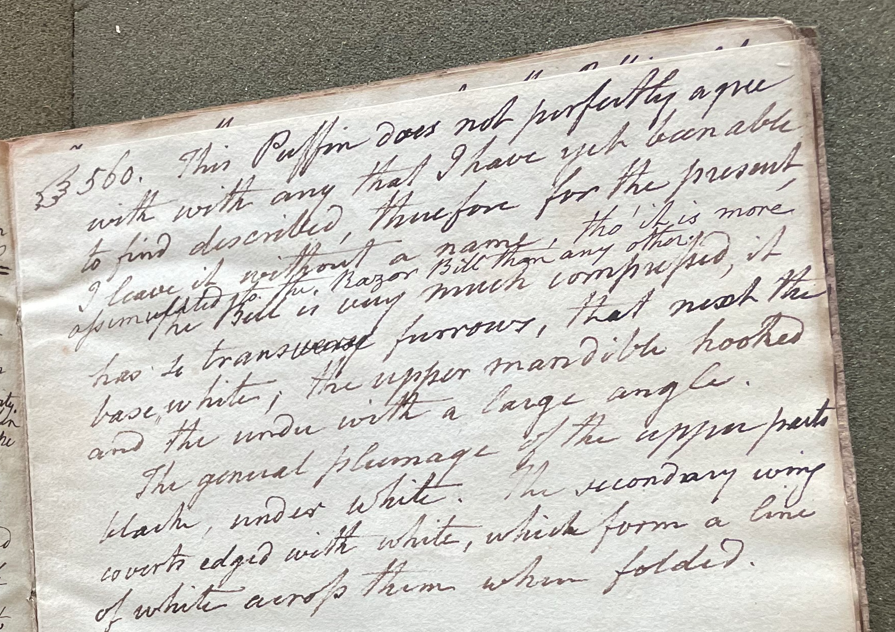
Charles Willson Peale, Lecture on Natural History 23. (ca. 1799). Academy of Natural Sciences of Drexel University Archives, coll. 40. / https://ansp.org/research/library/archives/0000-0099/coll0040/
Additional Source Text:
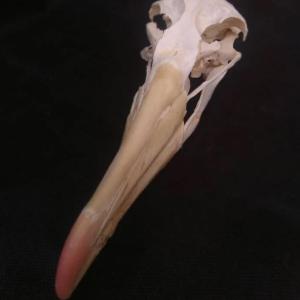
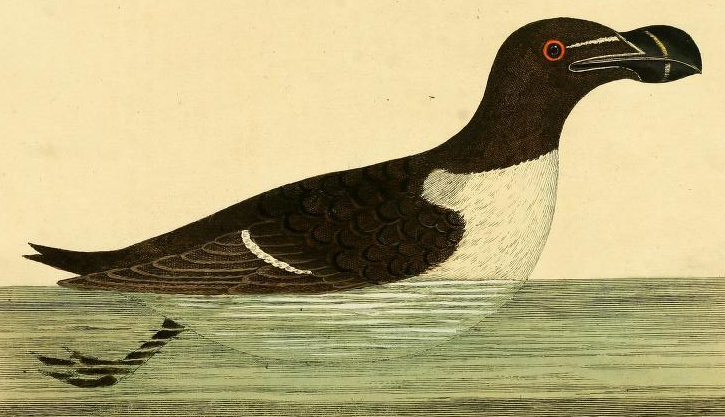
Charles Willson Peale (1741-1827) wrote, in his 23rd Lecture (ca. 1799): "560. This Puffin does not perfectly agree with any that I have yet been able to find described, therefore for the present, I leave it without a name, tho' it is more assimilated to the Razor Bill than any other. The Bill is very much compressed, it has [two] transverse furrows, that meet the base, white; the upper mandible hooked and the under with a large angle. The general plumage of the upper parts back, under white. The secondary wing coverts edged with white, which form a line of white across them when folded." (Academy of Natural Sciences of Drexel University Archives, coll. 40)
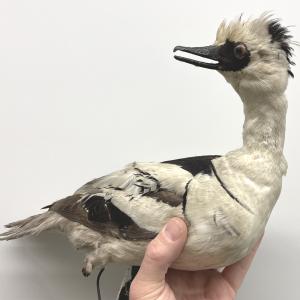
This was presumably an immature bird, or one in non-breeding plumage (i.e., lacking the eye-line) because Peale wrote, in "A Walk Through the Philad[elphi]a Museum" (1805–1806): "The largest [specimen] is something like the Razor-bill Auk (Alca Torda) but it has not the white line from the Bill to the Eye." (Historical Society of Pennsylvania, coll. 0481)
Specimen Type:
Dead/preserved
Current Common Name:
Razorbill
Current Scientific Name
Alcidae | Alca torda