Object Status:
Unlocated
Accession Date:
June 29, 1790
Primary Source Reference:
Pennsylvania Packet (Philadelphia), 29 June 1790
Additional Source Text:
In his Natural History Lecture No. 3 (1799), Academy of Natural Sciences of Drexel University, Peale wrote: "This Hyaena is more ferocious, than the species of Dog. . . . It is a native of Africa & the southern parts of Asia.
"I had this Animal alive for some months, and some curious circumstances relative to his disposition, are worthy of your notice. Whenever a Man approached his cage, he would snarl and growl in a frightful manner and seizing with his strong Jaws the Iron bars of his Cage, would make the whole tremble: yet if a Woman went alone to the Cage, the Animal was placid and mild, nor discovered the least disposition to bite. This fact can be testified by some hundreds of People who visited the Museum at the time.
"A Girl living in the family, wishing to make trial of this singular fact, dressed herself in a Man’s hat and great coat, and thus disguised, went to the cage. The Animal immediately started up, and raised his bristly back, but in an instant, as if sensible of his mistake, became mild and pleasant.
"Other females in the family would even put their hands into the Cage and stroke his head. "Being an eye witness to frequent trials of this kind, I endeavoured, by feeding him, and practicing the most gentle usage, to ingratiate myself into his favour, hoping that by these means I might in time effect a change in his disposition toward me; conceiving that the chief cause of his hatred to our sex was the frequent abuse he suffered from Gentlemen thrusting their Canes and sticks into his Cage, in order to torment him. But all my endeavours were fruitless, and I cannot say that he became in any considerable degree more attached to me than to those who treated him otherwise; since he would still continue to bite at my hand when I gave him food.
"Notwithstanding, however singular this fact, I cannot help being of opinion, that the ferocity in most animals is commonly no more than an effect of the principle of self-preservation implanted in their Natures, and expressed more or less forcibly in proportion to the Means of defense which they use, in order to intimidate us, for their own safety; yet let them only be convinced that you will do them no harm, and they will in general soon become gentle. It is nevertheless true, that his Natural fear of Man, is, in some Animals much more difficult to overcome, than in others.
"And perhaps it is possible even to tame this ferocious Hyaena, by beginning with him very young, and never using him with severity, for I discovered that he was a very timid Animal. A live mouse being tied by the legs and put into his Cage, terrified him almost to death! And altho’ this Animal is generally believed to be one of the most untameable of Animals, yet through fear, he never attacks Man in the woods, let him be ever so hungry.
"Is it not visible, that Parrots only bite thro’ a Motive of fear? How many other Animals may we call to our remembrance who are also offensive only through fear? – I believe if we examine a number of Animals, it will easily be found that fear, or in other words, self-defense, constitutes more or less of what we term ferocity.
"I ought to have mentioned that the Hyaena sometimes comes into the town at the Cape of Good Hope prowling after prey in the dead of the night – and they frequently violate the repositories of the dead, and greedily devour putrid bodies."
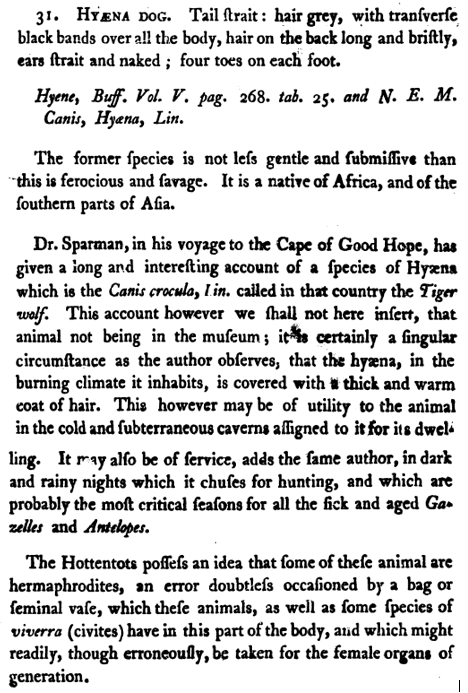
This animal was also described in A Scientific and Descriptive Catalogue of Peale's Museum (Philadelphia, 1796), pp. 26-27 (image attached).
Also listed in Herald of Freedom (Boston), 13 July 1790
Notes:
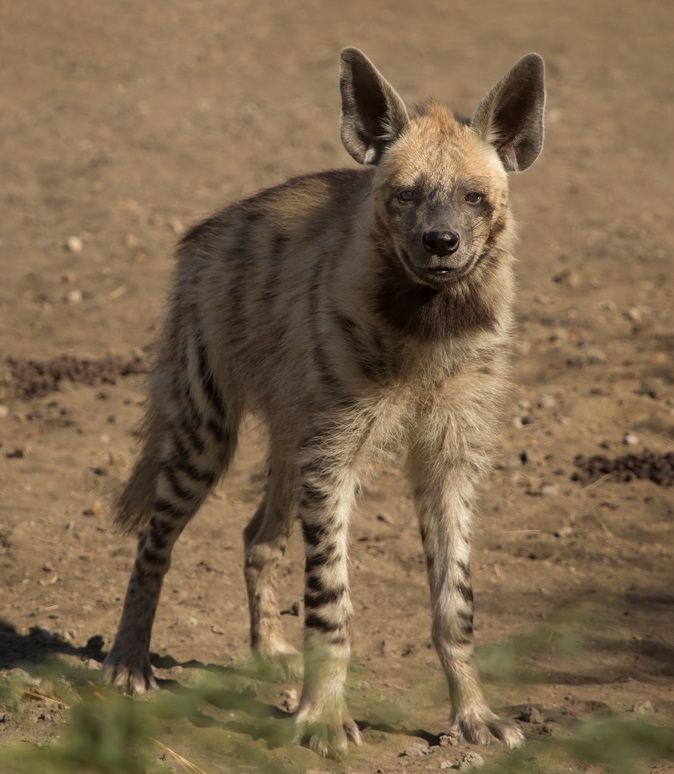
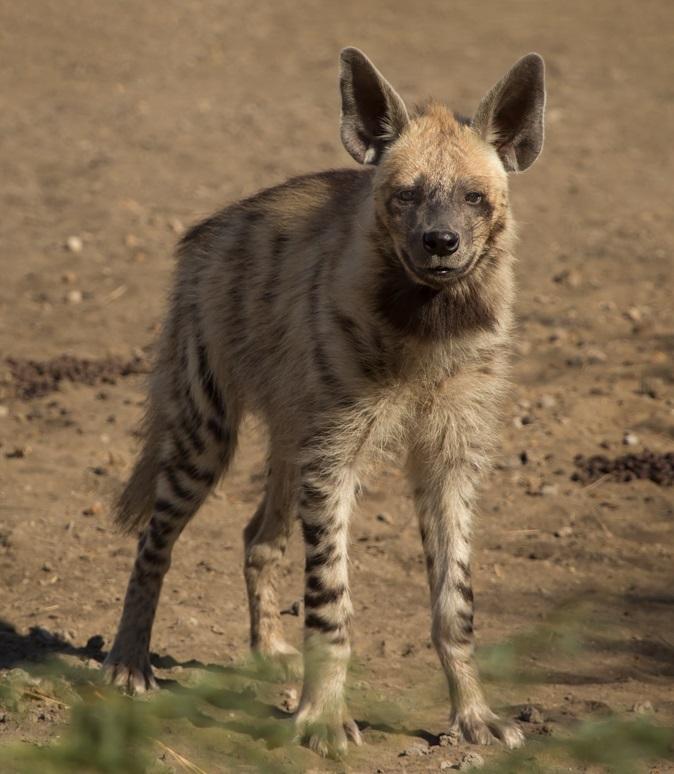
Probably the striped hyena (Hyaena hyaena).
Specimen Type:
Live (presumably eventually taxidermied/preserved)
Peale's Common Name:
Hyaena
Current Common Name:
Striped hyena
Current Scientific Name
Hyaena hyaena