Object Status:
Extant
Accession Date:
By 1803
Primary Source Reference:
Charles Willson Peale, Lecture on Natural History 35. (ca. 1799). Academy of Natural Sciences of Drexel University Archives, coll. 40. / https://ansp.org/research/library/archives/0000-0099/coll0040/
Additional Source Text:
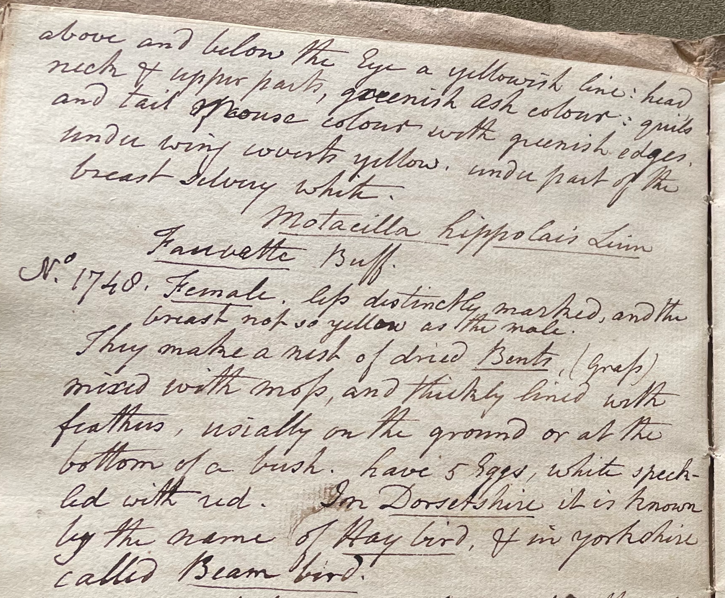
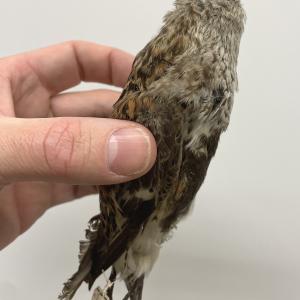
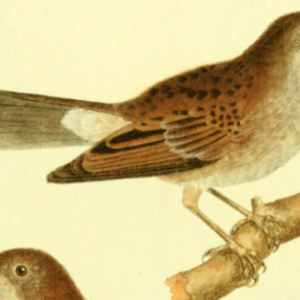
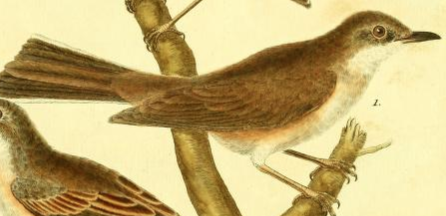
Charles Willson Peale (1741-1827) wrote, in his 35th Lecture (ca. 1799): "No. 1747. Petty-chaps Warbler. In size rather smaller than a Linnet. Bill short, the upper mandible black, the under bluish; above and below the Eye a yellowish line; head, neck & upper parts, greenish ash colour; quils and tail mouse colour with greenish edges; under wing coverts yellow; under part of the breast silvery white. Motacilla hippolais Linn. Fauvette Buff. [pl. enl. 579, f. 1.]" (Academy of Natural Sciences of Drexel University Archives, coll. 40)
Peale continued: "No. 1748. Female. less distinctly marked, and the breast not so yellow as the male. They make a nest of dried Bents (grass), mixed with moss, and thickly lined with feathers, usually on the ground or at the bottom of a bush. Have 5 Eggs, white speckled with red. In Dorsetshire it is known by the name Hay bird. & in Yorkshire called Beam bird." (ANSP Archives, coll. 40)
Rubens Peale (1784-1865) wrote to his father from London, on 1 June 1803: "I have got 2 new genera, which are Saxicola and Silvia … of the latter one … Silvia Hippolais. male & female" (Miller 1988: 529, Selected Papers, Vol. 2, part 1, Yale University Press).
Peale wrote, in "A Walk Through the Philad[elphi]a Museum" (1805–1806): "Petty Chaps Warbler (M. hippolais) In Dorsetshire it is known by the name of Hay-bird, and in Yorkshire called Beambird."(Historical Society of Pennsylvania, coll. 0481)
Notes:
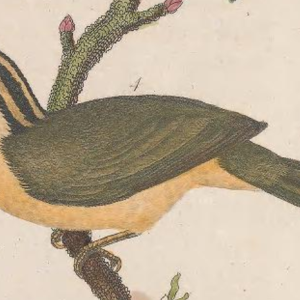
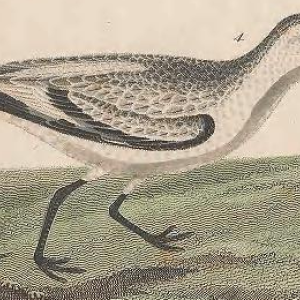
Peale's description of "Petty-chaps Warbler" likely refers to Chiff-Chaff Phylloscopus collybita (Vieillot, 1817). Peale described the morphologically-similar Willow Warbler Phylloscopus trochilus (Linnaeus, 1758) separately.
Specimen Type:
Dead/preserved
Current Common Name:
Common Chiffchaff
Current Scientific Name
Phylloscopidae | Phylloscopus collybita