Object Status:
Extant
Accession Date:
By 1799
Primary Source Reference:
Charles Willson Peale, Lecture on Natural History 15. (ca. 1799). Academy of Natural Sciences of Drexel University Archives, coll. 40. / https://ansp.org/research/library/archives/0000-0099/coll0040/
Additional Source Text:
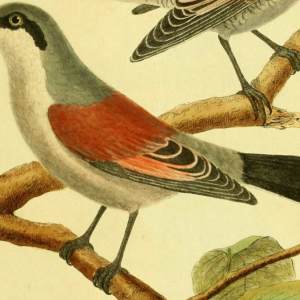
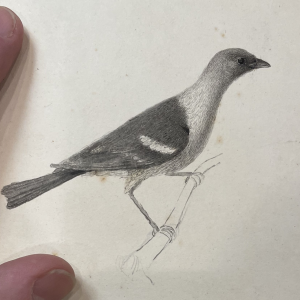
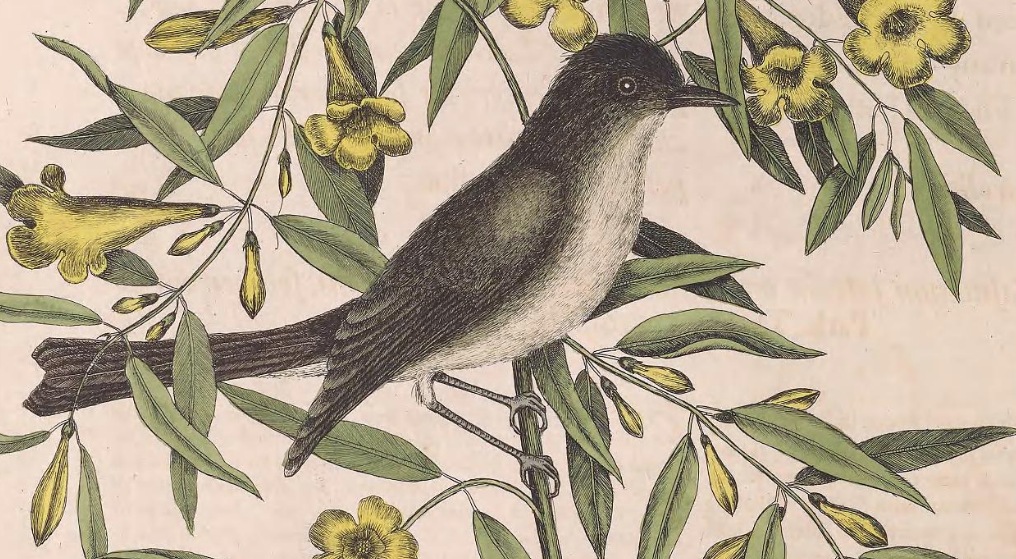
Charles Willson Peale (1741-1827) wrote, in his 15th Lecture (ca. 1799): "No. 102. Black Cap. About 6 inches long, Bill brown with the hook and notch at the end of the upper mandible, bristly at the base; crested black head; upper parts brown; the wing feathers bordered with lighter [colour]; tail dark, the 2 outermost edged lighter; Belly of yellowish & white, sides brown. Muscicapa fusca Linn. Black Cap flycatcher Catesby v. 1. T. 53 & Latham Synopsis II. 2. p. 353. No. 53. / No. 103. The female is a little less [in size], every part like the male except that the under bill is white at the base." (Academy of Natural Sciences of Drexel University Archives, coll. 40)
Peale continued: "This bird is remarkable for its boldness and activity in taking its prey. I have often been entertained in my excursions with my sons through the woods, seeing how little it regarded us. It was always known with us by the name of the [saucy] bird. I believe if Linnaeus had seen a well preserved bird, and known its manners, he would have placed it where I have done [i.e., among the shrikes]. However, I am not positive that I have done right [to] change the place of this bird, when several authors have described it among Muscicapa the fly-catchers, yet I am very sure its manners are strikingly different from most birds I have seen of that genus." This entire account was subsequently crossed out, with a note that reads: "Transferred to Muscicapa." (ANSP Archives, coll. 40)
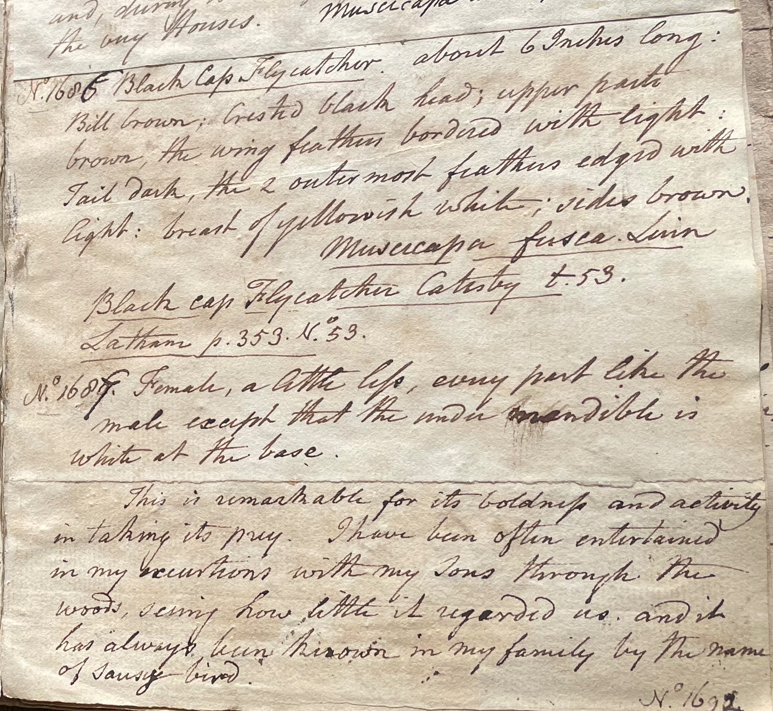
In his 35th Lecture, where he listed species in the genus Muscicapa, Peale gave a slightly different description: "No. 1686. Black Cap Flycatcher. about 6 Inches long. Bill brown; crested black head; upper parts brown; the wing feathers bordered with light; tail dark, the 2 outermost feathers edged with light; breast of yellowish white; sides brown. Muscicapa fusca Linn. Black Cap Flycatcher Catesby t. 53. Latham p. 353. No. 53. / No. 1689. Female, a little less, every part like the male except that the under mandible is white at the base. This is remarkable for its boldness and activity in taking its prey. I have been often entertained in my excursions with my sons through the woods, seeing how little it regarded us, and it has always been known in my family as sausy bird." (ANSP Archives, coll. 40)
Peale wrote, in "A Walk Through the Philad[elphi]a Museum" (1805–1806): "Black Cap flycatcher (Mus. fusca) is a bold bird, attacks Hawks, Eagles & Crows & actually will drive them from the fields were they resort." (Historical Society of Pennsylvania, coll. 0481)
Alexander Wilson (1766-1813) described this species under the name "Pewit Flycatcher / Muscicapa nunicola" in American Ornithology vol. 2 (Pl. 13), where "Peale's Museum No. 6618" was cited (Wilson 1810: 78). / https://www.biodiversitylibrary.org/item/175511#page/90/mode/1up (text) / https://www.biodiversitylibrary.org/item/175511#page/77/mode/1up (plate)
An unmounted male specimen of "Muscicapa (Pewit)" was listed in "A Catalogue of Duplicate Specimens...", May 1822. [unpublished] American Philosophical Society Library (Mss.B.P31).
Notes:
The English name “Black-cap Flycatcher” appears to have originated with Latham (1783, General Synopsis of Birds vol. 2, part 1: 353). The English naturalist, John Latham (1740-1837), was a friend of Peale, who occasionally deposited specimens and books in Peale's collection.
Specimen Type:
Dead/preserved
Current Common Name:
Eastern Phoebe
Current Scientific Name
Tyrannidae | Sayornis phoebe