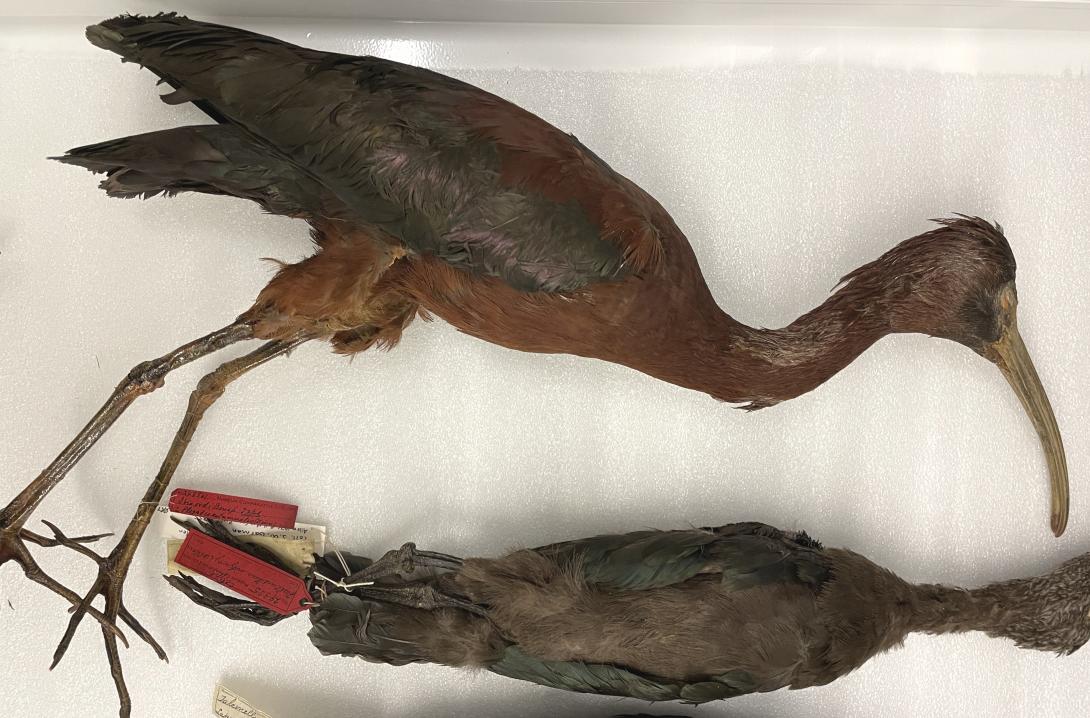
Object Status:
Unlocated
Accession Date:
8 May 1817
Primary Source Reference:
Peale Museum Accessions Book, 8 May 1817. Historical Society of Pennsylvania, coll. 0481, p. 84
Additional Source Text:
The Accessions Book entry reads: "shot at Egg harbor, supposed to be a male bird."
George Ord (1817, J. Acad. Nat. Sci. 1: 53) wrote: “On the 7th May, of the present year, Mr. Thomas Say received from Mr. Oram, of Great Egg-Harbour, a fine specimen of Tantalus, which had been shot there.” Ord (1817: 57) noted that “the sex of this specimen could not be ascertained, as its intestines had been removed before it was forwarded to Philadelphia, and the sexual parts were obliterated.”
Charles Lucien Bonaparte (1803–1857) deposited a specimen of "Ibis falcinellus" on 10 October 1827, as recorded in the Peale Museum Accessions Book. (Historical Society of Pennsylvania, coll. 0481)
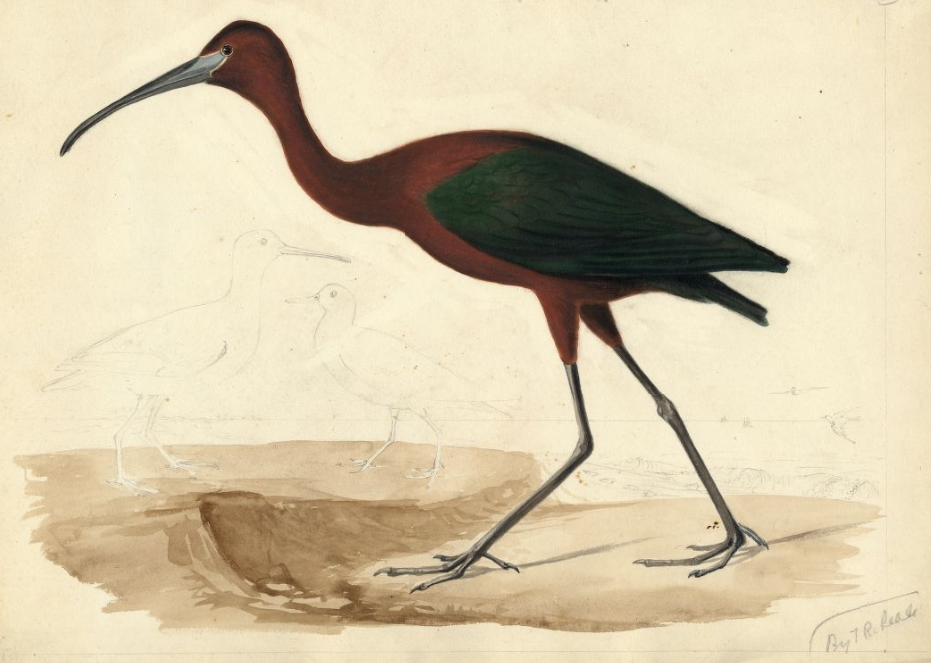
Bonaparte (1833) described this species under the name "Glossy Ibis / Ibis falcinellus" in his continuation of American Ornithology vol. 4 (1833, Pl. 23), where Ord's (1817) paper and "Philadelphia Museum" (no number given) were cited (Bonaparte 1833: 23-24). A colored drawing by Titian R. Peale (1779-1885), presumably of Bonaparte's fresher specimen (i.e., not the damaged one described by Ord), was engraved by Alexander Lawson (ca.1772-1846) for Plate 23 of Bonaparte's work. / https://search.library.wisc.edu/digital/AFKPEJIASN54OC8L/pages/AC6U5BWQ…
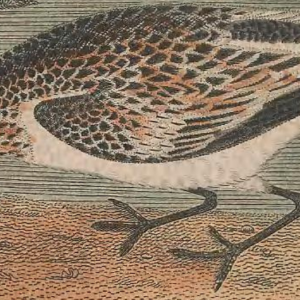
Two of Titian's preparatory drawings for Plate 23 are preserved in the American Philosophical Society Library (Mss.B.P31.15d). In the older of the two (shown here), the sandpipers are uncolored and there is no background. / https://diglib.amphilsoc.org/islandora/object/three-birds%3A-1-glossy-i… / Whereas, all three birds are colored and the background fully rendered in the finished drawing, which was presumably the image engraved by Lawson. / https://diglib.amphilsoc.org/islandora/object/three-birds%3A-1-glossy-i…
Bonaparte (1833: 25) wrote: “The credit of having added this beautiful species to the Fauna of the United States is due to Mr. [George] Ord, the well known friend and biographer of Wilson, who several years ago gave a good history and minute description of it in the Journal of the Academy of Philadelphia, under the name Tantalus mexicanus? His excellent memoir would have been sufficient to establish its identity with the species found so extensively in the old world, even if the specimen itself, carefully preserved in the Philadelphia Museum, did not place this beyond the possibility of doubt.” / https://search.library.wisc.edu/digital/AFKPEJIASN54OC8L/full/AFH63I4YT…
Bonaparte (1833: 40) also stated that “the specimen Mr. Ord described, and which produced a strong sensation even among experienced gunners and the oldest inhabitants as a novelty, was shot on the seventh of May, 1817, at Great Egg Harbour.” / https://search.library.wisc.edu/digital/AFKPEJIASN54OC8L/full/AFH63I4YT…
Notes:
After Peale's Museum closed, a portion of Peale's bird collection was purchased in 1850 by Moses Kimball (1809–95), who displayed it at his "Boston Museum". An advertisement in the Boston Transcript, printed 1 October 1850, stated that Kimball had acquired "One Half of the celebrated Peale's Philadelphia Museum". The other half of Peale's birds had been sold to the circus promoter P. T. Barnum (1810–91) and would be subsequently destroyed in a fire at his "American Museum" in New York City in July 1865. When the Boston Museum closed, Kimball's Peale remnants passed temporarily to the Boston Society of Natural History, who disposed of them to Charles J. Maynard (1845-1929), a local taxidermist. The specimens were stored in a barn in Massachusetts for several years, then eventually were deposited at the Museum of Comparative Zoology (MCZ), Harvard University. By the time the collection was catalogued by Walter Faxon (1848-1920) at MCZ, in 1914, in virtually every case the original mounts and labels had been disassociated from the specimens, and an untold number were lost. Walter Faxon, "Relics of Peale's Museum," Bulletin of the Museum of Comparative Zoology, 59, no. 3 (July 1915): 130, speculated that MCZ 248861 (shown here), a data-deficient specimen from the Boston Museum collection is, “without question the specimen described and figured in [Bonaparte 1833] as Ibis falcinellus, and afterward considered by Bonaparte to be a new species, Ibis ordi. Whether it is the same specimen as the one described at an earlier date by Ord, as Tantalus mexicanus?, is not clear from Bonaparte’s narrative.” Faxon also acknowledged that “There are two more examples of the Glossy Ibis in the Boston Museum collection.” Faxon seems to have been unaware of an "Ibis falcinellus" specimen deposited by Bonaparte on 10 October 1827 — the likely model for Plate 23 — which was not mentioned by Bonaparte (1833) or any other author, to my knowledge. This specimen (possibly MCZ 248861) was added to Peale's Museum after the death of Charles W. Peale, and thus falls beyond the scope of the "America's Earliest Museums" project. However, because of its importance to the history of the Glossy Ibis in the United States, we have provided these details.
Specimen Type:
Dead/preserved
Current Common Name:
Glossy Ibis
Current Scientific Name
Threskiornithidae | Plegadis falcinellus
Repository:
Museum of Comparative Zoology, Harvard University (MCZ 248861)