Object Status:
Extant
Accession Date:
By 1793
Primary Source Reference:
Charles Willson Peale, letter to Thomas Hall of Moorfields, London, dated 1793; Selected Papers, 2, part 1: 46.
Additional Source Text:
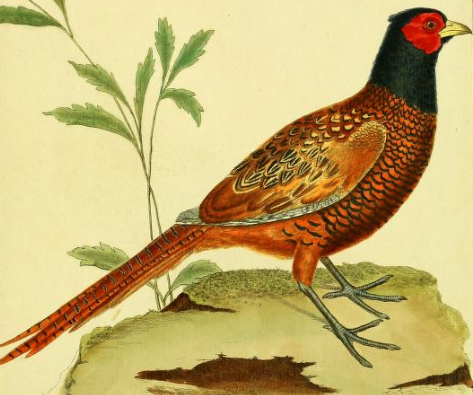
In early 1793, Charles Willson Peale (1741-1827) shipped specimens of "Cock Pheasants" to Thomas Hall in London, in exchange for European specimens (Miller 1988: 46, Selected Papers, Vol. 2, part 1, Yale University Press).
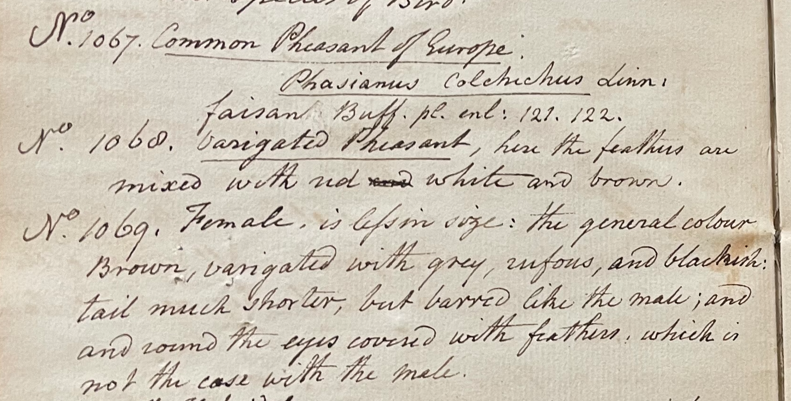
In his 29th Lecture (ca. 1799), Peale described several pheasants including hybrids and domestic varieties: "No. 1067. Common Pheasant of Europe. Phasianus colchichus Linn. Faisan Buff. pl. enl. 121. 122. No. 1068. Varigated Pheasant. Here the feathers are mixed with red, white and brown. No. 1069. Female, is less in size; the general colour brown, varigated with grey, rufous, and blackish; tail much shorter, but barred like the male; and round the eyes covered with feathers, which is not the case with the male … No. 1071. Ring Pheasant. This differs from No. 1067 in having a ring of pure white partly round its neck; the plumage is throught brighter in this species than the other, and the feathers on the lower part of the neck are more deeply indented, each feather appearing double at the ends." (Academy of Natural Sciences of Drexel University Archives, coll. 40)
Peale wrote to Samuel L. Mitchill on 26 July 1803: "We perfecty agree that we [the United States] have no pheasant but the Phasianus Gallus of Linneus" (Miller 1988: 587).
Peale wrote, in "A Walk Through the Philad[elphi]a Museum" (1805–1806): "The common Pheasant of Europe (P. Colchichus) is so Glossy, so bright the tints & blending into each other, as to baffle the Artist skill to make a tolerable immitation of it. We are told that when Croesus, king of Lydia, was seated on his throne, adorned with royal magnificence, and all the barbarous pomp of Eastern splendor, he asked Solon if he had ever beheld any thing so fine! The Greek Philosopher, no way moved by the objects before him, or taking a prided in his native simplicity, replied, that after having seen the beautiful plumage of the Pheasant, he could be estonished at no other finery." (Historical Society of Pennsylvania, coll. 0481).
Peale also mentioned that "The Ring Pheasant was received from the Oyee [Hawaiian] Islands", which predates the supposed introduction of that species in Hawaii by 60 years (see Caum, 1933, "The exotic birds of Hawaii", Occas. Pap. B. P. Bishop Mus. 10(9): 1–55).
An undated list of 21 bird specimens in Peale's handwriting includes a "Pheasant Male" and "D[itto] female" (American Philosophical Society Library, Mss.B.P31).
Specimen Type:
Dead/preserved
Current Common Name:
Common Pheasant
Current Scientific Name
Phasianidae | Phasianus colchicus