Object Status:
Extant
Accession Date:
By 1799
Primary Source Reference:
Charles Willson Peale, Lecture on Natural History 31. (ca. 1799). Academy of Natural Sciences of Drexel University Archives, coll. 40. / https://ansp.org/research/library/archives/0000-0099/coll0040/
Additional Source Text:
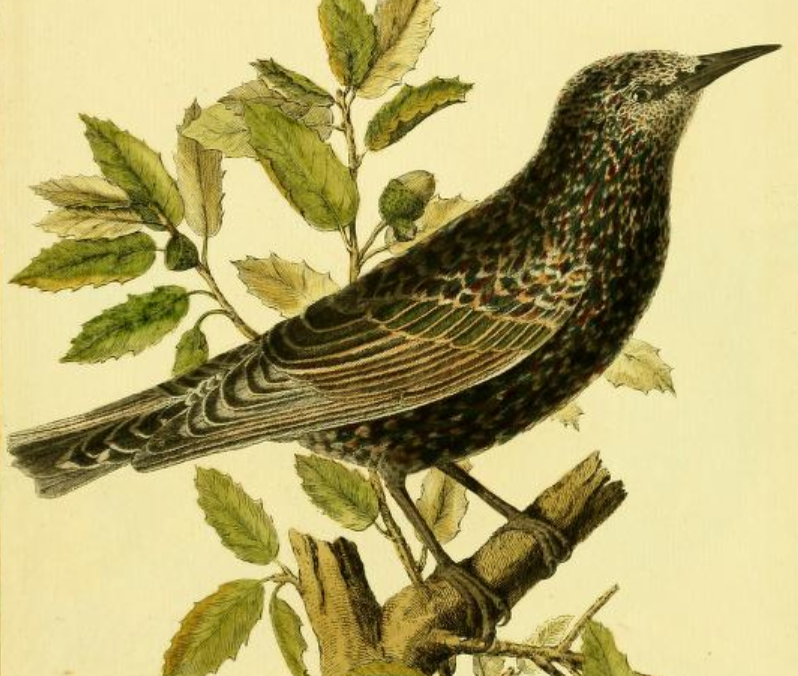
Charles Willson Peale (1741-1827) wrote, in his 31st Lecture (ca. 1799): "No. 1266. Starling. beak yellow, plumage black, reflecting green and purple, as they are opposed to different light; the form of the feathers in general, long and narrow, are tipped at the points with small spots of yellow on white. Sturnus vulgaris Linn. Etourneau Buff. pl. enl. 75. These birds feed on worms & other Insects; and it is said they will get into pigeon houses, for the sake of sucking eggs. Their flesh are so bitter, as to be scarce eatable." (Academy of Natural Sciences of Drexel University Archives, coll. 40)
Peale continued: "They breed in hollow trees, eaves of houses and cliffs of rocks. No. 1267. Female, the colours less brilliant than in the male; rather smaller, this bill is black, but light in the male, and it is said that the eyes is not so brown as in the other. They are fond of following oxen and other large cattle as they feed in meadows, attracted, it is said, by the Insects which flutter round them. In this and some other respects they resemble some of our black birds. Starlings are found in Sweden, Germany, France, Itally, the Isle of Malta, the cape of good-hope, and every where nearly the same. If there is any stares in America, it is not my lot to possess them in the Museum." (ANSP Archives, coll. 40)
Peale wrote, in "A Walk Through the Philad[elphi]a Museum" (1805–1806): "Starling (S. Vulgaris) inhabit Europe. They are in those countries, much like what our black birds are here, their habits agreeing in many respects." (Historical Society of Pennsylvania, coll. 0481)
An unmounted specimen of "Sturnus vulgaris (Starling)" from Europe was listed in "A Catalogue of Duplicate Specimens...", May 1822. [unpublished] American Philosophical Society Library (Mss.B.P31).
Specimen Type:
Dead/preserved
Current Common Name:
European Starling
Current Scientific Name
Sturnidae | Sturnus vulgaris