Object Status:
Extant
Accession Date:
By 1792
Primary Source Reference:
Charles Willson Peale, "My design in forming this Museum" broadside, dated 1792; Selected Papers, 2, part 1: 17.
Additional Source Text:
Charles Willson Peale (1741-1827), in a 1792 broadside: "I find [that glass cases are] the best mode to keep all the small birds. But the birds of the largest size, such as the ostrich, the cassawar [sic], the albatross, and some other very large birds, may, in the method which I must use for preserving large animals, be kept without glass covers, their strength and form being superior to slight injuries" (Miller 1988: 17, Selected Papers, Vol. 2, part 1, Yale University Press).
A notice in the New-York Gazette on 31 August 1795 announced Peale's acquisition of "An Ostrich of 10 months old, 6 ft. 2 in. high."
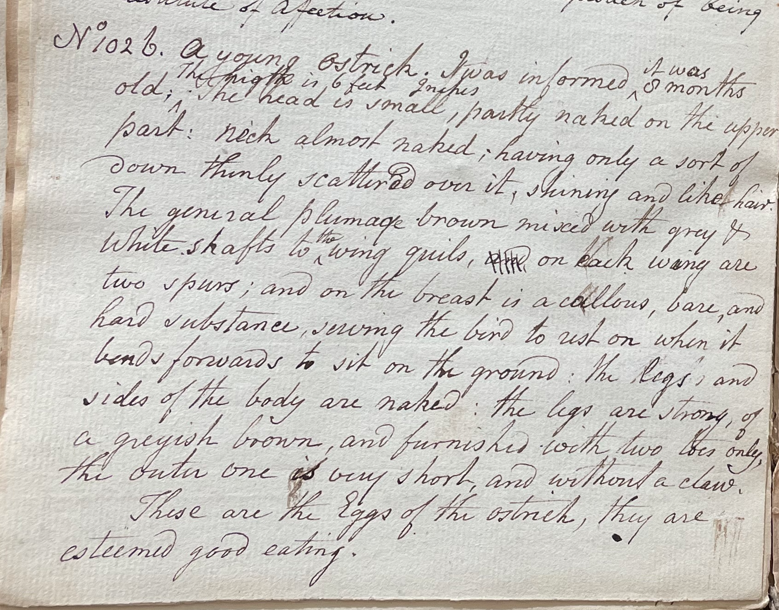
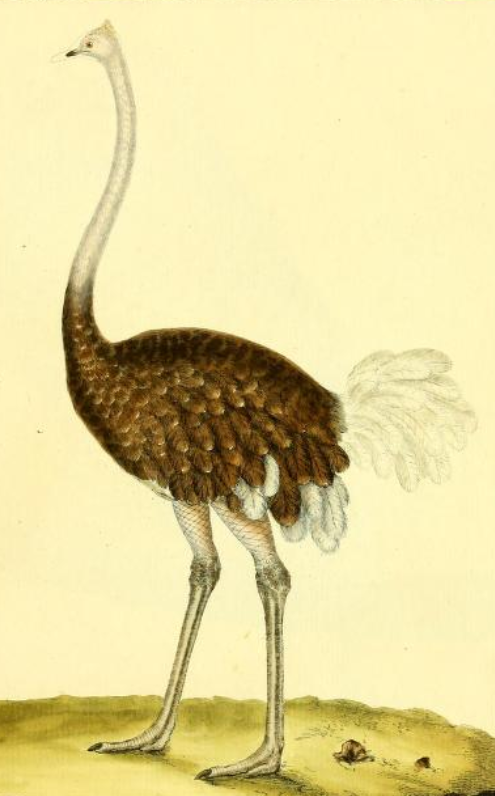
In his 27th Lecture, Peale wrote: "No. 1026. A young ostrich. I was informed it was 8 months old. The height is 6 feet [blank] Inches. The head is small, partly naked on the upper part; neck almost naked; having only a sort of down thinly scattered over it, shining and like hair. The general plumage brown mixed with grey & white shafts to the wing quils; on each wing are two spurs; and on the breast is a callous, bare, and hard substance, serving the bird to rest on when it bends forwards to sit on the ground; the legs, and sides of the body are naked; the legs are strong, of a greyish brown, and furnished with two toes only; the outer one is very short, and without a claw. These are the Eggs of the ostrich; they are esteemed good eating." (Academy of Natural Sciences of Drexel University Archives, coll. 40)
Peale wrote, in "A Walk Through the [Philadelphia] Museum" (1805–1806): "Black Ostrich (S. Camelus) this is from Africa, the feet having only two toes, is sufficient to distinguish it, where not its size considered, but it the largest of Birds." (Historical Society of Pennsylvania, coll. 0481)
Multiple donations of ostrich eggs were recorded in the Peale Museum Accessions Book (HSP, coll. 0481), including donations by Bellvue Soisson (21 May 1805), Thomas Hall (15 August 1806), Anthony Slater (29 July 1812) and G. Fairman, Jr. (30 September 1822).
Specimen Type:
Dead/preserved
Current Common Name:
African Ostrich
Current Scientific Name
Struthionidae | Struthio camelus