Object Status:
Extant
Accession Date:
29 March 1794
Primary Source Reference:
New-York Daily Gazette, 29 March 1794.
Additional Source Text:
On 29 March 1794, the following notice ran in the New-York Daily Gazette: "A bird was lately presented to Peale's Museum, at Philadelphia, which flew on board a vessel passing through the Gulph stream. It is thought to be the Porphyri-Americanus [sic], a very beautiful species of the Brazillian Moor-Hen; the very existence of which, has been doubted by several authors."
Charles Willson Peale (1741-1827) wrote, in his 27th Lecture (ca. 1799): "958. Purple Water-Hen. Thee birds are seldom seen so far northward on our coasts as the state of Virginia, & was thought a strange bird at Norfolk, where it was found & sent to me by a gentleman desiring to know its name. I had one alive before I received this, which was perfectly domesticated. It would take food from ones hand, yet much alarmed at any sudden noise." (Academy of Natural Sciences of Drexel University Archives, coll. 40)
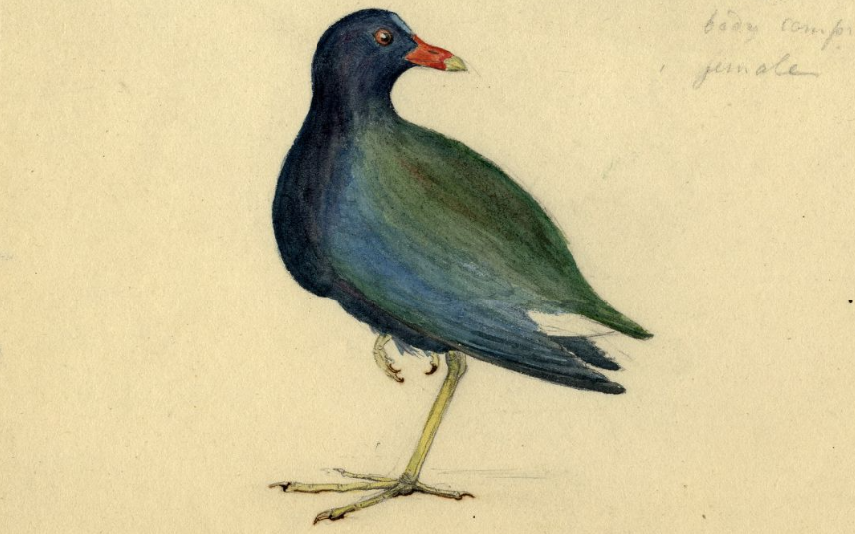
Peale continued: "The colours are much like the description of the Porphyrion of the Ancients, but I believe it is somewhat smaller, and it has the same habit of taking up food with its feet. We feed it with bread soaked in water, and were much pleased with our pet, as it shewed a confidence in us, besides it was a rare sight to our visitors, hence the loss of it was the greater. It was so unfortunate as to get within the reach of the red-nose-baboon, who destroyed it. The plumage is splendidly beautiful; a fine purple extends over the head, neck & breast, changing to blue & then green on the back; wings and tail dark green, beneath the tail white; red base of the bill, the tip yellow; iris red; feet flesh colour, toes very long. Fulica martinica Linn. Poule-Sultane Buff., who says it is a native of Guiana & resembles our Sultana hen so closely, that in the whole history of birds there are few examples of analogies so intimate between those of the two continents." (ANSP Archives, coll. 40)
On 28 March 1806, "A pool Sultan from the Bahama islands" (i.e., the "Poule-Sultane" of Buffon) donated by William Woodman was recorded in the Peale Museum Accessions Book (Historical Society of Pennsylvania, coll. 0481).
Alexander Wilson (1766-1813) described this species under the name "Purple Gallinule / Gallinula porphyrio" in American Ornithology vol. 9, published posthumously (Pl. 73), where "Peale's Museum, No. 4294" was cited. The editor, George Ord (1781–1866), wrote "The bird from which our drawing was taken, came from the state of Georgia, and is deposited in Peale's Museum … We were necessitated to take our description, and to color our figure, from the stuffed specimen in Peale's Museum, and it is possible that we may have been in error with respect to those parts." Ord also mentioned that "In Mr. Peale's collection there is a Gallinule which resembles the above in every respect, except its being considerably smaller" (Wilson 1814: 71). / https://www.biodiversitylibrary.org/item/175518#page/73/mode/1up (text) / https://www.biodiversitylibrary.org/item/175518#page/8/mode/1up (plate)
On 30 April 1828, a "Purple Galinule (Gallinula martinica) taken alive in the Gulf Stream" was deposited; and on 3 July 1828, there was an update recorded in the Peale Museum Accessions Book (HSP, coll. 0481): "The Purple Gallinule pres[ente]d by Captain Pelaske on the 30th of April last, escaped or was stolen from its cage this morning."
Specimen Type:
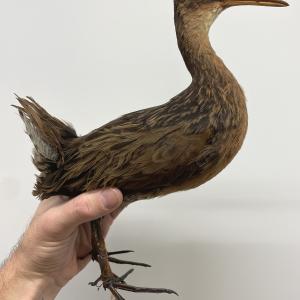
Live (later taxidermied)
Current Common Name:
American Purple Gallinule
Current Scientific Name
Rallidae | Porphyrio martinica