Object Status:
Extant
Accession Date:
By 1799
Primary Source Reference:
Charles Willson Peale, Lecture on Natural History 16. (ca. 1799). Academy of Natural Sciences of Drexel University Archives, coll. 40. / https://ansp.org/research/library/archives/0000-0099/coll0040/
Additional Source Text:
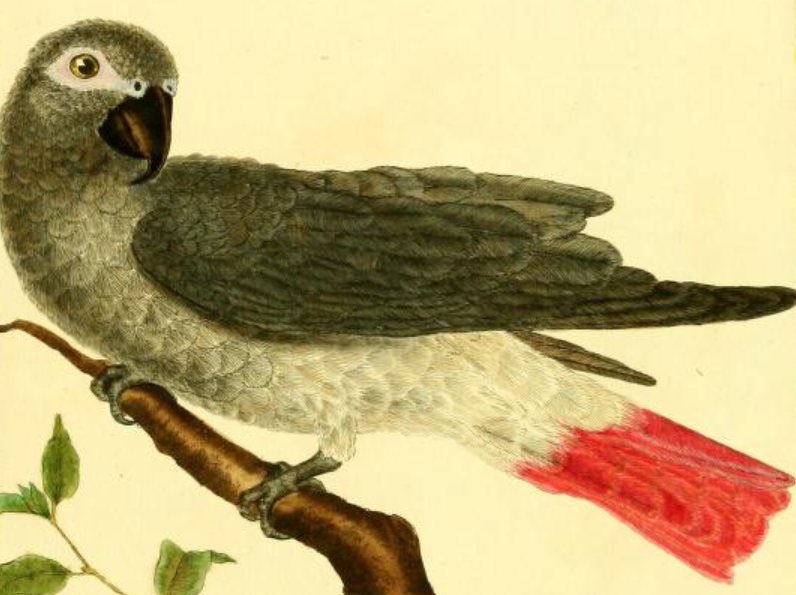
Charles Willson Peale (1741-1827) wrote, in his 16th Lecture (ca. 1799): "No. 135. Ash coloured Parrot. This species is generally preferred, as well on account of the mildness of its disposition, as its sagacity and docility; in which it at least equals the green Parrot, without the disagreeable cries. It seems to pronounce the word Jaco, and hence its usual appellation. All the body is of a fine pearl and slaty gray, which is deeper on the surface, lighter on the lower and inclined to white on the underparts of the body. The tail, which is virmilion [sic], terminates and heightens the plumage, which is glossed and powdered with a snowy colour, that gives it constantly a fresh appearance. The eye is placed in a white, naked, mealy skin, that covers the cheek; the bill is black; the feet grey, and the iris gold colour. The total length of the Bird is […] inches." (Academy of Natural Sciences of Drexel University Archives, coll. 40)
Peale continued: "Most of these Parrots are imported from the coast of Africa. They are very easily taught to speak, and seem fondest of imitating the voice of children, which are also the most successful in training them. But the cinerious or ash-coloured Parrot copies all the deep tones of the adult, though the effort is laborious, and the words are less distinct. One of these Guinea Parrots was so completely drilled by an old sailor, that it acquired axactly his hoarse voice and cough; and though it was afterwards given to a young person, and was in no other company, it never forgot the lessons of its first master; and it was diverting to observe its transitions from a soft gracious tone to its former hoarseness and course sea tones." (ANSP Archives, coll. 40)
Peale continued: "That sort of society which the Parrot forms with man, is, by means of language, more intimate and pleasing than what the monkey, from its gentle imitation of our gestures and actions, can claim. The useful and amiable qualities of the Dog, the Horse, or the Elephant, command our attention and esteem. The singular talents of the prattling Bird sometimes engages more powerfully our curiosity. It diverts and amuses; in solitude it is company; it takes part in conversation, it laughs, it breaths tender expressions, and mimics grave discourse; and its words uttered indiscriminately please by their incongruity, and sometimes excite surprise by their aptness." (ANSP Archives, coll. 40)
Peale continued: "This play of language, without meaning is uncommonly whimsical and though not more empty than that of Prattlers amongst us, it is always more amusing. The Parrot seems also to receive a tincture of our inclinations and manners; it loves, or it hates; it has particular attachments predilections, and caprices; it is the object of its own admiration and applause; it becomes joyous or sad; it is molted by caresses, and bills tenderly in return. In a house of mourning, it learns to moan; and often accustomed to repeat the dear name of a mistress whose loss is bewailed, it awakens, in feeling hearts, the memory of past joys. The power of imitating, exactly, articulate discourse, implies in the Parrot a peculiar and more perfect structure of organ; and the accuracy of its memory, though independent of the understanding, manifests a closeness of attention and a strength of mechanical recollection that no bird possesses in so high a degree." (ANSP Archives, coll. 40)
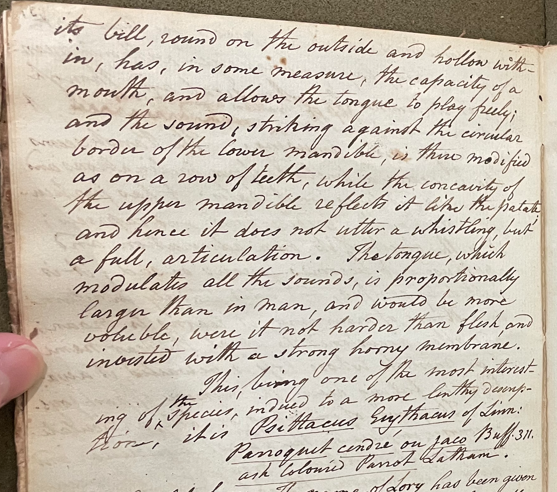
Peale continued: "Accordingly, all the naturalists have remarked the singular form of its bill, its tongue, and its head; its bill, round on the outside and hollow within, has, in some measure, the capacity of a mouth, and allows the tongue to play freely; and the sound, striking against the circular border of the lower mandible, is there modified as on a row of teeth, while the concavity of the upper mandible reflects it like the palate and hence it does not utter a whistling, but a full, articulation. The tongue, which modulates all the sounds, is propoertionally larger than in man, and would be more valuable, were it not harder than flesh, and incrusted with a strong horny membrane. This being one of the most interesting of the species, induced to a more lengthy description. It is Psittacus erythacus of Linn. Parroquet cendrê ou Jaco Buff. [pl. enl.] 311. Ash coloured Parrot Latham." (ANSP Archives, coll. 40)
Peale was briefer with his description in "A Walk Through the Philad[elphi]a Museum" (1805-1806): "We have often been surprised with the close immatations of the human voice by some Parrots, particularly of the large grey Parrot." (Historical Society of Pennsylvania, coll. 0481)
Specimen Type:
Dead/preserved
Current Common Name:
African Gray Parrot
Current Scientific Name
Psittacidae | Psittacus erithacus