Object Status:
Extant
Accession Date:
By 1793
Primary Source Reference:
Charles Willson Peale, letter to Thomas Hall of Moorfields, London, dated 1793; Selected Papers, 2, part 1: 46.
Additional Source Text:
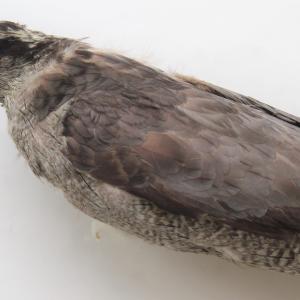
Charles Willson Peale (1741-1827) wrote "Black & white with red on the back part of the head, small wood pecker" on a manifest accompanying a batch of specimens, shipped to Thomas Hall in London in early 1793, in exchange for European specimens (Miller 1988: 46, Selected Papers, Vol. 2, part 1, Yale University Press).
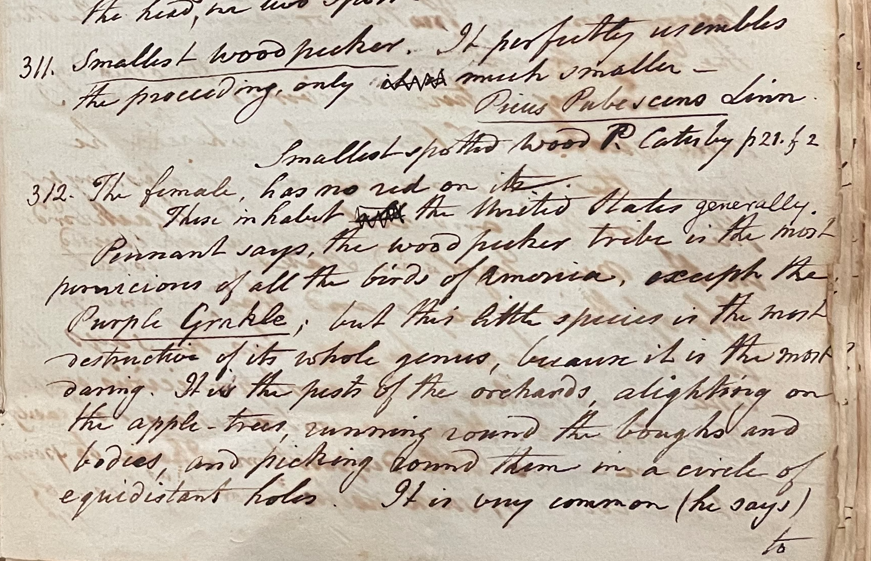
In his 19th Lecture, Peale wrote: "311. Smallest Woodpecker. It perfectly resembles the preceeding [i.e., Hairy Woodpecker, Leuconotopicus villosus], only much smaller. Picus pubescens Linn. Smallest spotted Wood P. Catesby p. 21. f. 2. 312. The female, has no red on it." Peale continued, paraphrasing from Thomas Pennant, 1785, Arctic Zoology, vol. 2 (London): "These inhabit the United States generally. Pennant says, the woodpecker tribe is the most pernicious of all the birds of America, except the Purple Grakle; but this little species is the most destructive of the whole genus, because it is the most daring. It is the pest of the orchards, alighting on the apple-trees, running round the boughs and bodies, and picking round them in a circle of equidistant holes. It is very common (he says) to see trees encircled with numbers of the these rings, at scarcely an Inch's distance from each other, so that the tree dies and perishes." (Academy of Natural Sciences of Drexel University Archives, coll. 40)
Peale continued: "I believe Mr. Pennant is totally mistaken in his Idea's of these birds doing injury to the extent he speaks of, to our fruit trees. I am fully satisfied that they eat those small Insects, which if left alone would totally destroy the fruit. Therefore it is my humble opinion they are more useful than pruning-hook. These take the living enemy from the orchard, and the other the dead limbs. In my lecture delivered on Saturday the other day I quoted Mr. Pennant, where he stated the bad consequences of destroying the grakle and red winged blackbird, in the New England States, which caused the total loss of their grass and Hay in 1749; and yet, in the passage before us, he says the little woodpecker is the most pernicious except the Grackle. These are contradictions not easily got over, so little disposition I have to point at the errors of such useful works as those of Mr. Pennant or Buffon, that I would willingly have passed them by, but that I know how often we are deceived in supposing that certain Animals are useless or a nuisance to us, what at the same time, were were to look a little further, we should then find, that such, are sent as so many blessings." (ANSP Archives, coll. 40)
Peale continued: "And may we not rather suppose that instead of woodpeckers distroying the fruit trees, by peking a few small holes in the outer bark, they rather take away the numerous vermin, which if left still to increase, would probably speedly sap all the Trees, and instead of our having such of choise [Pippons], we should not have a single Apple-tree left. Besides, do not the beautiful variegated plumage of the woodpecker delight the Eye when we pass along the road, or ramble through the forest? Are not their shrill note a fine contrast to the cooing of the Turtle Dove? And, I positively declare the rattle which they sometimes make on the roof of [the] Barn is infinitely more pleasing to my Ear than the Rubadub of the soldiers' Drum or the clangor of the Trumpets sound; the forerunners of [more…] Murder." (ANSP Archives, coll. 40)
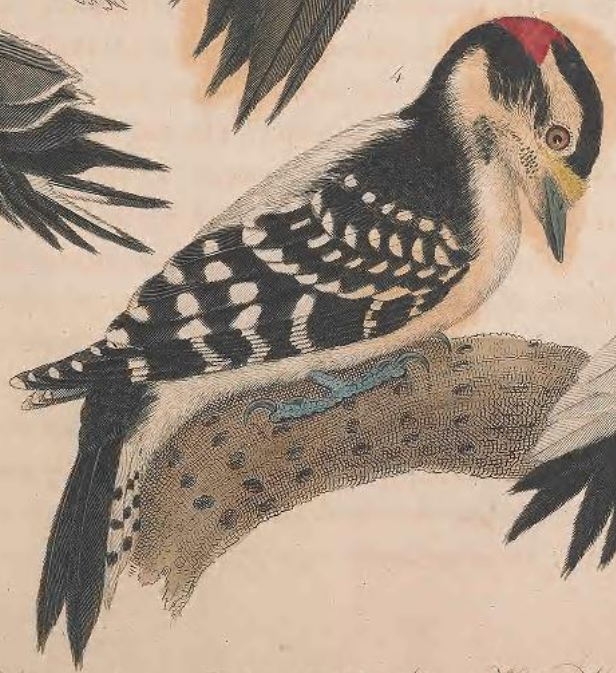
Alexander Wilson (1766-1813) described this species under the name "Downy Woodpecker / Picus pubescens" in American Ornithology vol. 1 (Pl. 9), where "Peale's Museum No. 1986" was cited (Wilson 1808: 153). / https://www.biodiversitylibrary.org/item/175530#page/183/mode/1up (text) / https://www.biodiversitylibrary.org/item/175530#page/171/mode/1up (plate)
An unmounted specimen of "Picus pubescens (Downy Wr)" from Florida was listed in "A Catalogue of Duplicate Specimens...", May 1822. [unpublished] American Philosophical Society Library (Mss.B.P31).
Specimen Type:
Dead/preserved
Current Common Name:
Downy Woodpecker
Current Scientific Name
Picidae | Dryobates pubescens