Object Status:
Extant
Accession Date:
29 June 1790
Primary Source Reference:
Pennsylvania Packet (Philadelphia), 29 June 1790.
Additional Source Text:
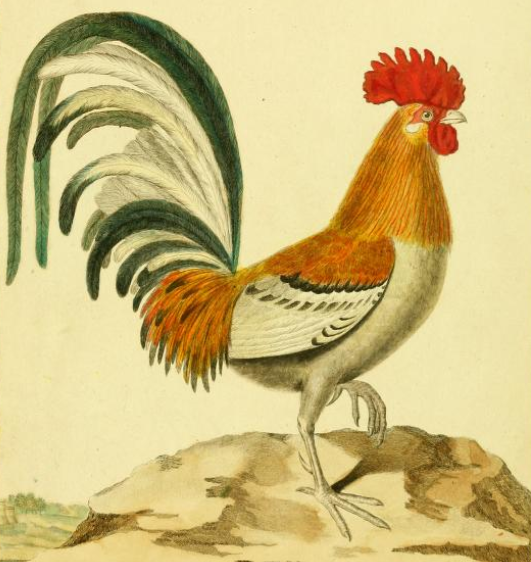
On 29 June 1790, the donation of "A Cock with a curious Crest; from Holland" by Thomas Mifflin was announced in the Pennsylvania Packet, published in Philadelphia.
Charles Willson Peale (1741-1827) wrote, in his 28th Lecture (ca. 1799): "The common poultry of our yards are so well known, that it might be supposed unnecessary to say any thing about them; however in our survey of the feathered tribe we should not neglect any, however common. The Dun-hill Cock is highly deserving our attention; were it a rare bird no doubt we would hasten to give something to see it. The form of several parts of him, his beauty in general, with […] character deserves our consideration. The dress of the Cock is composed of the most brilliant colours; his body is full and portly; his gait slow and grave, as it were, measured in each step; with an elevated neck he raises his head on high; his looks are keen and animated; he has a pround air, without being ferocious or threatning, it's a confidence in his strength and courage, knowing his worth, without disdaining others. Confident of his superiosity and the rights given him, he knows their importance and will maintain them, yet he is condescending to those whom he feels cannot inspire him. Altho' a despot & lover in a numerous court, he is an attentive husband & tender father. Hens and the chickens that follow them are his family which must obey him, and whom he governs with tenderness. Knowing their weakness and the strength of their sovern, consecrates the regards and attentions of a society, that place a reliance on him for protection and security. Desiring only what is necessary to support his strength, if he finds a delicate morsal, without taking any part of it, his chucks attract them and they run at the voice of the Master who calls; of the husband and father who invites, divides it amongst the mother and children—a happy family is heard to reply in low soft notes around him." (Academy of Natural Sciences of Drexel University Archives, coll. 40)
Peale continued: "He watches and keeps them together; he seeks those that stray and threatens them with his displeasure, but never treats them with severity. He protects them with all his powers; and he is enraged at intruders of his territory. His courage has become proverbial, and it is a pity it should ever be made use off, to gratify a wanton cruelty, the basest of passions, so disgracing to humanity as that of Cock fighting. However, it is a pleasing reflection that this ridiculous sport is declining in all parts of the civilized world; as people become polished and refined in their manners, such amuseuments decline. We now seldom hear of them, except amongst the lowest vulgar. The importance of this race of animals is fully demonstrated by their obtaining the care and attention of all nations, even the savages of our wilderness possess them. Their manners therefore being so generally known, it is needless to extend, and I shall only mention, that a hen well kept, will yield to the proprietor upwards of 200 eggs pr. year; hence how profitable to a good housewife." (ANSP Archives, coll. 40)
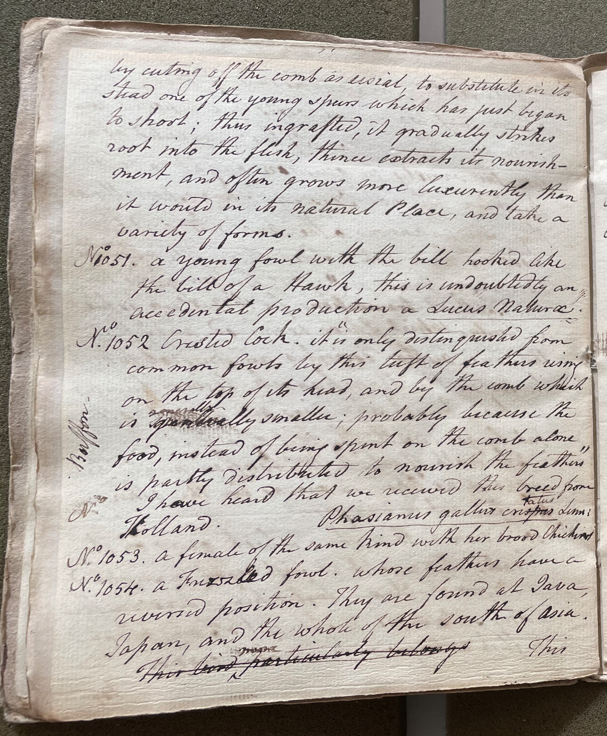
Peale continued: "No. 1049. A Dunghill Cock, with a compressed comb. Phasianus gallus Linn. The tail of these kinds of poultry, fold together and are very different perhaps from all other kinds of birds. We may remember seeing now and then, fowls without tails, which [I] had always considered an accidental effect, but I find a strange passage in Buffon, [where] he says: "Most of the Hens and Cocks in Virginia have no rump, and yet they are undoubtedly of the English breed. The Inhabitants of that colony affirm that when these birds are imported, they soon lose the rump. If this be admitted as a fact, the variety in question ought to be called Virginian, and not Persian cocks; especially as they were unknown to the ancients, and the moderns have not noticed them till after the discovery of America." Mr. Buffon refers us to the Philosophical Transactions for 1693. […] / No. 1050. A cock with a spur which grew on its head; this might at first sight be supposed a Lusus naturae [freak of nature], but when is known that bony substances freshly cut off, and planted in flesh will grow, the wonder ceases. By cutting off the comb as usial, to substitute in its stead one of the young spurs which has just began to short; thus ingrafted, it gradually strikes root into the flesh, thence extracts its nourishment, and often grows more luxurently than it would in its natural place, and take a variety of forms." (ANSP Archives, coll. 40)
Peale continued: "No. 1051. a young fowl with the bill hooked like the bill of a Hawk; this is undoubtedly an accidental production, a Luses naturae. / No. 1052. Crested Cock. It is only distinguished from common fowls by this tuft of feathers rising on the top of its head, and by the comb which is […] smaller; probably because the food, instead of being spent on the comb alone, is partly distributed to nourish the feathers. [A footnote mentions this information was sourced from Buffon.] No. [blank] I have heard that we received this breed from Holland. Phasianus gallus cristatus Linn. / No. 1053. a female of the same kind with her brood chicken. / No. 1054. A Frizzled fowl, whose feathers have a reversed position. They are found at Java, Japan, and the whole of the south of Asia. This bird belongs more peculiarly to the warm countries; for chickens of this breed are extremely sensible to cold, and can hardly support our climate. / No. 1055. This [is] only a variety of No. 1052. / No. 1056. A singular sport of Nature, a fowl born without a bill. I had her living a considerable length of time; she took up her food with more difficulty than those with bills. No. 1057. I could exhibit a number of other subjects of this nature, some with a redundancy of leggs, wings, heads &c., all of which may be dispenced with as subjects rather disagreeable than otherwise." (ANSP Archives, coll. 40)
Specimen Type:
Dead/preserved
Current Common Name:
Domesticated fowl
Current Scientific Name
Phasianidae | Gallus sp.