Object Status:
Extant
Accession Date:
26 May 1791
Primary Source Reference:
Dunlap's American Daily Advertiser (Philadelphia) and General Advertiser (Philadelphia), 26 May 1791.
Additional Source Text:
On 26 May 1791, the donation of "A pair of Partridges, from Spanish America" by William Hamilton was announced in Dunlap's American Daily Advertiser and the General Advertiser, both published in Philadelphia, which probably referred to this species. Announcements also ran in the Independent Gazetteer (Philadelphia) on 28 May 1791, Osborne's New-Hampshire Spy on 8 Jun 1791, and Maryland Gazette (Annapolis) on 9 June 1791.
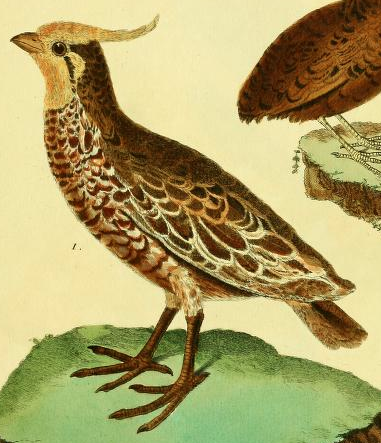
Charles Willson Peale (1741-1827) wrote, in his 30th Lecture (ca. 1799): "No. 1130. Crested Quail. They are larger than the European Quail. The bill is strong and dark brown; the crest consists of a few feathers which turn forwards. This crest, crown of the head, and throat is fulvus. The general plumage back is brown with fine penciled lines of black & stripes of white; the underparts fulvus, barred with black & spotted with white. No. 1131. Female, crested and much like the male except that the fulvus colour is much paler. Tetrao cristatus Linn. La Caille Huppée du Mexique Buff. pl. enl. 126. Crested Quail Latham No. 26. p. 784. I had these birds alive, but found that they were not able to bear the least cold." (Academy of Natural Sciences of Drexel University Archives, coll. 40)
Peale wrote, in "A Walk Through the Philad[elphi]a Museum" (1805–1806): "The Crested quail (T. Cristatus) these come from South America. very little difference between the male and female, the latter rather lighter colours." (Historical Society of Pennsylvania, coll. 0481)
An undated list of 21 bird specimens in Peale's handwriting includes an unidentified "Quail F[emale]" (American Philosophical Society Library, Mss.B.P31).
Specimen Type:
Live (later taxidermied)
Current Common Name:
Crested Quail
Current Scientific Name
Phasianidae | Colinus cristatus