Object Status:
Unlocated
Accession Date:
January 17, 1817
Primary Source Reference:
Poulson's American Daily Advertiser (Philadelphia), 17 Jan 1817
Additional Source Text:
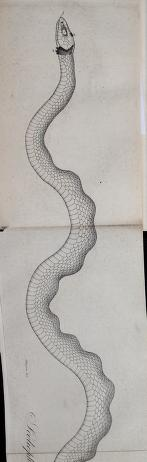
"To be seen until the 24th inst. in Peale's Museum, State House, the celebrated Young Sea Serpent, which was taken on the 27th of September last, near Loblolly Cove, Gloucester, New England, where the great Sea Serpent has frequented. Which was submitted by Capt. Beach, jun., to the inspection of the Linnaean Society of New England, and by them named Scoliophis Atlanticus, and in all probability the young one of the monster that infested that coast. R. Peale has made arrangements with the proprietor to exhibit it for one week only in the Museum, where the citizens may have an opportunity of being gratified. Admittance as usual 25 cents. jan 16."
The Accessions Book, p. 91 (27 Jan 1818) recorded the acquisition of a large painting by J. R. Penniman "of the Harbor of Gloucester representing the Large Sea Serpent as he appeared on the 14 of august 1817 in presence of some of the most inteligent inhabitants of the town."
Notes:
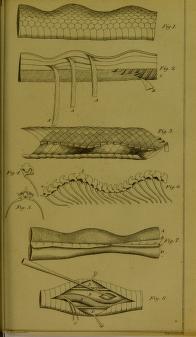
"From 1817 to 1819, a mass of people, including fishermen, military personnel and pedestrians, reported seeing a sea monster at least 80 but perhaps 100 feet long, with a head resembling a horse, in the harbor off Gloucester, Massachusetts. There were so many eyewitness reports that the Linnaean Society of New England formed a special investigating committee to examine the possibility of such a creature. In October 1817, two young boys found a 3-foot-long serpent body with humps on a beach not far from where the sightings had occurred. The Linnaean Society declared that the Gloucester sea serpent had visited the harbor to lay eggs, and that the specimen the boys had found represented one of its young. They invented an entirely new genus and named it Scoliophis atlanticus (“Atlantic Humped Snake”). Shortly thereafter, naturalist Alexandre Lesueur examined the specimen and reported that it was, in fact, a deformed common blacksnake (Coluber constrictor)." (Grace Costantino, "Five 'Real' Sea Monsters Brought to Life by Early Naturalists," 27 Oct 2014 / https://www.smithsonianmag.com/science-nature/five-real-sea-monsters-br…
See Report of a committee of the Linnaean Society of New England, relative to a large marine animal, supposed to be a serpent, seen near Cape Ann, Massachusetts, in August 1817 (Boston, 1817); Chandos Michael Brown, "A Natural History of the Gloucester Sea Serpent: Knowledge, Power, and the Culture of Science in Antebellum America," American Quarterly, 42, no. 3 (Sep 1990): 402-436.
Specimen Type:
Dead/preserved