Object Status:
Unlocated
Accession Date:
September 3, 1814
Primary Source Reference:
Peale Museum Accessions Book, Historical Society of Pennsylvania, p. 73
Notes:
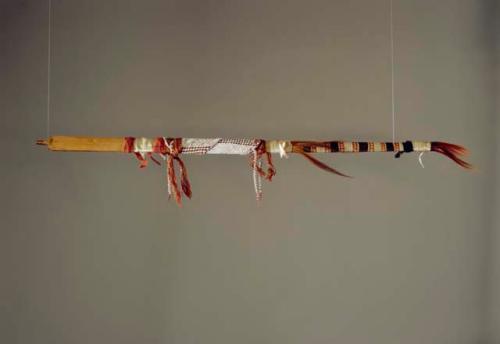
The Peabody Museum of Archaeology and Ethnography, Harvard University, acquired many cultural items in 1899 from Moses Kimball's Boston Museum. Kimball and P. T. Barnum jointly purchased many of the Peale collections when they were sold about 1849. This donation cannot be positively identified with a particular extant pipe, or calumet, but it may have resembled the pipe at the Peabody pictured here. See Castle McLaughlin, The Arts of Diplomacy: Lewis and Clark's Indian Collection (Seattle, 2003), pp. 200-249.
In his "Walk through the Philad[elphi]a Museum" (1805-1806), pp. 27-28, Peale wrote: "These quills variously dyed, are used by the aborigenes of America to ornament their dresses &c. and although short, are more dangerous than the long ones of the crested Porcupine, for they are barbed whereas the points of the others are smooth." Peale wrote of porcupine quills: "These quills variously dyed, are used by the aborigenes of America to ornament their dresses &c. and although short, are more dangerous than the long ones of the crested Porcupine, for they are barbed whereas the points of the others are smooth."
The donor, Baltus Raser (b. 1749) lived in Germantown, Pa. On this date he also donated an otter bag and a quilled belt.
John D. Godman, in his American Natural History. Part I. Mastology, 3 vols. (Philadelphia, 1826-1828), 2: 153-154, describes one of the methods Native Americans used to ornament their clothing, based on the large collection of such items in the Peale Museum / https://www.biodiversitylibrary.org/page/49165857