Object Status:
Unlocated
Accession Date:
March 1777
Primary Source Reference:
Du Simitière Memorandum Books, Library of Congress, fol. 19r
Notes:
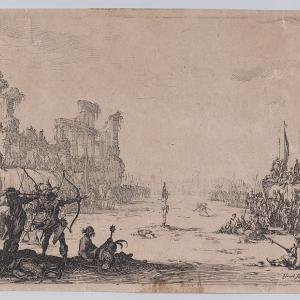
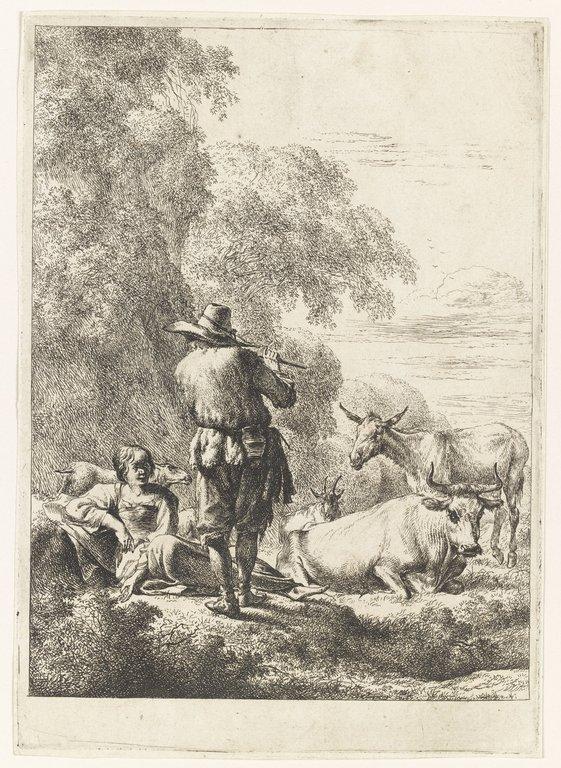
No such print after Philip James de Loutherbourg (1740-1812) has been located; there is a print in aqua fortis by Nicolaes Pietersz Berchem (ca. 1620-1683) depicting a shepherd playing the flute, pictured here, that is now in the Louvre.
The process of engraving with aqua fortis (nitric acid) is described in John Shepard, The artist & tradesman's guide embracing some leading facts & principles of science, and a variety of matter adapted to the wants of the artist, mechanic, manufacturer, and mercantile community (Utica, N.Y., 1827), pp. 86-88.
The donor was Tadeusz Kosciuszko (1746-1817), a Polish-Lithuanian military engineer, statesman, and military leader who became a national hero in Poland, Lithuania, Belarus, and the United States. In 1776, Kosciuszko moved to North America, where he took part in the American Revolution as a colonel in the Continental Army. An accomplished military architect, he designed and oversaw the construction of state-of-the-art fortifications, including those at West Point, New York. In 1783, in recognition of his services, the Continental Congress promoted him to brigadier general.