
Object Status:
Unlocated
Accession Date:
September 1779
Primary Source Reference:
Du Simitière Memorandum Books, Library of Congress, fol. 45v
Notes:
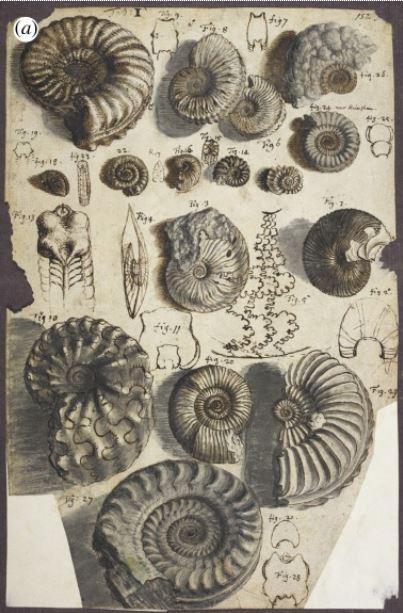
Ammonites, or Cornua ammonis (horns of Ammon), called snake stones, or serpent stones, are fossils of an extinct group of cephalopods of the subclass Ammonoidea. Pictured here are drawings of fossils by Robert Hooke and Richard Waller that were the basis of the engravings in Hooke's Posthumous Works (1705).
The donor, Charles Logan (1754-1794), was the son of William Logan and grandson of James Logan. He owned a plantation in Virginia and in 1788, after promising to manumit nine of his slaves in Pennsylvania, took them there and sold them. See George William Van Cleve, A Slaveholders' Union: Slavery, Politics, and the Constitution in the Early American Republic (Chicago, 2010), p. 82.
Du Simitière's Scientific Name:
Cornua ammonia
Current Common Name:
Snake stone
Current Scientific Name
Cornu Ammonis