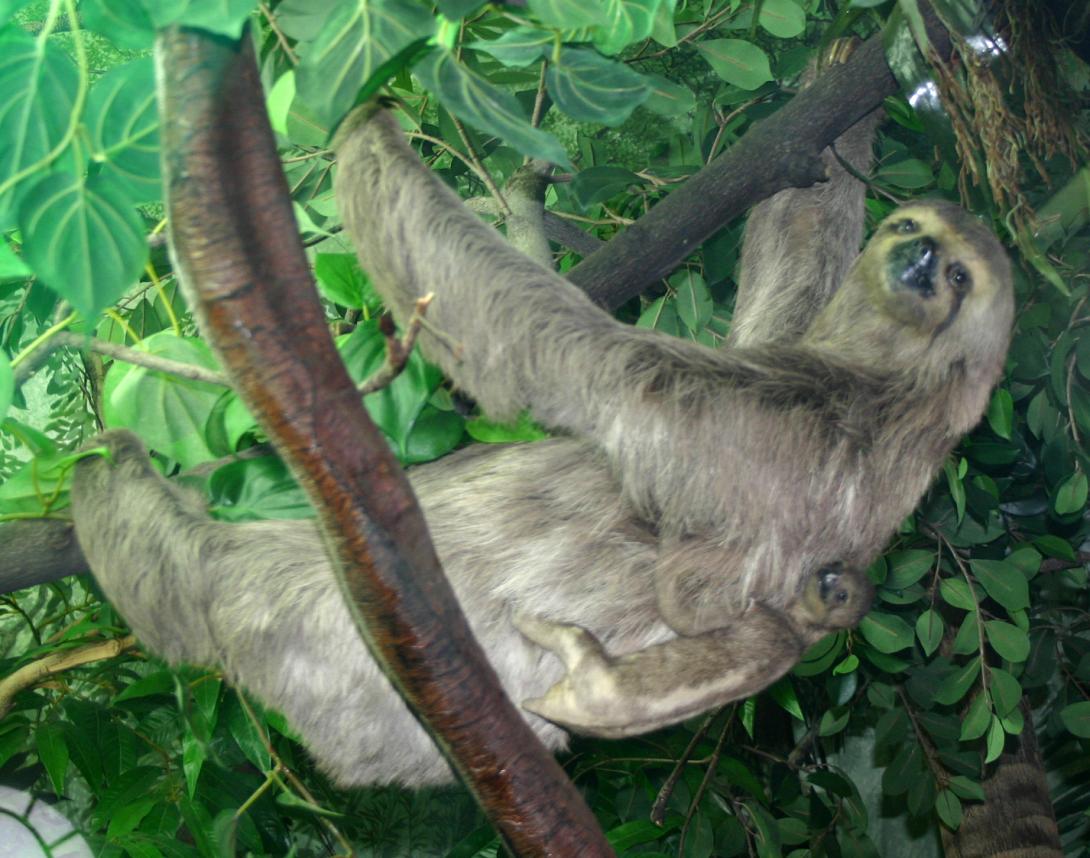
Object Status:
Unlocated
Accession Date:
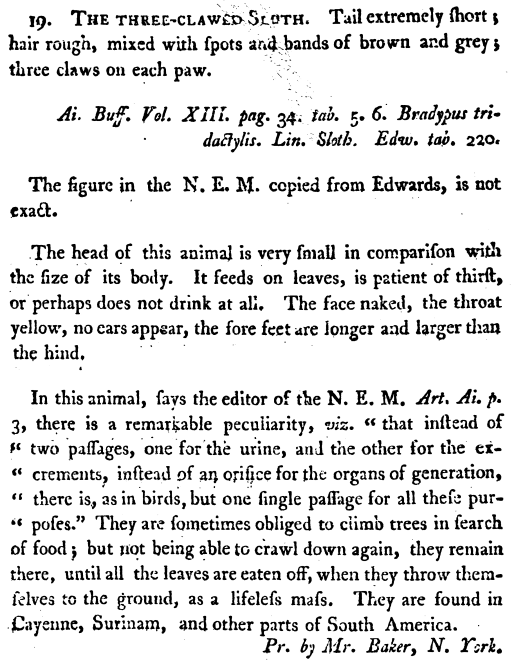
By 1796
Primary Source Reference:
A Scientific and Descriptive Catalogue of Peale's Museum (Philadelphia, 1796), p. 17
Additional Source Text:
In his Natural History Lecture No. 2 (Academy of Natural Sciences of Drexel University), Peale wrote: "Now I shall describe the Manners of an Animal which I have seen alive, it is properly called the Sloth, for when it attempted to crawl, it began with stretching forward one limb at a time, and so slow that it was many minutes getting that forward and turning its claws down; then it began with another limb in the same slow motion, and at last when it had got its legs moved, it began to drag forward its body, seemingly with pain, & uttering an [illegible] plaintive cry. They cannot endure cold or rain; the change from wet to dry spoils their fur, which resembles badly dressed [illegible], rather than wool or hair. It feeds on fruit & Leaves of trees, with difficulty climbs up, & crawls from branch to branch and, by degrees, strips the whole tree of its foliage. In this manner it remains several weeks without moistening its dry food with any liquid; and, when it has consumed its store, and the tree is entirely naked, yet unable to descend, it continues on till hunger presses, and becoming more powerful than fear of danger or death it drops, a heavy mass, to the ground, without being capable of exerting any effort to break the violence of the fall. It is an Inhabitant of South America, is the Bradypus Tridactylus of Linnaeus. It has three Toes or rather long nails – There is one other species which has only two toes on each foot, which is a native of Ceylon."
In his "Walk through the Phil[adelphi]a Museum" (1805-1806), Peale wrote: "Feeding on the leaves of trees, it is said they inhabit one untill they rob it of its foliage & then slowly creep to another, not without danger of suffering by the way. Instead of walking, they crawl & hang by their long claws to the branches; and to protect them from Wet as they hang, their coarse hair, contrary to other animals, grows from their belly towards their back. Altho’ apparently so inanimate, they are very affectionate to their young."
Notes:
Bradypus tridactylus is one of the four species of three-toed sloths. In A Scientific and Descriptive Catalogue of Peale's Museum (Philadelphia, 1796), Peale identified the donor of the three-clawed sloth as Mr. Brady of New York. And in the Accessions Book, an entry of 21 July 1813 records the donation of "A Female three-toed Sloath, (Tridactylus) from the interior Valantia in the province of Valanticea [Valencia?] S. America" from "Mr. Bello, of S. America" (p. 68).
Specimen Type:
Dead/preserved
Peale's Common Name:
Sloth
Peale's Scientific Name:
Bradypus tridactylus
Current Common Name:
Pale-throated sloth
Current Scientific Name
Bradypus tridactylus