Object Status:
Unlocated
Accession Date:
By 1796
Primary Source Reference:
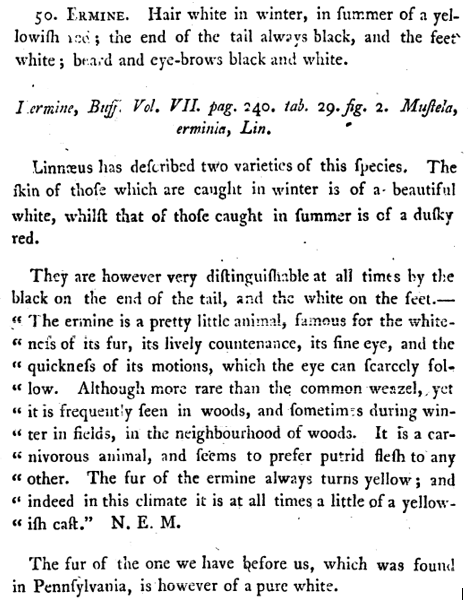
A Scientific and Descriptive Catalogue of Peale's Museum (Philadelphia, 1796), p. 40
Additional Source Text:
In his Natural History Lecture No. 5 (1799), Academy of Natural Sciences of Drexel University, Peale wrote of the ermine: "The Coat of this little Animal has been the pride of Kings and Nobles, who have thought themselves superlative fine in their Robes, when lined with the skins of this beautiful ermine. I believe few persons know that we possessed such an Animal.
"This I had living. It was found in the neighborhood of Philadelphia; less than 5 miles from the City. And although it really appears to be a rare Animal, I am well convinced that it is common amongst us, that the skins are often brought into our markets, but not of this colour, or rather this absence of Colour. (being entirely white except the tip of its tale.) In the summer season they are of a duskey red, the common colour of the Weasel, but the end of the tail continuing always black determines the Animal, so that instead of killing them in the summer, were our hunters to keep them until the Frosty weather sets in, they would see an entire change of the colour of the Animal and the Value of the skin greatly enhanced with the dealers in furs."
In his "Walk through the Phil[adelphi]a Museum" (1805-1806), p. 23, Peale wrote: "We distinguish the Ermine by its white coat and black tiped tail. This was found in the vicinity of Philada. Their fur, so fine a white in winter, becomes a redish brown in summer, yet they may easily be known in any season by the end of the tail. The coat of this little animal forms the lining of the robes of Kings and Princes."
Notes:
The Peale Museum had two specimens of Mustela erminea: the stoat (with a brown coat) and the ermine (a stoat in the species' winter white coat).
On 15 Aug 1806 Thomas Hall of London donated both a stoat and a "white ferret," or ermine. Peale Museum Accessions Book, Historical Society of Pennsylvania, p. 17
The Museum also received an ermine that had been sent back from the Lewis and Clark Expedition. Philadelphia Medical and Physical Journal, 2 (1806): 159-160
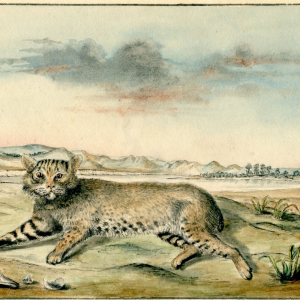
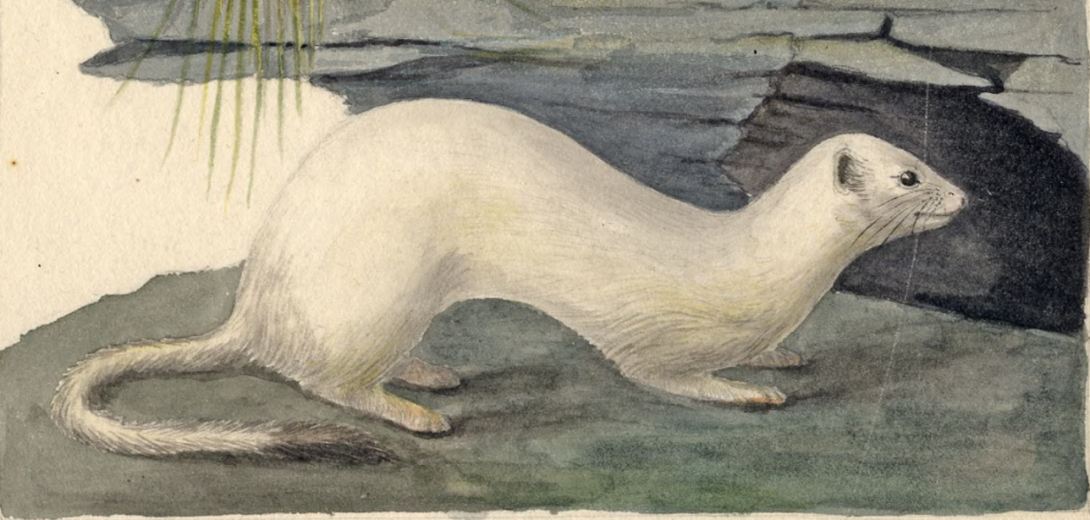
Titian Ramsay Peale executed a watercolor of the mink and the ermine when engaged on the Long Expedition in 1819-1820, a deatil of which is pictured here.
John D. Godman, American Natural History. Part I. Mastology, 3 vols. (Philadelphia, 1826-1828), 1: 193-200 described and illustrated the ermine, perhaps based on a specimen in the Museum / https://hdl.handle.net/2027/dul1.ark:/13960/t4wh6dv4h?urlappend=%3Bseq=….
Richard Harlan dscribed the ermine in Fauna Americana: Being a Description of the Mammiferous Animals Inhabiting North America (Philadelphia, 1825), pp. 62-62, citing Museum No. 750 / https://www.biodiversitylibrary.org/page/3194399
A 2021 study split Mustela erminea into 3 species: M. erminea sensu stricto (Eurasia and northern North America), M. haidarum (several islands off the Pacific Northwest coast), and M. richardsonii (most of North America).
Specimen Type:
Live (presumably eventually taxidermied/preserved)
Peale's Common Name:
Ermine
Peale's Scientific Name:
L'ermine, Buff.; Mustela erminia, Lin.
Current Common Name:
Ermine
Current Scientific Name
Mustela erminea