Object Status:
Unlocated
Accession Date:
March 23, 1821
Primary Source Reference:
Peale Museum Accessions Book, Historical Society of Pennsylvania, p. 112
Additional Source Text:
"Zoological Specimen . . . prepared by Titian Peale, Assistant Naturalist, for the Exploring Expedition, and deposited in the Philadelphia Museum by Major S. H. Long. Maj. U.S. Eng[ineers pursuant to instructions of the Secretary of War."
Notes:
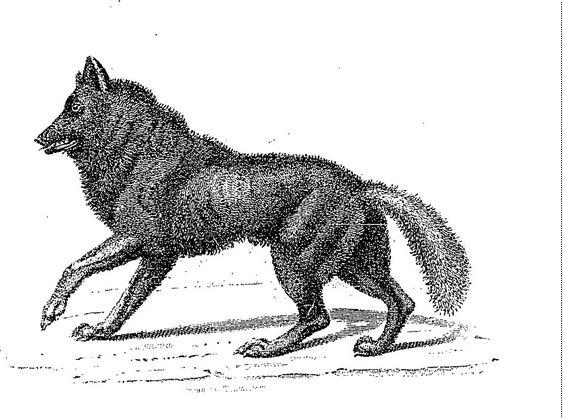
John D. Godman (1794-1830) described and illustrated the black wolf, which Linnaeus named Canis lycaon and which is now thought to be a melanistic color variant of the gray wolf (Canis lupus), in his American Natural History, Part I -- Mastology, vol. 1 (Philadelphia, 1826), p. 267 / https://archive.org/details/americannatural02godmgoog/page/n302/mode/2up. His illustration was likely based on this specimen in the Peale Museum. Godman quoted from Thomas Say's description as published in Edwin James, Account of an Expedition from Pittsburgh to the Rocky Mountains, Performed in the Years 1819 and '20, by Order of the Hon. J.C. Calhoun, Sec'y of War: Under the Command of Major Stephen H. Long. From the Notes of Major Long, Mr. T. Say, and other Gentlemen of the Exploring Party, 2 vols. (Philadelphia, 1823), 1: 102 / https://hdl.handle.net/2027/chi.20044762?urlappend=%3Bseq=118
Except for red wolves (Canis rufus), all living North American wolves are now considered to be one of more than 30 recognized subspecies of Canis lupus.
Specimen Type:
Dead/preserved
Peale's Common Name:
Black wolf
Current Common Name:
Grey wolf
Current Scientific Name
Canis lupus