Object Status:
Unlocated
Accession Date:
By 1796
Primary Source Reference:
"Walk through the Phil[adelphi]a Museum" (1805-1806), p. 24
Additional Source Text:
"These little Animals are thought handsome, but are disagreeable pets, occasionally discharging a smell so offensive, as effectively to repel the attack of Dogs."
Notes:
"In the early 19th century, only a single species of skunk was recognized as inhabiting North America. This one species was variably identified as Viverra putorius Linnaeus, 1758; V. mephitis, or Mephitis americana Desmarest, 1820, each name broadly applied to encompass all North American skunks, although with the recognition that there were any number of varieties." Neal Woodman, Adam W Ferguson, "The relevance of a type locality: the case of Mephitis interrupta Rafinesque, 1820 (Carnivora: Mephitidae)," Journal of Mammalogy, 2021, gyab094 / https://doi.org/10.1093/jmammal/gyab094
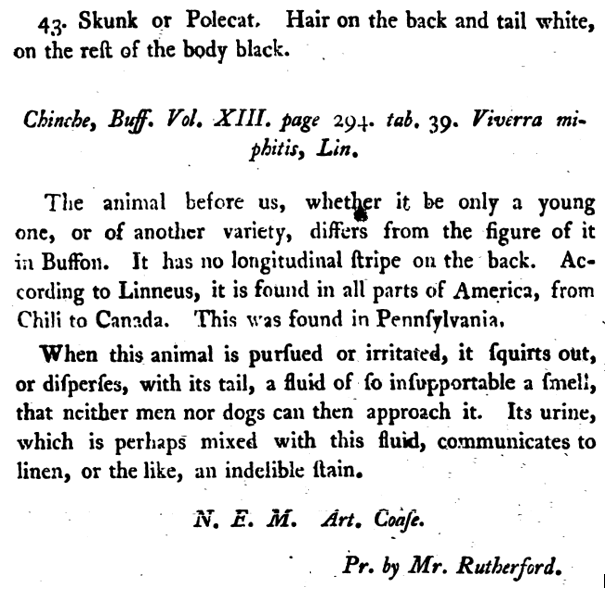
Peale's Museum had several specimens of skunk, or polecat. In the 1796 Scientific and Descriptive Catalogue, Peale listed both a "Skunk or Polecat (Chinche, Buff.; Viverra miphitis, Lin.)" and a "Skunk (Viverra nigra)" (pp. 36-37). Richard Harlan, in Fauna Americana: Being a Description of the Mammiferous Animals Inhabiting North America (Philadelphia, 1825), p. 70, identified the species as Mephitis americana, "the polecat of Kalm" (Voyage, p. 452), and the skunk of the Americans, and referred to "Several prepared specimens in the Philad. Museum, Nos. 65, 649, &c." / https://www.biodiversitylibrary.org/page/3194402
Peale also described the species in his fifth natural history lecture (1799), where he identified it as the "striated weasel of Pennant. These Animals are our Pole-cats, or what is often called the Skunk."
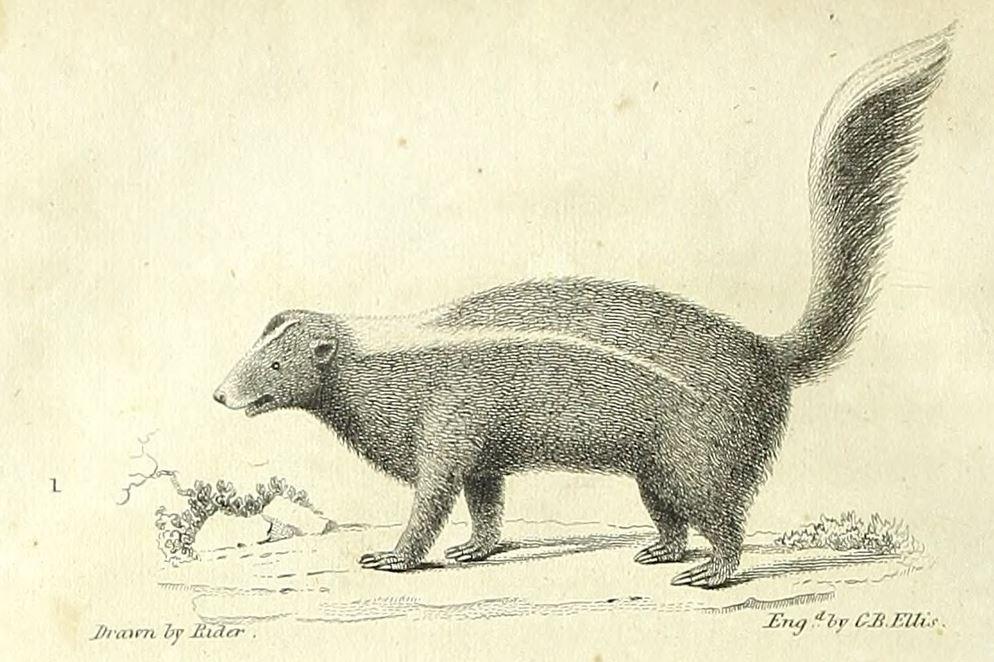
John D. Godman described and illustrated the skunk (which he called Mephitis Americana) based on the "several specimens" in the Museum in his American Natural History. Part I. Mastology, 3 vols. (Philadelphia, 1826-1828), 1: 211-219 and plate following p. 212 (detail pictured here). He wrote: "of several specimens in the Philadelphia Museum there is not one corresponding with the other in colour; neither have we ever seen two exactly alike. Sometimes they are of a uniform dark brown colour, having a white spot on the top of the head; sometimes they have two white stripes, commencing from a white patch on the back, while only the tip of the tail is pure white; again, other individuals are found with white and black rays on the back and sides, and the tail in great part white, as the skunk is representd in the ordinary figures."
Charles Willson Peale's account of trying to rid a cadaver of a polecat or skunk of its offensive smell in 1798 is in a letter to Thomas Jefferson of 2 Feb 1806 and in his Autobiography. Selected Papers, 2, part 2: 931; 5: 263.
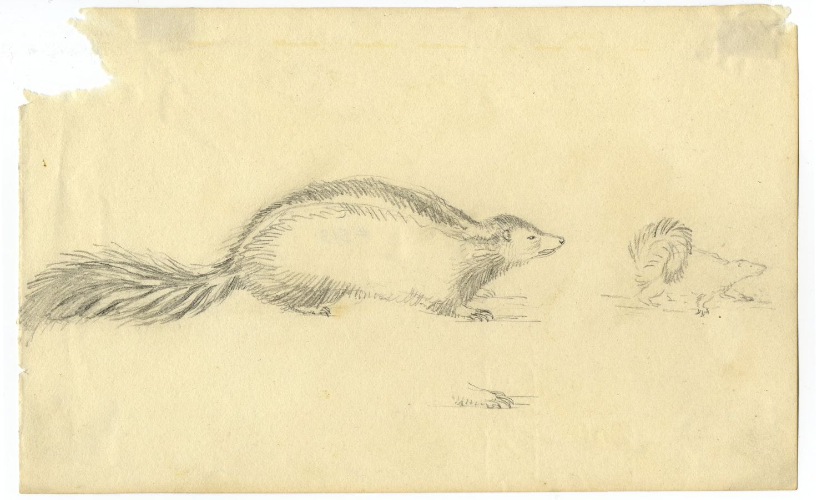
On 23 Mar 1821 the Museum received from Titian Ramsay Peale "1 Drawing of a Skunk (unfinished)" from the Long Expedition. Accessions Book, p. 112. Poulson's American Daily Advertiser (Philadelphia), 9 Jan 1822 included a polecat on a list of specimens "mostly obtained from high up the Missouri by Titian Peale" during the Long Expedition. His pencil sketch is pictured here.
In 1822 Richard Harlan contributed a skull of a polecat. Poulson's American Daily Advertiser (Philadelphia), 9 Jan 1822
Given the date of Harlan's donation, it is possible that the skull was from a specimen brought back from the Long Expedition by Titian Ramsay Peale and Thomas Say. The word polecat does not appear in the published Account of the expedition, but the expedition encountered the striped skunk, which Say named Mephitis putorius (now Mephitis mephitis). The Account reported that "The flesh of the skunk we had sometimes dressed for dinner, and found it a remarkably rich and delicate food." Edwin James, Account of an Expedition from Pittsburgh to the Rocky Mountains, Performed in the Years 1819 and '20: By Order of the Hon. J.C. Calhoun, Sec'y of War: Under the Command of Major Stephen H. Long, vol. 1 (Philadelphia, 1823), p. 180
Specimen Type:
Dead/preserved
Peale's Common Name:
Skunk
Peale's Scientific Name:
Putorius
Current Common Name:
Striped skunk
Current Scientific Name
Mephitis mephitis