Object Status:
Extant
Accession Date:
By 1799
Primary Source Reference:
Charles Willson Peale, Lecture on Natural History 35. (ca. 1799). Academy of Natural Sciences of Drexel University Archives, coll. 40. / https://ansp.org/research/library/archives/0000-0099/coll0040/
Additional Source Text:
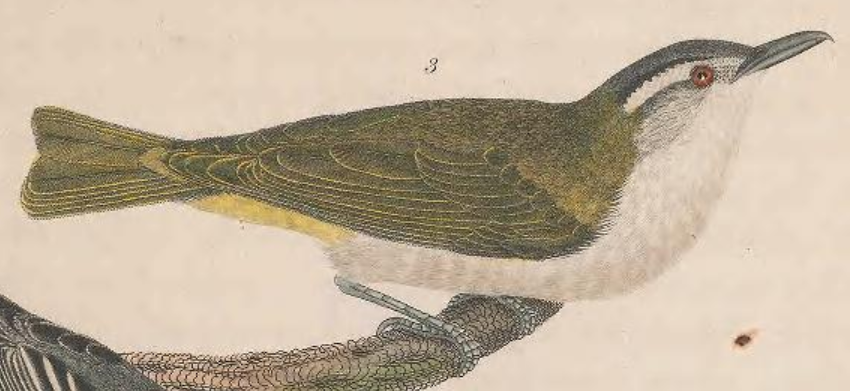
Charles Willson Peale (1741-1827) wrote, in his 35th Lecture (ca. 1799): "No. 1672. Red eyed Flycatcher. with red irides: the top of the head lead colour. back of the neck, back, wings and tail, olive green: the throat, breast, and under parts white, shaded on the sides with olive. Muscicapa olivacea Linn. Le Gobe-mouche olive de la Caroline Buff. Red eyed Flycatcher, Catesby, Pennant & Latham. No. 1673. Female. has the same colours, but less vivid. Common throughout the United States. In the thick forests they are heard uttering a mournfull note, when scarcely any other bird is seen or heard. They have also a song, which seems to assimilate with a bird like it, found at Jamaica, whose note they say, is, Whip Tom Kelly & such they have named it. They make a pendulous nest of curious and firm texture of moss &c." (Academy of Natural Sciences of Drexel University Archives, coll. 40)
Peale wrote, in "A Walk Through the Philad[elphi]a Museum" (1805–1806): "Red Eyed flycatcher (M. Olivacea) Many of this genus of Birds have great part of their plumage of an olive Colour, but only this one has red Eyes, therefore I have given it the name." (Historical Society of Pennsylvania, coll. 0481)
Alexander Wilson (1766-1813) described this species under the name "Red-eyed Flycatcher / Sylvia olivacea" in American Ornithology vol. 2 (Pl. 12), where "Peale's Museum No. 6675" was cited (Wilson 1810: 55). https://www.biodiversitylibrary.org/item/175511#page/65/mode/1up (text) / https://www.biodiversitylibrary.org/item/175511#page/57/mode/1up (plate)
A mounted specimen of "Muscicapa olivacea (Red eye'd Flycatcher)" was listed in "A Catalogue of Duplicate Specimens...", May 1822. [unpublished] American Philosophical Society Library (Mss.B.P31).
Specimen Type:
Dead/preserved
Current Common Name:
Red-eyed Vireo
Current Scientific Name
Vireonidae | Vireo olivaceus