Object Status:
Extant
Accession Date:
By 1799
Primary Source Reference:
Charles Willson Peale, Lecture on Natural History 15. (ca. 1799). Academy of Natural Sciences of Drexel University Archives, coll. 40. / https://ansp.org/research/library/archives/0000-0099/coll0040/
Additional Source Text:
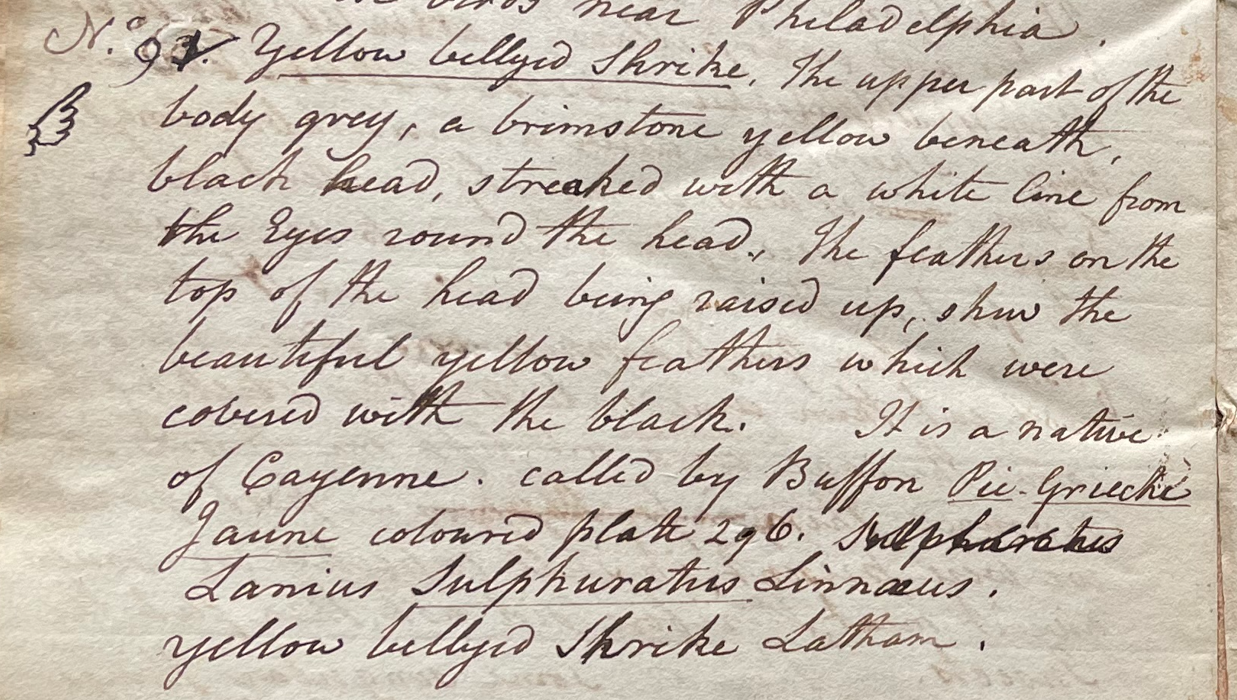
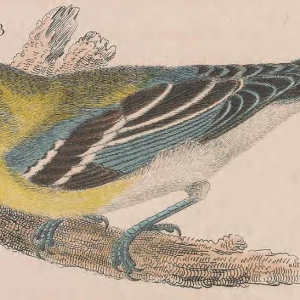
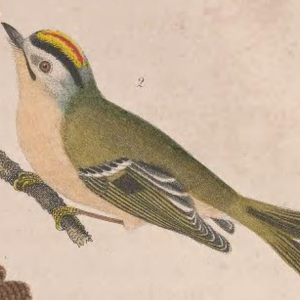
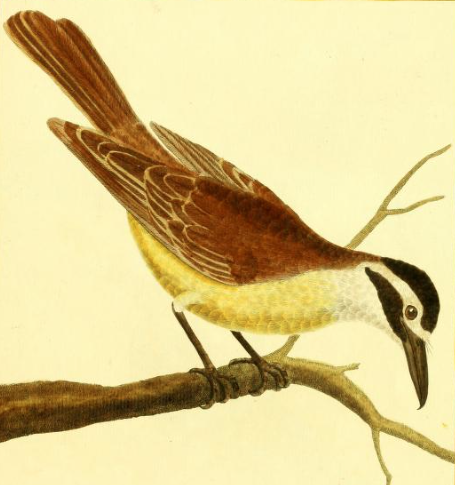
Charles Willson Peale (1741-1827) wrote, in his 15th Lecture (ca. 1799): "No. 94. Yellow bellyed Shrike. The upper part of the body gray, a brimstone yellow beneath, black head, streaked with a white line from the eyes round the head. The feathers on the top of the head being raised up, show the beautiful yellow feathers which were covered with the black. It is a native of Cayenne, called by Buffon Pie-Griêche Jaune, coloured plate 296. Lanius sulphuratus Linnaeus. Yellow bellyed Shrike Latham." (Academy of Natural Sciences of Drexel University Archives, coll. 40)
Notes:
Peale did not specify the origin of his specimen, but it seems likely to be Cayenne, French Guiana, a major South American trade center in the 18th century. In 1793, Raphaelle Peale (1774-1825) travelled to Cayenne to collect specimens for Peale's Museum. However, to the editor's (MRH) knowledge, there is no detailed inventory of the specimens he brought back, and there are many examples of specimens from northern South America that were donated by other people. For more discussion about Raphaelle's travels, see Lillian B. Miller, 1993, "Father and Son: The Relationship of Charles Willson Peale and Raphaelle Peale", The American Art Journal 25: 4-161. / https://doi.org/10.2307/1594599
Specimen Type:
Dead/preserved
Current Common Name:
Great Kiskadee
Current Scientific Name
Tyrannidae | Pitangus sulphuratus