Object Status:
Extant
Accession Date:
By 1799
Primary Source Reference:
Charles Willson Peale, Lecture on Natural History 20. (ca. 1799). Academy of Natural Sciences of Drexel University Archives, coll. 40. / https://ansp.org/research/library/archives/0000-0099/coll0040/
Additional Source Text:
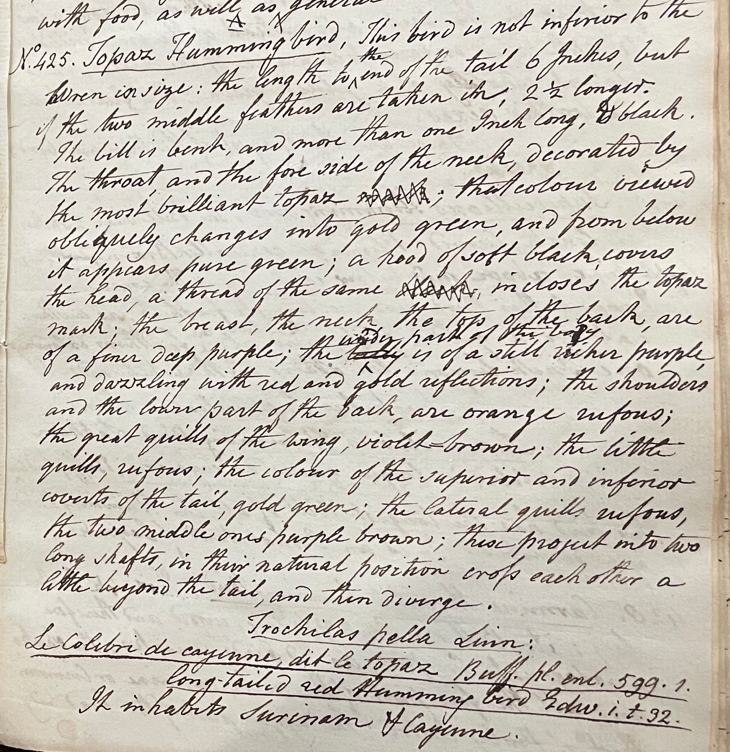
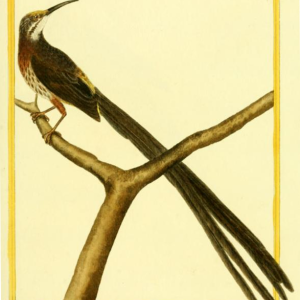
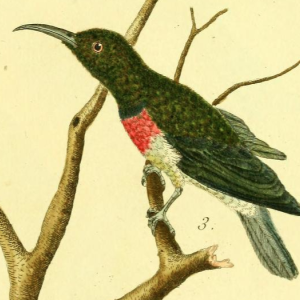
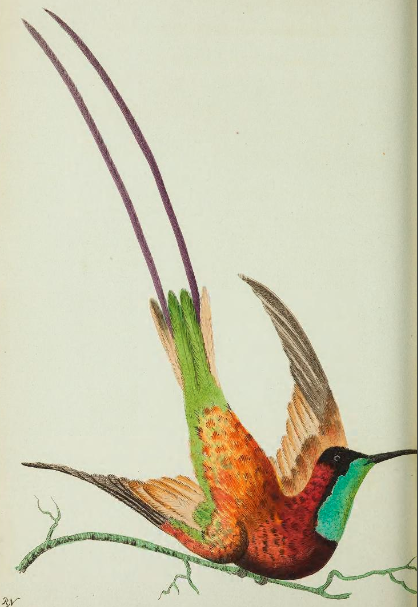
Charles Willson Peale (1741-1827) wrote, in his 20th Lecture (ca. 1799): "No. 425. Topaz Hummingbird. This bird is not inferior to the wren in size; the length to the end of the tail [is] 6 inches, but of the two middle feathers are taken in, 2 ½ [inches] longer. The bill is bent, and more than one inch long, & black. The throat, and the fore side of the neck, decorated by the most brilliant topaz; that colour viewed obliquely changes into gold green, and from below it appears pure green; a hood of soft black covers the heard, a thread of the same incloses [sic] the topaz mark; the breast, the neck, the top of the back, are of a finer deep purple; the upper part of the body is of a still richer purple, and dazzling with red and gold reflections; the shoulders and the lower part of the back, are orange rufous; the great quills of the wing, violet-brown; the little quills, rufous; the colour of the superior and inferior coverts of the tail, gold green; the lateral quill rufous, the two middle ones purple brown; these project into two long shafts, in their natural position cross each other a little beyond the tail, and then diverge." (Academy of Natural Sciences of Drexel University Archives, coll. 40)
Peale continued: "Trochilus pella Linn. Le Colibri de Cayenne, dit le Topaz. Buff. pl. enl. 599. 1. Long-tailed red Humming bird. Edw. i. t. 32. It inhabits Surinam & Cayenne. 426. Female of the proceeding; it is without the gilded topaz mark on the throat; without these 2 long feathers in the tail; and instead of the fine brilliant purple and rufous plumage of the male; it is almost wholly of a gilded green; the feet white in both sexes. These are the largest of the Humming birds." (ANSP Archives, coll. 40)
Peale wrote, in "A Walk Through the Philad[elphi]a Museum" (1805–1806): "The largest of the Colibri is the Topaz Hummingbird (Trochilus pella) it is remarkable by 2 long tail feathers as well as by its brilliant colours. It forms a strong contrast to the plain dress of the supercilious Hummingbird." (Historical Society of Pennsylvania, coll. 0481)
Notes:
Peale did not specify the origin of the specimen described in his lecture, but it seems likely to be Cayenne, French Guiana, a major South American trade center in the 18th century. In 1793, Raphaelle Peale (1774-1825) travelled to Cayenne to collect specimens for Peale's Museum. However, to the editor's (MRH) knowledge, there is no detailed inventory of the specimens he brought back, and there are many examples of specimens from northern South America that were donated by other people. For more discussion about Raphaelle's travels, see Lillian B. Miller, 1993, "Father and Son: The Relationship of Charles Willson Peale and Raphaelle Peale", The American Art Journal 25: 4-161. / https://doi.org/10.2307/1594599
Specimen Type:
Dead/preserved
Current Common Name:
Crimson Topaz
Current Scientific Name
Trochilidae | Topaza pella