Object Status:
Extant
Accession Date:
By 1799
Primary Source Reference:
Charles Willson Peale, Lecture on Natural History 26. (ca. 1799). Academy of Natural Sciences of Drexel University Archives, coll. 40. / https://ansp.org/research/library/archives/0000-0099/coll0040/
Additional Source Text:
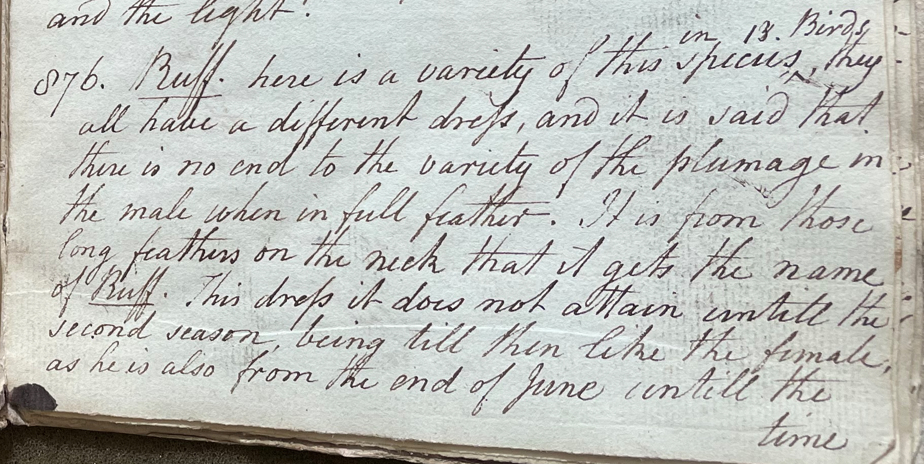
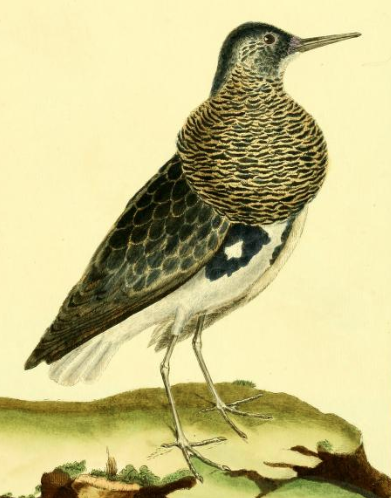
Charles Willson Peale (1741-1827) wrote, in his 26th Lecture (ca. 1799): "876. Ruff. Here is a variety of this species in [11] Birds. They all have a different dress, and it is said that there is no end to the variety of the plumage in the male when in full feather. It is from those long featers on the neck that it gets the name of Ruff. This dress it does not attain until the second season, being till then like the female; as he is also from the end of June until the time of pairing, when nature cloaths him with those long feathers and pimples on his face. They inhabit the north of Europe in summer, as far as Iceland, and are very common in the northern marshes of Russia and Sibiria. When they arrive in England in the spring, the males are in greater number than the females; hence the continual battles for possession. [A note here mentions this information was sourced from Latham.]" (Academy of Natural Sciences of Drexel University Archives, coll. 40)
Peale continued: "The male chuses a stand on some dry bank near a splash of water, running round a particular spot so often as to make a bare circular path; the moment the female appears, all the males within a given distance begin fighting, at which time the fowlers catch them by means of nets, in great numbers, by placing a clap-net, 14 yds. Long & 4 broad, over night; 44 birds have been caught the next morning. A fowler has caught between 40 and 50 dozen in one season. [A note here mentions this information was sourced from "Brit. Zool."] It is usial to [fatten] these birds for the table by means of bread and milk, mixed with hempseed, and some times boiled wheat; some add sugar, which in a fortnight's time will cause them to be one lump of fat, when they will fetch from two shillings to half a crown stirling each. The chamber where they are keept to fatten must be darkened, otherwise they will be continually making battle & kill each other." (ANSP Archives, coll. 40)
Peale continued: "Here, particular description becomes unnecessary as the description of these will never answer to others that we meet with. I shall only observe that when the bird is in a tranquil state these long feathers of the neck lay flat; that they are raised when the bird is prepared for battle, or some such occasions; perhaps also when frightened. 877. Rée. The female, whose general appearance is like this specimen. The plumage is generally brown grey and black; light throat & breast. Tringa pugnax Linn. Combattant Buff. pl. enl. 305." (ANSP Archives, coll. 40)
Peale wrote, in "A Walk Through the Philad[elphi]a Museum" (1805–1806): "Near relations are the genus Tringa or Sandpiper. These are a piping or whistling family of the shores or meadows. They are not very numerous in species, yet furnish a variegated dress – more especially the Ruffs (T. pugnax). The males in full feather are scarcely ever found two alike. This is verified by one Case being filled with those birds of singular variety from those long feathers on their neck they have acquired the name of ruff. This dress it does not attain untill the 2d season, being till then like the female, (called Rée's) as he is also from the end of June untill the time of pairing, when nature cloath him with those long feathers and pimples on his face. / They are fighting Birds hence the French name Combattant. Latham relates on their arrival in England in the Spring, the males are in greater number than the females; hence the continued battles for possession. The male [chooses] a stand on some dry bank near a splash of water, running round a particular path: the moment the female appears, all the males within a given distance begin fighting, at which time the fowlers catch them by means of nets, in great numbers. keeping them to fatten they must be kept in a dark place or they would be continually fighting."(Historical Society of Pennsylvania, coll. 0481)
On 15 August 1806, a donation from Thomas Hall that included two specimens of "Ruff" was entered into the Peale Museum Accessions Book, p. 17 (Historical Society of Pennsylvania, coll. 0481).
Notes:
Thomas Hall (ca.1746-1813) was a natural history dealer and showman in London who, like Peale, assembled a collection of exotic taxidermy and natural oddities in his home, which he displayed to paying customers. Hall’s museum was known by the names “Curiosity House” and “Finsbury Museum”, and he distributed tokens advertising himself as “The first artist in Europe for preserving Birds, Beasts &c.” Today, many of these tokens are preserved in the British Museum. / https://www.britishmuseum.org/collection/term/BIOG145361 Peale proposed a specimen exchange with Hall, in a letter dated 28 April 1792: “I therefore make you the proposal of sending you all the Variety of this Country, for an Equal number of European [species] … which shall be preserved in the best manner (of which I now feel myself fully equal to) and sent and that I may be prepared for such an exchange I am now using every means in my power to Collect and preserve the Birds of the present season … I have not time to give you any description of such as I suppose are peculiar to this part of America, and I find that every year I discover some kinds that I had not known before, and from what I have read, I find that those who have attempted the Natural History of this Country [were] generally deficent of inteligence [sic].” (Miller 1988: 31–32, Selected Papers, Vol. 2, part 1, Yale University Press). Peale announced in June 1792 that he was “busily employed in preserving the Birds of our Country [the United States] in order to furnish [himself] with such a number of duplicates as [would enable him] to make an extensive exchange” with Hall, and with institutions in Sweden and Holland (Miller 1988: 37). During his travels in London, Rubens Peale (1784-1865) wrote to his father on 1 June 1803: “I wish you to inform me in the next [letter] how you stand with Hall, recolleckting that I have had from him a considerable number of subjects in return from what I let him have.” (Miller 1988: 529) The final specimen deposit from Hall was recorded in the Peale Museum Accessions Book on 17 August 1806 (Historical Society of Pennsylvania, coll. 0481).
Specimen Type:
Dead/preserved
Current Common Name:
Ruff
Current Scientific Name
Scolopacidae | Calidris pugnax