Object Status:
Extant
Accession Date:
By 1799
Primary Source Reference:
Charles Willson Peale, Lecture on Natural History 37. (ca. 1799). Academy of Natural Sciences of Drexel University Archives, coll. 40. / https://ansp.org/research/library/archives/0000-0099/coll0040/
Additional Source Text:
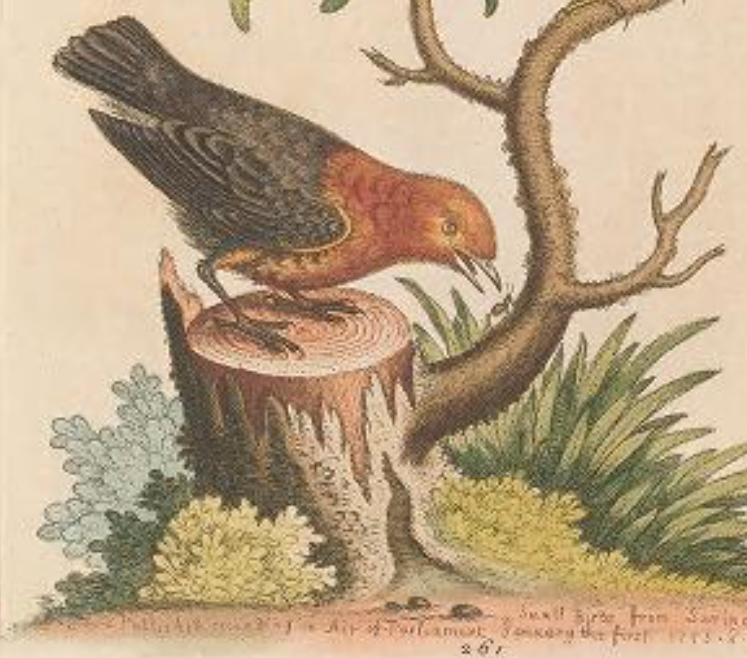
Charles Willson Peale (1741-1827) wrote, in his 37th Lecture (ca. 1799): "No. 1887. Red and Black Manakin. Length 3 ¼ Inches; Bill half an Inch long, black; the base of it surrounded with orange; head, neck, throat, and breast red; the other parts black, except the edges of the wings, which are yellow. Pipra aureola Linn. Le Manikin Rouge. Buff. pl. enl. 302. f. 2. not quite exact. Red and black Manakin. Edw. pl. 261. f. 2. is better. The upper part of the female is olive with a mere trace of red surrounding the head like a crown; the under parts of the body olive yellow; the rest as in the male. Young birds are olive colour, and the head & breast marked with red spots. This species are very common at Guiana, the most so of all of this genus." (Academy of Natural Sciences of Drexel University Archives, coll. 40)
Notes:
Peale did not specify the origin of the specimen described in his lecture, but it seems likely to be Cayenne, French Guiana, a major South American trade center in the 18th century. In 1793, Raphaelle Peale (1774-1825) travelled to Cayenne to collect specimens for Peale's Museum. However, to the editor's (MRH) knowledge, there is no detailed inventory of the specimens he brought back, and there are many examples of specimens from northern South America that were donated by other people. For more discussion about Raphaelle's travels, see Lillian B. Miller, 1993, "Father and Son: The Relationship of Charles Willson Peale and Raphaelle Peale", The American Art Journal 25: 4-161. / https://doi.org/10.2307/1594599
Specimen Type:
Dead/preserved
Current Common Name:
Crimson-hooded Manakin
Current Scientific Name
Pipridae | Pipra aureola