Object Status:
Extant
Accession Date:
By 1799
Primary Source Reference:
Charles Willson Peale, Lecture on Natural History 19. (ca. 1799). Academy of Natural Sciences of Drexel University Archives, coll. 40. / https://ansp.org/research/library/archives/0000-0099/coll0040/
Additional Source Text:
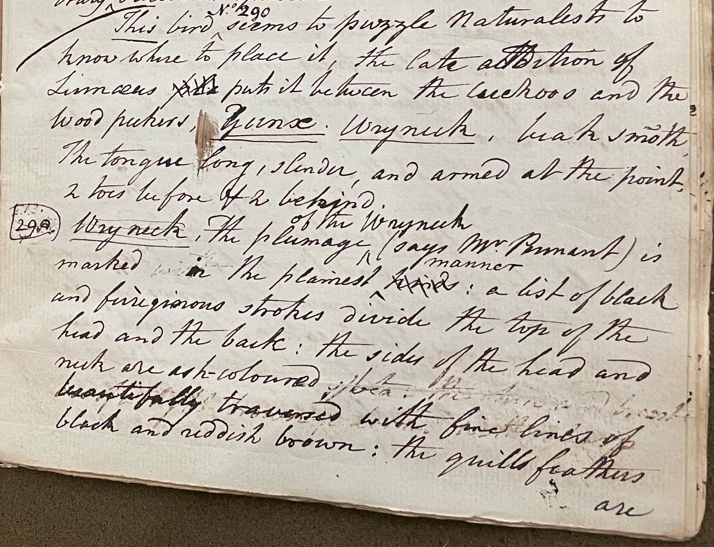
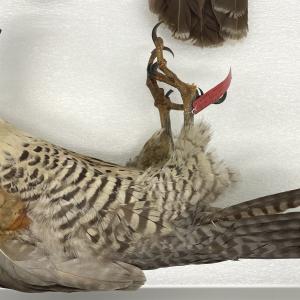
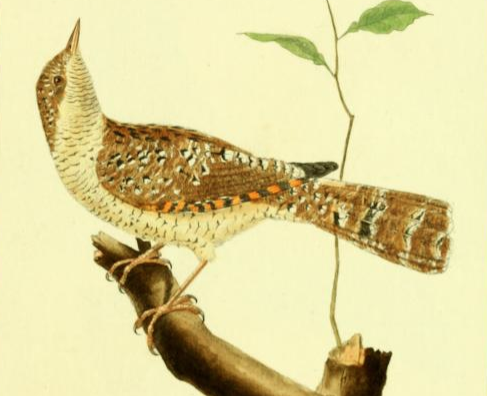
Charles Willson Peale (1741-1827) wrote, in his 19th Lecture (ca. 1799): "This bird, No. 290, seems to puzzle Naturalists to know where to place it, the late addition [sic] of Linnaeus puts it between the Cuckoos and the Woodpeckers. Yunx. Wryneck. beak smooth, the tongue long, slender, and armed at the point. 2 toes before & 2 behind. The plumage of the Wryneck (says Mr. Pennant) is marked in the plainest manner; a list of black and ferruginous strokes divide the top of the head and the back; the sides of the head and neck are ash-coloured, traversed with fine lines of black and reddish brown; the quill feathers are dusky, but each web is marked with rust-coloured spots; the chin and breast are of a light yellowish brown, adorned with sharp-pointed bars of black; the tail consists of ten feathers, broad at their ends, and weak, of a pale ash-colour, powdered with black and red, and marked with four equidistant bars of black. Yunx torquilla Linn. Le Torcol Buffon. pl. enl. 698. Lath. p. 548. 291." (Academy of Natural Sciences of Drexel University Archives, coll. 40)
Peale continued: "The female is paler in colour than the male. It builds in hollow trees, making no nest, but laying the Eggs, which are from 8 to 10, on the bare rotten wood within; these Eggs are as white as Ivory, the shell so thin that the yolk may be seen within. It is a migratory bird, and is found in Russia, Sweden, Lapland, Greece, Itally, Babylon, and Bengal. Buffon says that at the end of summer it grows very fat, when it is excellent eating; for which reason some have called it the Ortolan. Its food is chiefly ants, which the male has been observed to carry to the female whilst sitting. The young ones, while in the nest will hiss like so many snakes; insomuch that many have been prevented from plundering the old ones of their offspring, on supposition, that they were advancing their hands on the brood of a hostile reptile." (ANSP Archives, coll. 40)
Peale continued: "Buffon, speaking of these birds, says, 'it may be distinguished at first sight by a habit peculiar to itself; it twists and turns back its neck, its head reverted on its back, and its eyes half-shut, and the motion is slow, tortuous, and exactly similar to the waving wreaths of a reptile. It seems to be occassioned by a convulsion of surprise and fright; and it is also an effort which the bird makes to disengage itself when held, yet this motion is natural to it, and depends in a great measure on its structure; for the callow brood have the sae vermicular wreathing and many a timorous nest-finder has fancied them to be be young serpents. The Wryneck has also another singular habit, one which had been shut twenty four hours in a cage, turned towards a person who approached it, and, eyeing him steadily, it rose upon its spurs, stretched slowly forwards, raising the feathers on the top of its head and, spreading its tail; then it suddenly drew back, striking the bottom of the cage with its bill, and retracting its crest. It repeated this gesture, which was often observed by Schwenefeild to the number of 100 times, and as long as the spectator remained beside it. The strange attitudes and natural contortions seem anciently to have prompted superstition to adopt this bird in enchantments, and to prescribe its flesh as the most powerful incentive to love; in so much that the name Jynx denoted all sort of enchantments, violent passions, and whatever we call the charm of beauty; that blind power which irresistibly commands our affections'. We may call it the fabulous bird of the ancients, whose tales, we cannot here spare time to detail." (ANSP Archives, coll. 40)
Peale wrote, in "A Walk Through the Philad[elphi]a Museum" (1805–1806): "The next is a small difference from woodpeckers, in a genus termed Yunx [sic]. Called Wryneck, from their perpetually twisting its neck round and looking about. They agree with woodpeckers by having a tongue worm shaped and armed at the point, and feet for climbing — and they also feed on the larva of Insects and Ants — but their tail is compozed of 10 Soft feathers — whereas Woodpeckers tails are rigid & sharp pointed, very useful to them while pecking the holes in trees. Wrynecks inhabit Europe, Asia & Africa." (Historical Society of Pennsylvania, coll. 0481)
Specimen Type:
Dead/preserved
Current Common Name:
Wryneck
Current Scientific Name
Picidae | Jynx torquilla