Object Status:
Extant
Accession Date:
By 1793
Primary Source Reference:
Nicholas Collin, letter to Charles Willson Peale dated 2 June 1793; Selected Papers, 2, part 1: 49.
Additional Source Text:
In his letter, Rev. Nicholas Collin (1746-1831) informed Charles Willson Peale (1741-1827) that "Mr. Gustavus Von Carlson ... an eminent ornithologist ... has already in return [for American specimens sent by Peale], forwarded several of the most valuable Swedish Birds, such as the Urogallus major and Urogallus minor, the Lagopus, &c."
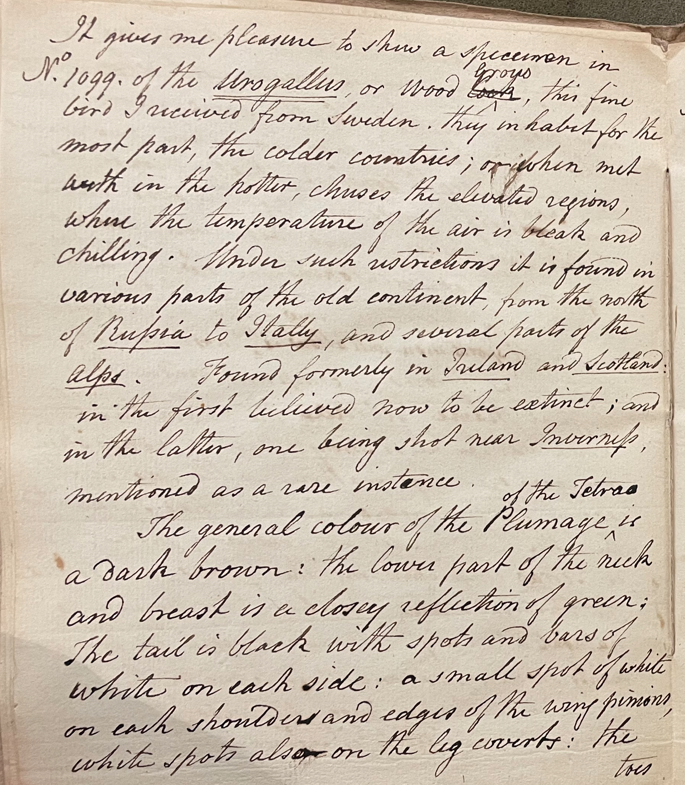
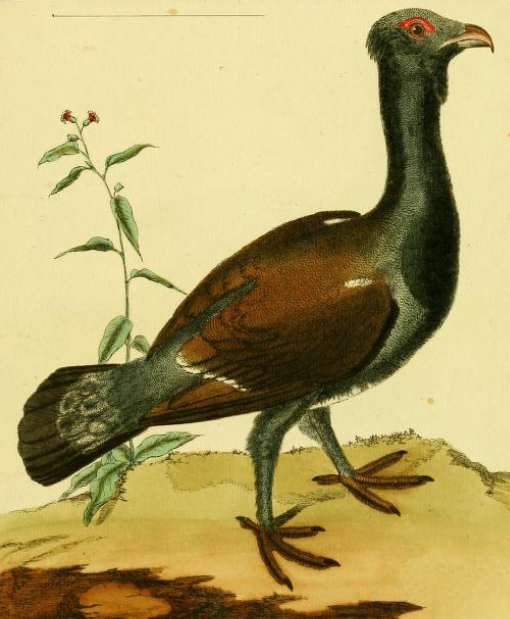
In his 29th Lecture, Peale wrote: "No. 1099. Of the Urogallus, or Wood Grous, this fine bird I received from Sweden. They inhabit for the most part, the colder countries; or when met with in the hotter, chuses the elevated regions where the temperature of the air is bleak and chilling. Under such restrictions it is found in various parts of the old continent, from the north of Russia toItally, and several parts of the Alps. Found formerly in Ireland and Scotland, in the first believed now to be extinct; and in the latter, one being shot near Inverness mentioned as a rare instance. The general colour of the plumage of the Tetrao is a dark brown; the lower part of the neck and breast is a closey [sic] reflection of green; the tail is black with spots and bars of white on each side; a small spot of white on each [of the] shoulders and edges of the wing pinions; white spots also on the leg coverts; the toes pectinated, formed like a comb." (Academy of Natural Sciences of Drexel University Archives, coll. 40)
Peale continued: "No. 1100. Female, is of a ferruginus colour, barred with black and white. The length of the Male is 2 feet 8 inches, and the weight about 14 pounds, and the female is 2 feet in length. / In the British Zoology it is called Wood Grous. It is the Tetrao urogallus of Linn. La Tetras ou le Grand Coq de Bruyere, Buff. pl. enl. 73. 74. / Their food consists of many kinds of plants, grain, the young buds of trees; and above all, the seeds of pine and fir trees, of which sometimes they are known wholly to strip one tree of its cones, while the next is untouched. It is said there is great numbers of these birds in Russia and Sibiria, where they are met with in all the woods in the northern parts, especially the pine-forests. Is common both about Moscow and St. Petersburgh, from whence they are sent as presents to London, their flesh being much esteemed." (ANSP Archives, coll. 40)
On 30 August 1802, in a letter to his son Rubens concerning specimens that were "totally destroyed by dermest[id] beetles", or were in otherwise poor condition, Peale wrote: "all my Birds from Sweden are miserable—Particularly the Grouse, viz—Tetrae [sic] Urogalus. Linn. Grand Coq de bruyere ou Tetras Buff. Pl. enl.73.74" (Miller 1988: 451).
An undated list of 21 bird specimens in Charles Willson Peale's (1741-1827) handwriting includes an unidentified "Grouse" (American Philosophical Society Library, Mss.B.P31).
Notes:
A letter from Rev. Nicholas Collin (1746-1831) to Charles W. Peale, dated 2 June 1793, confirms that “Mr. Gustavus Von Carlson (President of one of the supreme courts of Justice) has charged himself with the exchange of Birds. This eminent ornithologist owns a precious Cabinet of Birds, containing more than 800 species; & has by testamentary disposition generously bequeathed the whole to the said [Swedish] Academy of Sciences. You will therefore be pleased to send in future the birds directly to him. He has already in return, forwarded several of the most valuable Swedish Birds…” (Miller 1988: 49, Selected Papers, Vol. 2, part 1, Yale University Press).
Specimen Type:
Dead/preserved
Current Common Name:
Western Capercaillie
Current Scientific Name
Phasianidae | Tetrao urogallus
Category:
Collection: