Object Status:
Extant
Accession Date:
By 1793
Primary Source Reference:
Charles Willson Peale, letter to Thomas Hall of Moorfields, London, dated 1793; Selected Papers, 2, part 1: 46.
Additional Source Text:
Charles Willson Peale (1741-1827) sent "Sprigg Tail Drakes" to Thomas Hall in London, in early 1793, in exchange for European specimens (Miller 1988: 46, Selected Papers, Vol. 2, part 1, Yale University Press).
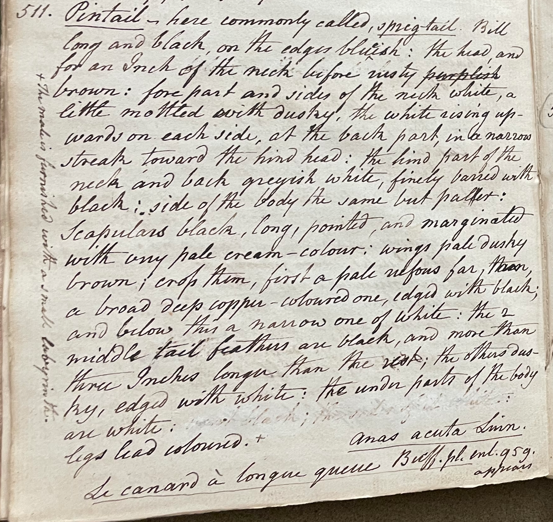
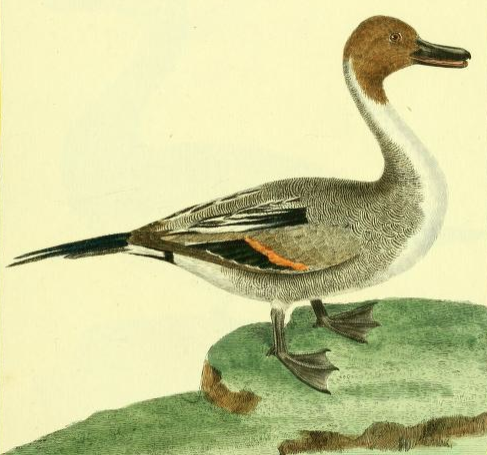
In his 22nd Lecture, Peale wrote: "511. Pintail. here commonly called, sprig-tail. Bill long and black, on the edges bluish; the head, and for an Inch of the neck before rusty purplish brown; forepart and sides of the neck white, a little mottled with dusky, the white rising upwards on each side, at the back part, in a narrow streak toward the hind heard; the hind part of the neck and back greyish white, finely barred with black; side of the body the same but paler; scapulars black, long, pointed, and marginated with very pale cream-colour; wings pale dusky brown; cross them, first a pale rufous bar, then, a broad deep copper-coloured one, edged with black; and below this a narrow one of white; the 2 middle tail feathers are black, and more than three Inches longer than the rest, the others dusky, edged with white; the under parts of the body are white; legs lead coloured. This male is furnished with a small labyrinth. Anas acuta Linn. Le Canard à longue queue Buff. pl. enl. 959." (Academy of Natural Sciences of Drexel University Archives, coll. 40)
Peale continued: "[It] appears on our waters with the other wild fowl and stays with us all the winter. They go with them in the summer to breed, in the more northern climates. Pennant says, they are seen in Sweden about 14 days in the spring, on its passage northward; and in autom repasses the same way to the south. Visit the Orknies in great flocks in the winter. In the Russian empire, extends to Kamtschatka. They are well tasted & tender. 512. Female." An undated scrap of paper tucked into Peale's 21st lecture manuscript contains a scribbled list of duck specimens, including: "Pintail D (acuta)" (ANSP Archives, coll. 40)
Peale wrote, in "A Walk Through the Philad[elphi]a Museum" (1805–1806): "The Pin-tail (a. Acuta) is called with us the Sprig-tail." (Historical Society of Pennsylvania, coll. 0481)
Alexander Wilson (1766-1813) described this species under the name "Pintail Duck / Anas acuta" in American Ornithology vol. 8, published posthumously (Pl. 68), where "Peale's Museum, No. 2806" was listed among the synonyms (Wilson 1814: 72). / https://www.biodiversitylibrary.org/item/175758#page/88/mode/1up (text) / https://www.biodiversitylibrary.org/item/175758#page/83/mode/1up (plate)
Specimen Type:
Dead/preserved
Current Common Name:
Northern Pintail
Current Scientific Name
Anatidae | Anas acuta