Object Status:
Extant
Accession Date:
January 9, 1822
Primary Source Reference:
Poulson's American Daily Advertiser (Philadelphia), 9 Jan 1822
Additional Source Text:
On a list of specimens "mostly obtained from high up the Missouri by Titian Peale" during the Long Expedition.
Notes:
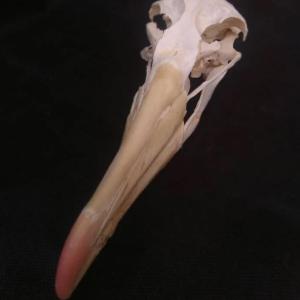
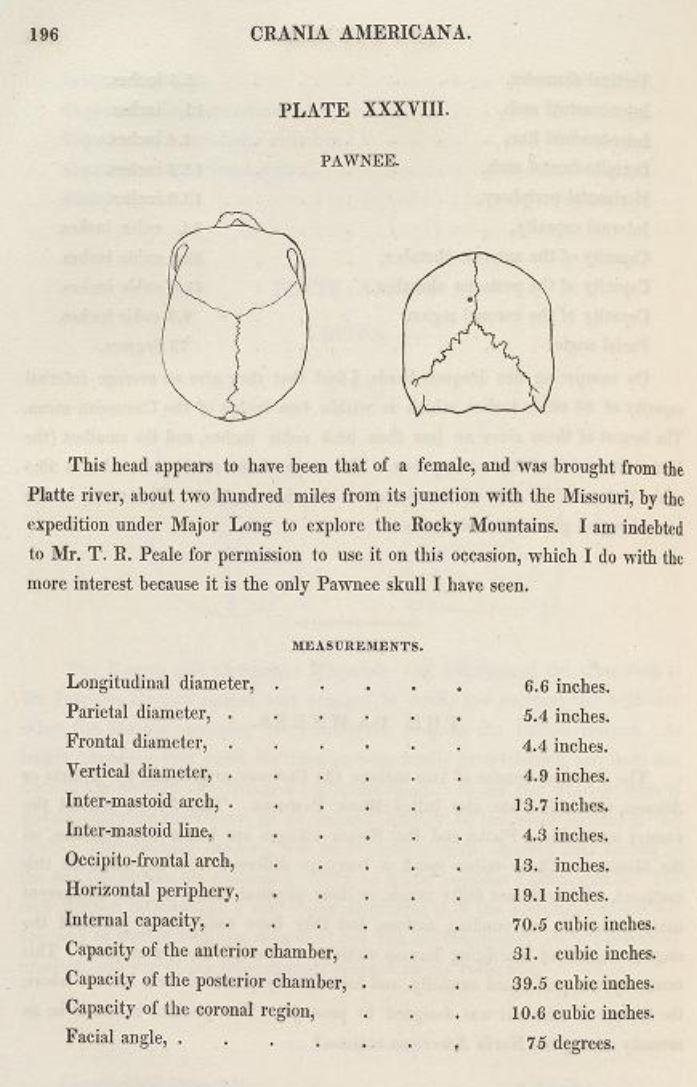
After being displayed in the Peale Museum, this skull was given to Samuel George Morton (1799-1851), the American physician, natural scientist, and writer who from the 1830s through the 1840s collected human crania and is considered to be one of the progenitors of scientific racism.
T. R. Peale reported to Samuel Morton on 14 July 1846 that "The skull of the Pawnee to which you allude was not the property of the late Philadelphia Museum Comp[an]y; it was collected with other matters by the expedition to the Rocky Mts. and deposited by Major Long with the other collections of that expedition in the Museum, and properly belongs to the government of the United States. It cannot be in better hands than yours, until called for." Library Company of Philadelphia, Morton Papers, 7389 F22, Box 2, folder 39
The skull is presumed to be in the Morton Cranial Collection now at the Penn Museum and the subject of current discussions about repatriation and burial. See https://www.penn.museum/sites/expedition/the-samuel-george-morton-crani… and https://www.penn.museum/sites/morton
Titian Ramsay Peale (1799-1885) was engaged as assistant naturalist on the Long Expedition (May 1819-Nov 1820). His services were "required in collecting specimens suitable to be preserved, in drafting and delineating them, in preserving the skins, &c. of animals, and in sketching the statifications of rocks, earths &c. as presented on the declivities of precipices." (Edwin James, Account of an Expedition from Pittsburgh to the Rocky Mountains, Performed in the Years 1819 and '20: By Order of the Hon. J.C. Calhoun, Sec'y of War: Under the Command of Major Stephen H. Long, vol. 1 [Philadelphia, 1823], p. 3)