Object Status:
Unlocated
Accession Date:
By March 1825
Primary Source Reference:
Thomas Say, "On Two Genera and Several Species of Crinoidea," Journal of the Academy of Natural Sciences of Philadelphia, vol. 4, part 2 (1825): 289-296 (described on pp. 293-294) / https://www.biodiversitylibrary.org/page/24655407
Additional Source Text:
"Read March 1, 1825"
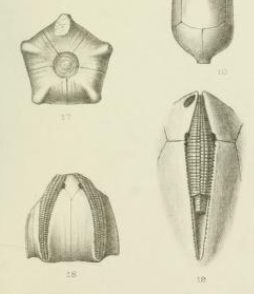
"This large and fine species belongs to the Philadelphia Museum. It was brought from England by Mr. Reubens Peale, who understood that it was found in the vicinity of Bath. None of this species, I believe, has yet been found in America."
Notes:
Say's specimen is "not improbably" Acentrotremites ellipticus (Cumberland). Robert Etheridge, P. Herbert Carpenter, Catalogue of the Blastoidea in the Geological Department of the British Museum (Natural History). Department of Geology (London, 1886), pp. 158, 235-237
Thomas Say (1787-1834) was an American naturalist. His definitive studies of insects and shells, numerous contributions to scientific journals, and scientific expeditions to Florida, Georgia, the Rocky Mountains, Mexico, and elsewhere made him internationally known. Say has been called the father of American descriptive entomology and American conchology. He served as librarian for the Academy of Natural Sciences of Philadelphia, curator at the American Philosophical Society, and professor of natural history at the University of Pennsylvania. In 1821 he was appointed Professor of Zoology at the Peale Museum, but he evidently did not give the planned lectures.