Object Status:
Unlocated
Accession Date:
By September 13, 1826
Primary Source Reference:
Peale Museum Accessions Book, Historical Society of Pennsylvania, p. 127
Additional Source Text:
"Was purchased by C. W. Peale for the Museum from a Trader who had procured them for the purpose of exhibition here and in Europe -- Cost $200."
Peale's notice in Poulson's American Daily Advertiser (Philadelphia), 13 Sep 1826 reports "that an extensive and very complete collection of the Dresses, Arms, Implements, Pipes, and Instruments of Music, &c. of the Sioux, Shienne, Aricaree, Mandan, and Osage Nations of Indians, are now placed for a short time in the Philadelphia Museum. The collections consists of the male and female Dresses of the above nations, ornamented in their peculilar manner with dyed porcupine quills, and is in some of the specimens, extremely beautiful, one of the SKIN LODGES, used by them, is placed in such a manner as to exhibit its use, and is very curious. Their arms, consisting of bows and arrows, war clubs, &c., and a buffaloe skin, upon which is painted a record of the fight of Colonel [Henry] Leavenworth, with the Aricaree [Arikara] Indians, executed by themselves, their flag, shield, etc. will give a good idea of their manner of warfare. In short, this collection contains all their Dresses of War, Ceremony and the Dance, and is the most complete that has ever been exhibited."
C. W. Peale to Rembrandt Peale, 24 Sep 1826: "I have lately purchased a vauable collection of Indian dresses &c the most complete that has ever been seen in Philada. some Indian traders had taken much pains to collect them, and they must have cost considerably more than what I gave for them -- Their plan was to go to Europe with some Indians to exhibit them, and doubtless they would have made money by such exhibition -- but the Indians got discontented, and left them here -- Their plan being thus frustrated, they offered me the collection for 200 $ and I think myself very fortunate in the purchase, as in all probability such things will not be had in a few years hence." Selected Papers, 4: 558
Notes:
Charles Coleman Sellers conjectured that the traders were from St. Louis and that their number included one David Delaunay, "a Frenchman who held the rank of major in the territorial militia." They later took another group of Native Americans to France, where they were abandoned before being rescued and returned home by Lafayette and others. Mr. Peale's Museum, pp. 252-254.
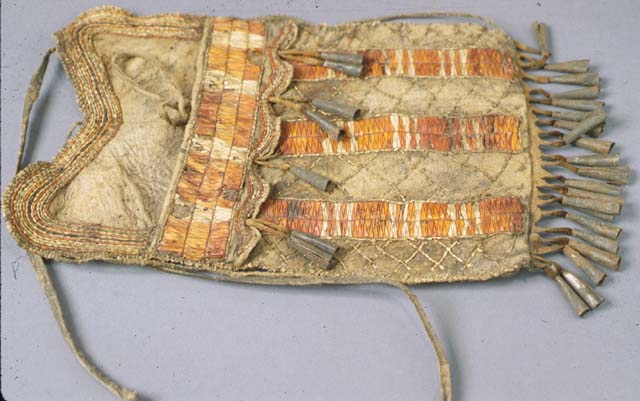
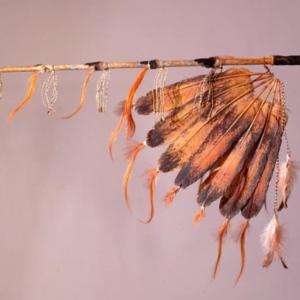
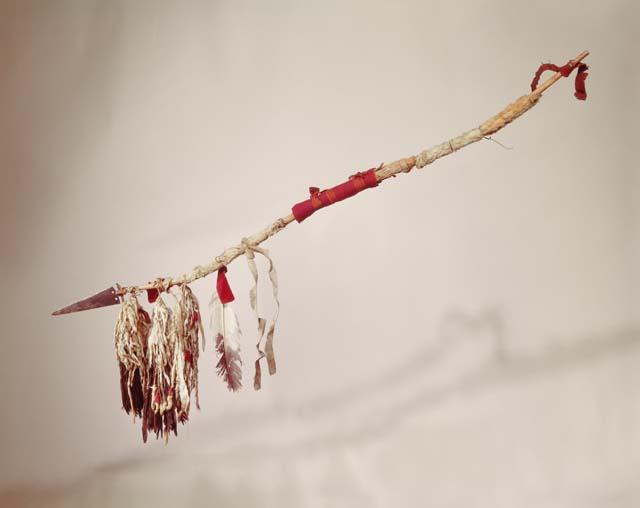
The Peabody Museum of Archaeology and Ethnography, Harvard University, acquired a number of cultural items in 1899 from Moses Kimball's Boston Museum. Kimball and P. T. Barnum jointly purchased many of the Peale collections when they were sold about 1849. This donation cannot be positively identified with particular extant artifacts, but one of the acquired objects used for ceremony may have been the medicine bow at the Peabody pictured here. Also pictured is a Sioux shot pouch from the same source that may once have been in the Peale Museum.
Some of these items may have been among the lots in the October and December 1869 sales of "Peale's Museum Relics" owned by Montroville Wilson Dickeson (1810-1882). See Selected Papers, 4: 558-560; Sellers, Mr. Peale's Museum, pp. 252-254, 320-321.