Object Status:
Extant
Accession Date:
June 6, 1806
Primary Source Reference:
Peale Museum Accessions Book, Historical Society of Pennsylvania, p. 9-10
Additional Source Text:
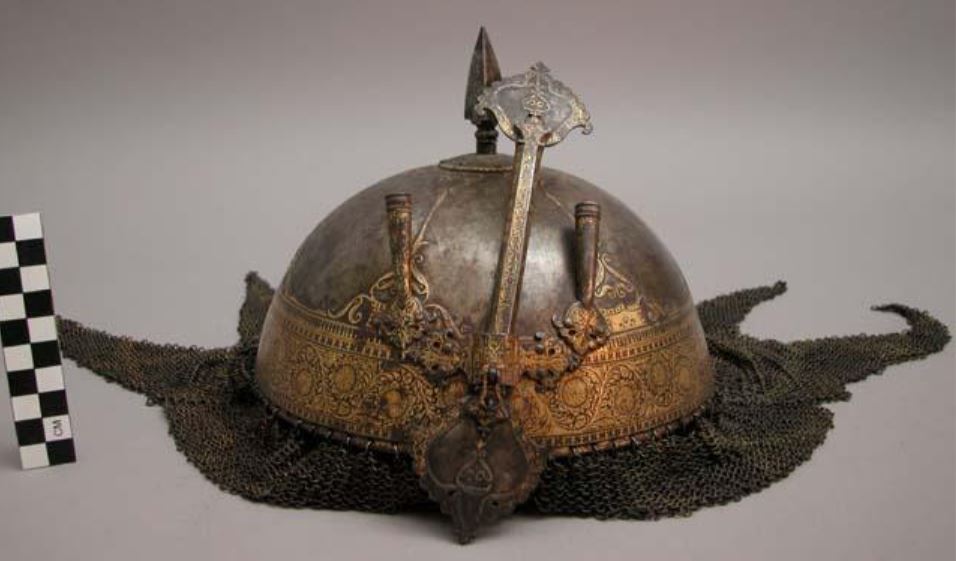
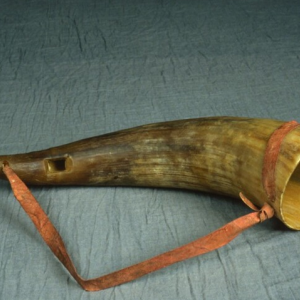
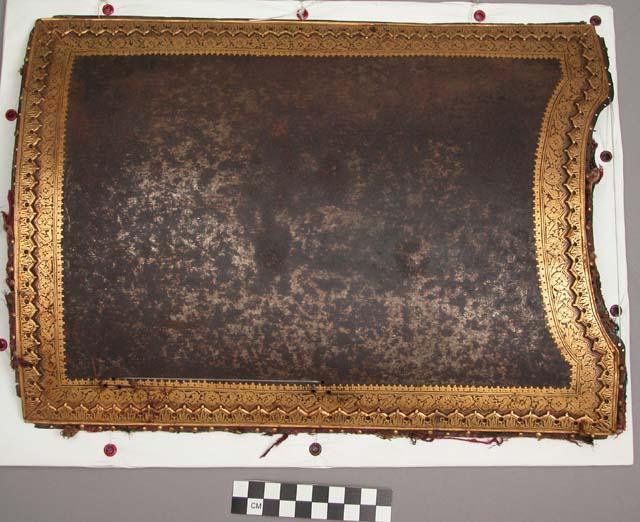
"Viz. 3 Jackets made of rings of different metals interwoven [of prodigious weight]. A Coat of Mail, composed of Crimson Velvet richly studded with Gold & finished with plates of Steel highly ornamented, on the Breast, back & sides, the whole of this quilted with Cotton, between which and the Velvet, is a curious interlining of large Fish-scales -- the Arms are enclosed from the Elbow in what may be called Boxes of embossed Steel trimmed with studded Velvet, and fastened on with Buckles. This appears to be part of the Dress of an Emperor or Commander in Chief. Two embossed Helmets with Wire Netttings, Several Elegant & curious Sabres & Daggers, Canteens made of Ivory & Buffaloes Horns. A Curious Astronomical Instrument & other Miscellaneous articles."
Notes:
United States Gazette (Philadelphia), 7 Feb 1806 records this donation and supplies the three bracketed words in the description.
Charles Willson Peale told Raphaelle Peale on 6 June 1805 that the Museum received "Three suites or coats of Mail from the East Indies, very valuable which I had long been promised." Selected Papers, 2, part 2: 844
The Peabody Museum of Archaeology and Ethnography, Harvard University, acquired many cultural items in 1899 from Moses Kimball's Boston Museum. Kimball and P. T. Barnum jointly purchased many of the Peale collections when they were sold about 1849. This donation cannot be positively identified with a particular extant group of artifacts, but they may have resembled the fish-scale armor, canteens, and helmet at the Peabody pictured here.
George Harrison (1762-1845) was a business associate of Robert Morris. Selected Papers, 1: 546n
Category:
Geographic Origin:
Donor:
Collection: