Object Status:
Unlocated
Accession Date:
October 1, 1807
Primary Source Reference:
Peale Museum Accessions Book, Historical Society of Pennsylvania, p. 25
Additional Source Text:
"Valued at 10 guineas. Received by the Ship Ocean from Mr. Latham in London."
Notes:
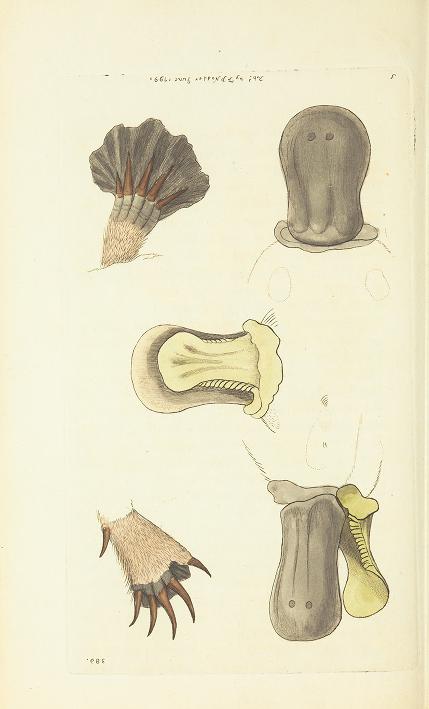
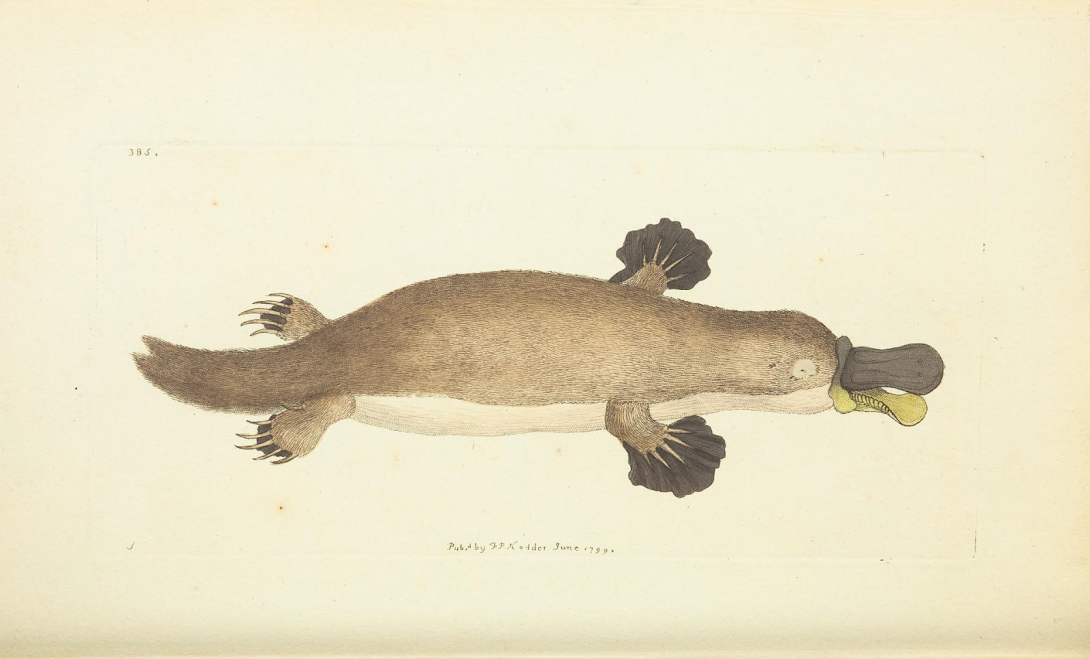
The platypus (Ornithorhynchus anatinus), sometimes referred to as the duck-billed platypus, is a semiaquatic egg-laying mammal endemic to eastern Australia, including Tasmania. It is the sole living representative or monotypic taxon of its family and genus. It was first described and illustrated by George Shaw in his The Naturalist's Miscellany, or Coloured Figures of Natural Objects, vol. 10 (London, 1799), plate 365 (pictured here). Poulson's American Daily Advertiser of 27 Oct 1807 carried the text from Shaw's book preceded by this statement: "The Platypus, which is now in the Museum in this city, is 23-1/2 inches long, and is a more perfect specimen than the one from which Mr. Shaw took the following description."
Poulson's American Daily Advertiser (Philadelphia), 8 Jan 1808 adds that the platypus "seems to be a connecting link between the Duck and the Otter. Very few of these animals have been carried to Europe -- this is the only one in America." That description is indeed accurate, as the platypus lays eggs like a duck and has feet like an otter's. It had only been discovered about ten years before the Peale Museum's acquisition.
Specimen Type:
Dead/preserved
Peale's Common Name:
Duck-bill Platypus
Peale's Scientific Name:
Platypus anatinus
Current Common Name:
Platypus
Current Scientific Name
Ornithorhynchus anatinus