Object Status:
Unlocated
Accession Date:
By 1799
Primary Source Reference:
Charles Willson Peale, Lecture on Natural History 30. (ca. 1799). Academy of Natural Sciences of Drexel University Archives, coll. 40. / https://ansp.org/research/library/archives/0000-0099/coll0040/
Additional Source Text:
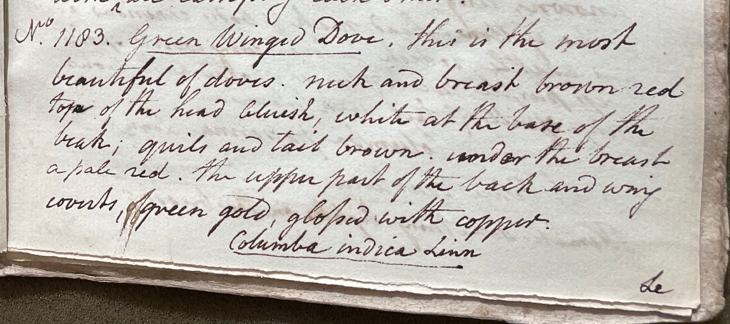
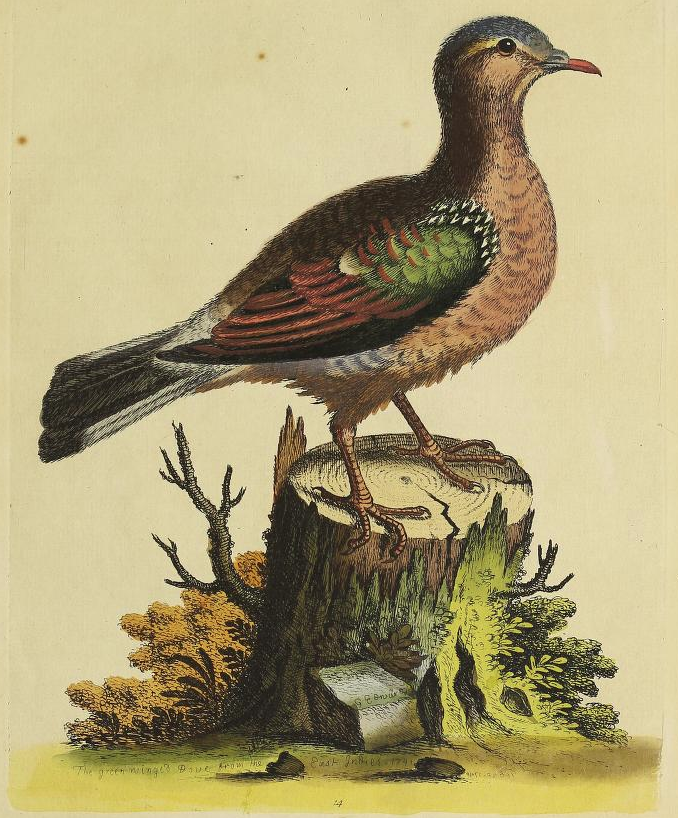
Charles Willson Peale (1741-1827) wrote, in his 30th Lecture (ca. 1799): "No. 1183. Green winged Dove. This is the most beautiful of doves; neck and breast brown red; top of the head blueish; white at the base of the beak; quils and tail brown; under the breast a pale red; the upper part of the back and wing coverts of green gold, glossed with copper. Columba indica Linn. Le Pigeon ramier d'amboine Brisson i. p. 284. No. 29. Green winged Dove. Edwards pl. 14. Inhabits Amboina [i.e., Ambon island], in the East Indies." (Academy of Natural Sciences of Drexel University Archives, coll. 40)
Peale wrote, in "A Walk Through the Philad[elphi]a Museum" (1805–1806): "The most beautiful of Doves is the Green Winged Dove (C. Indica) it Inhabits Amboina in the East Indies." (Historical Society of Pennsylvania, coll. 0481)
Specimen Type:
Dead/preserved
Peale's Common Name:
Green winged Dove
Peale's Scientific Name:
Columba indica
Current Common Name:
Common Emerald Dove
Current Scientific Name
Columbidae | Chalcophaps indica