Object Status:
Extant
Accession Date:
23 March 1821
Primary Source Reference:
Peale Museum Accessions Book, 23 March 1821. Historical Society of Pennsylvania, coll. 0481.
Additional Source Text:
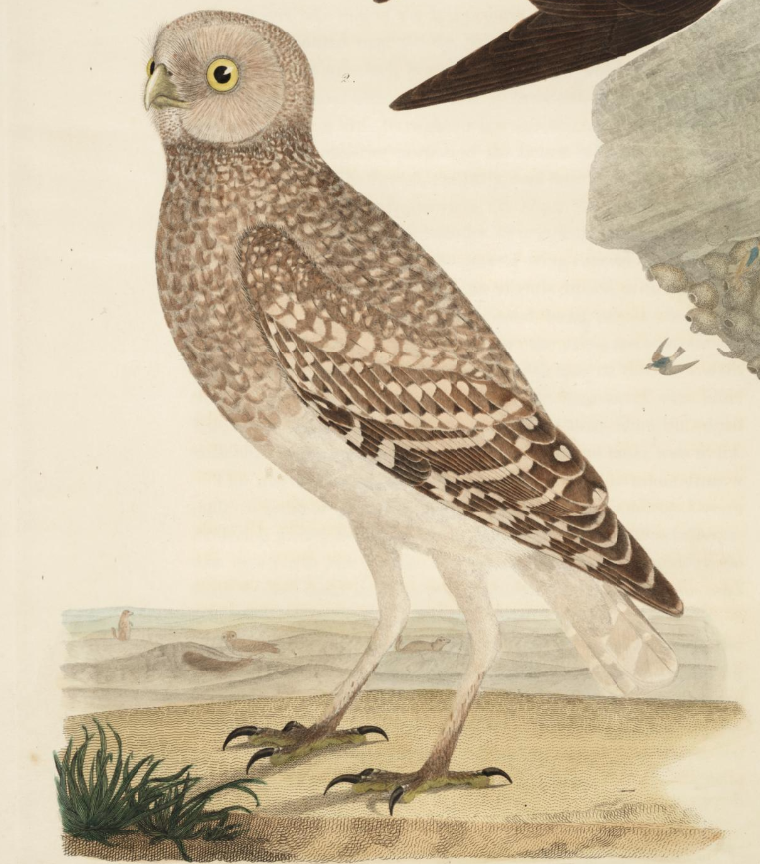
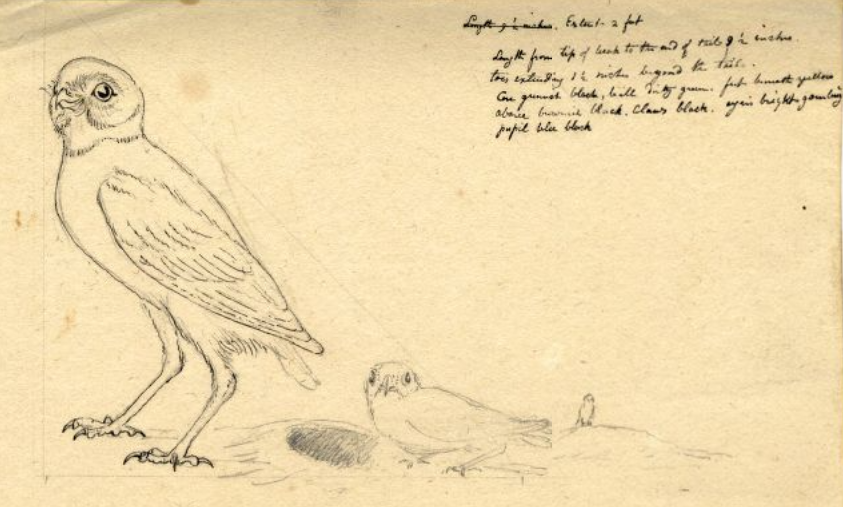
Titian Ramsay Peale (1799-1885) deposited specimens of "2 [Species] of Owls" and "1 [drawing of] Owl" on 23 March 1821, after returning from the Long Expedition, which evidently included several specimens of this species (Accessions Book, Historical Society of Pennsylvania, coll. 0481). Titian's inked drawing (shown here), executed in the field, is dated 7 August 1820 (APS Library Mss.B.P.31.15d).
Thomas Say (1787-1834) told the story of Titian collecting the first specimen of the species in Edwin James, 1823, Account of an Expedition from Pittsburgh to the Rocky Mountains..., vol. 2, p. 97 (Philadelphia): "In passing through a village of prairie dogs, of which we saw great numbers, Mr. Peale killed a burrowing owl. The bird, though killed instantly, had fallen into one of the marmot's burrows, but had luckily lodged within the reach of the arm. On opening it, the intestines were found filled with the fragments of grasshoppers' wings, and the hard parts of other insects. We have never been able from examination to discover any evidence, that these owls prey upon the marmots, whose villages they infest." / https://www.biodiversitylibrary.org/item/124315#page/109/mode/1up
Charles Lucien Bonaparte (1803–1857) described this species under the name "Burrowing Owl / Strix cunicularia" in his continuation of American Ornithology vol. 1 (1825, Pl. 7). Bonaparte (1825: 68) cited "Philadelphia Museum, No. 472" and wrote: "The individual we have described is a male, and no difference is observable in several other specimens; the female differs in nothing expect that of her eyes are of a pale yellow color." Bonaparte's (1825) plate was based on Titian's drawing, which was engraved by Alexander Lawson (ca. 1772-1846) / https://search.library.wisc.edu/digital/AFKPEJIASN54OC8L/pages/A6KPB7XA… text) / https://search.library.wisc.edu/digital/AFKPEJIASN54OC8L/pages/AYSNZUTU… (plate)
Notes:
Bonaparte (1825: 68, American Ornithology), who cited “Peale’s Museum, No. 472," incorrectly attributed the discovery to Thomas Say (1787-1834): “The votaries of natural science must always feel indebted to the learned and indefatigable Say, for the rich collection of facts he has made whenever opportunities have been presented, but more especially in the instance of this very singular bird, whose places of resort, in this country, are too far distant to allow many the pleasure of examining for themselves." Titian Peale's drawing bears an inscription with the following original data: "Length 9 1/2 inches. Extent - 2 feet / Length from tip of beak to the end of tail 9 1/2 inches. Toes extending 1 1/2 inches beyond the tail. Cere greenish black, bill dirty green. Feet beneath yellow, above brownish black. Claws black. Eyeris [sic] bright [...] pupil blue black" (APS Library Mss.B.P.31.15d). Here, for simplicity, we state that Titian R. Peale (1799-1885) deposited the Long Expedition specimens at Peale's Museum. However, it should be noted that the specimens did not belong to Titian, and were not his to give away. Officially, they were the property of the United States government, and as such were formally deposited by Major Stephen Harriman Long (1784-1864), who led the government-sponsored expedition. The Peale Museum Accessions Book, pp. 112-113 (Historical Society of Pennsylvania, coll. 0481) contains an "Invoice of Zoological Specimens and Drawings prepared by Titian Peale, Assistant Naturalist for the Exploring Expedition, and deposited in the Philadelphia Museum by Majr. S. H. Long, Maj. U.S. Engr. pursuant to instructions of the Secretary of War." At the conclusion of the invoice, "Rubens Peale [1784-1865], manager" signed the following statement: "Received, Philadelphia Museum, March 23d. 1821. of Majr. S. H. Long, the several articles, specified in the above Invoice, as a deposit for safe keeping, preservation and Exhibition; and I hereby promise, as agent for the Institution to hold the said articles subject to the orders of the War Department, thru the said Maj. Long." (HSP, coll. 0481)
Specimen Type:
Dead/preserved
Current Common Name:
Burrowing Owl
Current Scientific Name
Strigidae | Athene cunicularia