Object Status:
Extant
Accession Date:
By 1799
Primary Source Reference:
Charles Willson Peale, Lecture on Natural History 28. (ca. 1799). Academy of Natural Sciences of Drexel University Archives, coll. 40. / https://ansp.org/research/library/archives/0000-0099/coll0040/
Additional Source Text:
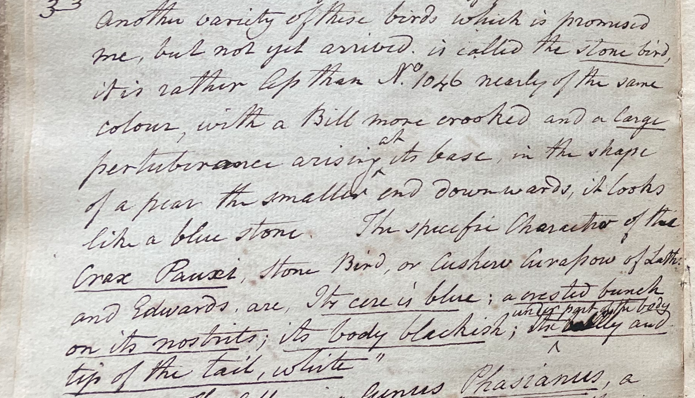
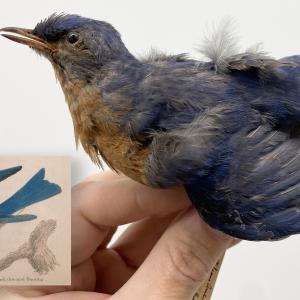
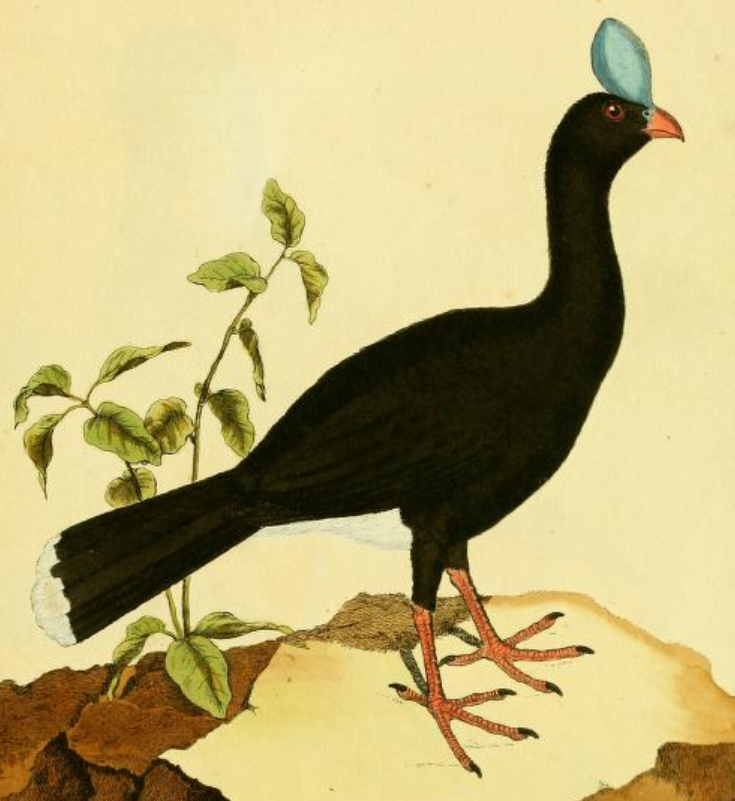
Charles Willson Peale (1741-1827) wrote, in his 28th Lecture (ca. 1799): "Another variety of these birds which is promised me, but not yet arrived, is called the Stone bird; it is rather less than No. 1046 [=Black Curassow, Crax alector], nearly of the same colour, with a Bill more crooked and a large pertuberance arising at its base, in the shape of a pear, the smaller end downwards; it looks like a blue stone. The specific character of the Crax pauxi, Stone bird, or Cushew Curassow of Latham and Edwards, are: Its cere is blue; a crested bunch on its nostrils; its blody blackish; under part of the body and tip of the tail, white." (Academy of Natural Sciences of Drexel University Archives, coll. 40)
Peale mentioned, in "A Walk Through the Philad[elphi]a Museum" (1805–1806), after a lengthy discussion about the Black Curassow: "we dont know whether this [species] is the same in Egg like shape of the Cashew bird (C. Pauxi) which is so large & blue to give it the name of Stone-bird (only the head of this is here at present)." (Historical Society of Pennsylvania, coll. 0481)
Specimen Type:
Dead/preserved
Current Common Name:
Helmeted Curassow
Current Scientific Name
Cracidae | Pauxi pauxi